


Global Travel Chaos: Hundreds of Thousands Stranded as Middle East Airspace Shuts Down
Global Travel Chaos: Hundreds of Thousands Stranded as Middle East Airspace Shuts Down
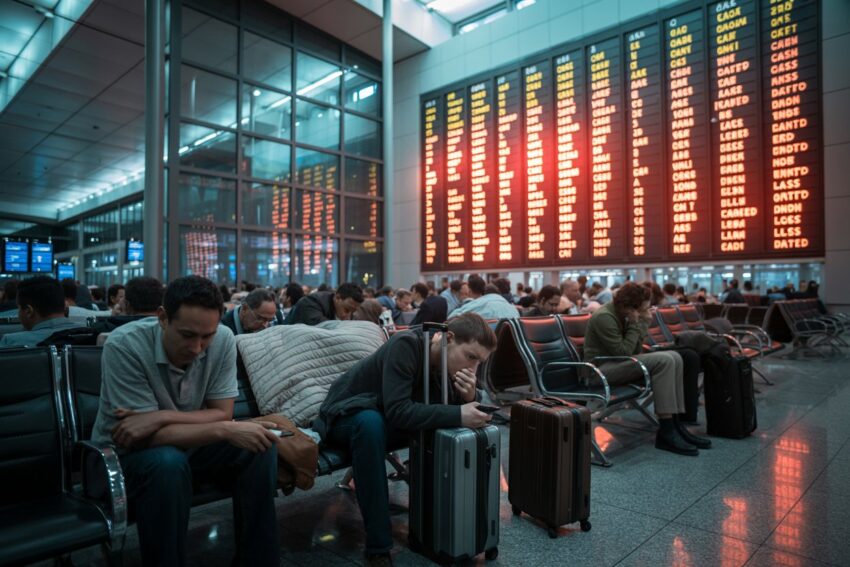
On March 1, 2026, the world woke up to a transformed aviation map. What was once a bustling corridor connecting East and West has become a “no-go zone.” Following a dramatic escalation in regional conflict—marked by joint US-Israeli strikes on Iran and subsequent retaliatory barrages—at least eight nations have shuttered their airspace, leaving hundreds of thousands of travelers stranded in a logistical nightmare of historic proportions.
From the high-tech terminals of Dubai to the crowded gates of New Delhi and London, the human cost of geopolitics is being measured in missed connections, canceled holidays, and the anxiety of those trapped far from home.
The Great Redirection: A Region Goes Dark
The disruption began in the early hours of February 28, 2026, as military operations codenamed “Operation Epic Fury” (US) and “Operation Roaring Lion” (Israel) commenced. Within hours, a domino effect of airspace closures swept across the region. Iran, Israel, Iraq, Jordan, and Lebanon were the first to lock down their skies. They were quickly followed by the UAE, Qatar, Kuwait, and Bahrain as retaliatory missiles and drones crossed the Persian Gulf.
For pilots, the suddenness was jarring. Flight-tracking maps, which usually show a dense “river” of aircraft flowing over the Gulf, showed an eerie, empty void.
Stranded in the Hubs: The View from the Ground
The impact has been most severe at the world’s “super-hubs.” Dubai International (DXB), the busiest airport for international travel, briefly suspended all operations. For the 90,000 transiting passengers who pass through the region daily, the experience has been one of pure exhaustion.
Dubai & Abu Dhabi: Travelers reported sleeping on terminal floors as hotels reached 100% capacity. In a terrifying turn, debris from intercepted drones reportedly caused minor damage to the facade of the iconic Burj Al Arab and led to a casualty at Zayed International Airport.
Doha: Qatar Airways was forced to turn back dozens of flights mid-air, with aircraft circling over Saudi Arabia before being cleared to land back at their origin.
India: The “bridge” to the West has been cut. Air India, IndiGo, and SpiceJet have suspended all Middle East operations until at least midnight on March 1. Over 100 flights to the Gulf were canceled in a single day, affecting thousands of Indian workers and their families.
The “Long Way Around”: The Cost of Diversions
For flights that haven’t been canceled, the journey has become grueling. To avoid the conflict zone, carriers are rerouting over Central Asia or deep into African airspace.
Extra Fuel & Time: A standard flight from London to Singapore now takes up to three hours longer as planes “skirt” around the edge of the closed zones.
Technical Stops: Some ultra-long-haul flights to North America are now forced to make unscheduled refueling stops in cities like Vienna or Rome because the longer routes exceed the aircraft’s fuel range.
Safety First: The Regulator’s Mandate
The European Union Aviation Safety Agency (EASA) and India’s DGCA have issued urgent bulletins warning of a “high risk” to civil aviation. The primary fear is not just intentional targeting, but the risk of “misidentification”—a tragic echo of past conflicts where civilian airliners were mistaken for military threats in high-tension environments.
“We are not taking any chances,” a representative from Air India stated after their Delhi-Tel Aviv flight was ordered to “air-return” to Mumbai while already over Saudi Arabia. “The safety of our crew and passengers is the only metric that matters right now.”
The Human Experience: A Different Kind of Marathon
Behind the data are individual stories of resilience. In Qatar, Doug Kelley, a co-founder of the famous Spokane Bloomsday run, found himself sheltering in a hotel as “booms” rattled his windows. In Dubai, families traveling for spring breaks are now navigating a maze of rebooking apps that are crashing under the weight of millions of simultaneous users.
Airlines are struggling to cope. Support centers have seen a 240% spike in calls, and while many carriers are offering full refunds and “waiver” periods until March 7, the sheer volume of displaced people makes immediate solutions nearly impossible.
What Travelers Should Do Now
If you have travel plans involving the Middle East or long-haul routes between Europe and Asia, the following steps are critical:
Check Status Constantly: Don’t just check the day of; schedules are changing hour-by-hour as airspace “windows” open and close.
eRegister: For Singaporean and Indian citizens, registering with your respective Ministry of Foreign Affairs is vital for receiving emergency evacuation updates.
Stockpile Digital Resources: Ensure you have your airline’s app downloaded and your travel insurance documents accessible offline.
Looking Toward the Horizon
As of March 1, the situation remains “perilous,” according to EU officials. While some limited operations may resume by March 2, aviation analysts suggest that the “war-risk surcharges” and operational inefficiencies will linger for weeks, potentially adding significant costs to international tickets.
For now, the global aviation industry is in a defensive crouch. The world is smaller than it was yesterday, and for the hundreds of thousands currently waiting in airport lounges, the only thing moving fast is the news.
The post Global Travel Chaos: Hundreds of Thousands Stranded as Middle East Airspace Shuts Down appeared first on Travel And Tour World.
Source: travelandtourworld.com



Sorry, the comment form is closed at this time.