



Travel Expert Simon Calder Predicts “Window of Escape” for 10 Million Stranded Passengers Amid Middle East Crisis
Travel Expert Simon Calder Predicts “Window of Escape” for 10 Million Stranded Passengers Amid Middle East Crisis
As the sun rose on March 2, 2026, the global aviation map looked like a jigsaw puzzle with the center pieces missing. The escalating conflict between the U.S., Israel, and Iran has triggered what travel expert Simon Calder describes as one of the most significant disruptions in aviation history. With approximately 10 million travelers affected globally and over 3,400 flights cancelled in just 48 hours, the question on everyone’s lips is simple: When can we go home?
Speaking from Istanbul—a city that has itself become a temporary sanctuary for diverted passengers—Calder provided a much-needed voice of reason and a cautious “window of hope” for those currently sheltering in place.
A Scale of Disruption “Heading Toward 10 Million”
The numbers are staggering. Over the course of a single week, roughly 20 countries have closed or restricted their airspace. Major international hubs—Dubai, Abu Dhabi, Doha, and Manama—have flickered between “indefinitely closed” and “tentative reopening.”
“We are seeing extraordinary times,” Calder noted in a recent update. “The sheer size of the airports involved means that even when the ‘all clear’ is given, it won’t be a flick of a switch. We have planes, pilots, cabin crew, and passengers all completely out of position. It is a logistical Rubik’s cube.”
The “Escape” Timeline: When Will the Engines Start?
Despite the grim headlines, Calder believes that the infrastructure for a recovery is already being laid. Here is the breakdown of his current predictions for the major Middle Eastern carriers:
Emirates & Dubai: While the airport has faced indefinite closures due to security threats, Calder points to a potential restart on Monday afternoon. Emirates has signaled that they are monitoring a 3:00 PM local time window for a phased resumption of services.
Etihad & Abu Dhabi: In a surprising twist of optimism, Etihad has suggested they might be the first to “break the seal,” with potential openings as early as 10:00 AM GMT on Monday.
Qatar Airways & Doha: The situation in Doha remains the most fluid. Authorities are expected to provide a comprehensive update by 6:00 PM British time on Monday.
However, Calder warns that “opening” an airport is not the same as “clearing the backlog.” His advice for those stuck in Doha or Dubai? “March 5 is not a bad day to have planned your escape.” He suggests that it will take at least three to four days of clear skies for airlines to move the hundreds of thousands of passengers currently occupying every available hotel room in the Gulf.
“My Absolute Sympathy”: The Human Cost
What sets Simon Calder apart is his ability to look past the spreadsheets and see the people. “My goodness me, my absolute sympathy with anybody who is stuck in a war zone with missiles coming in,” he said. “It is unbelievable and I am so, so sorry it is happening.”
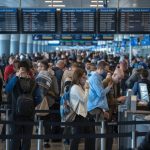
For the average traveler, the “war zone” isn’t a battlefield; it’s a crowded terminal where the vouchers have run out, the Wi-Fi is failing, and the uncertainty is mounting. Calder’s advice focuses on three pillars of survival:
Don’t Twist the Airline’s Arm: Safety is the only metric that matters right now. Airlines will not fly until they are 100% confident that the “missile-filled” airspace is secure.
Monitor the Foreign Office: The lifting of the “Do Not Travel” advice is the first domino that needs to fall before insurance companies and airlines resume normal operations.
The “Istanbul Pivot”: For those trying to get back to the UK or Europe, Calder suggests looking at hubs like Istanbul or even Cairo as potential “stepping stones” once regional short-haul flights resume, rather than waiting for a direct long-haul “rescue” flight that may be days away.
The Recovery: A “Small Way” Forward
Calder predicts that when flights do resume in the next 48 to 72 hours, they will start in a “small way.” Priority will likely be given to those who have been stranded the longest and those with urgent medical or humanitarian needs.
“I simply hope that it is done with the maximum energy and indeed money,” Calder urged, calling on the travel industry to prioritize passenger welfare over the bottom line during the repatriation phase.
Conclusion: The Long Way Home
The Middle East travel crisis of 2026 will be remembered as the moment the world’s most vital transit corridor went dark. But as Simon Calder suggests, the darkness is beginning to lift. While the “escape” won’t be immediate, the next 48 hours are critical. If you are among the millions waiting for that boarding call, the message is clear: Stay safe, stay registered with your embassy, and aim for a March 5th departure.
The road home is long, but for the first time in days, the map is starting to look a little less empty.
The post Travel Expert Simon Calder Predicts “Window of Escape” for 10 Million Stranded Passengers Amid Middle East Crisis appeared first on Travel And Tour World.
Source: travelandtourworld.com


Sorry, the comment form is closed at this time.