


Australia–New Zealand Route Dispute Resolved as Qantas Airways Issues Full Refund After Melbourne–Auckland Cabin Biohazard Incident
Australia–New Zealand Route Dispute Resolved as Qantas Airways Issues Full Refund After Melbourne–Auckland Cabin Biohazard Incident
A routine trans-Tasman journey between Australia and New Zealand was unexpectedly transformed into a widely discussed aviation incident after a passenger onboard a Qantas Airways (QF) flight was struck by projectile vomit while the aircraft was taxiing for departure. The service, operating from Melbourne Airport (MEL) to Auckland Airport (AKL) on January 28, became the center of public scrutiny when the affected traveler’s request for reimbursement was initially denied. What followed was a debate over airline accountability, hygiene standards, and customer care during inflight biohazard events.
The situation drew significant attention after the passenger’s experience was shared publicly, prompting questions about compensation policies on international routes linking Australia and New Zealand. After further review, the airline reversed its earlier stance, attributing the denial to an internal referral error. A full refund was ultimately issued. The case has since highlighted how passenger compensation, biohazard incidents, and airline responsibility are increasingly viewed through the lens of transparency and evolving customer expectations within modern aviation.
Incident on the Melbourne–Auckland Service
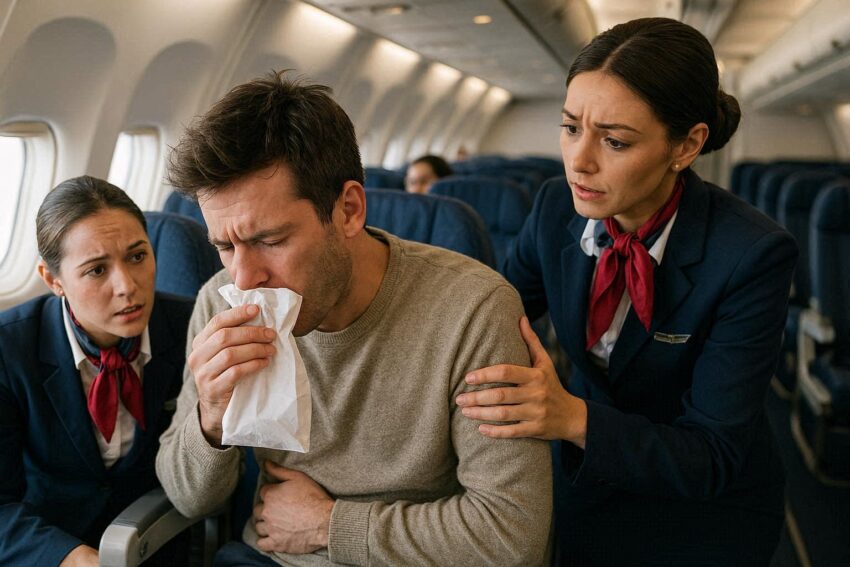
The event occurred during taxi procedures prior to takeoff from Melbourne Airport. A nearby traveler reportedly became suddenly unwell, resulting in bodily fluids being expelled across adjacent seating areas. The confined environment of the aircraft cabin amplified the impact, as surrounding passengers were directly affected.
Contamination of clothing and personal belongings was reported, creating visible discomfort and distress. In the early moments following the incident, cabin crew were said to have provided limited cleaning materials that were available onboard. However, given the severity of the situation, the aircraft was returned to the gate before departure.
Upon arrival back at the terminal, affected passengers were permitted to disembark in order to seek appropriate cleaning assistance. While immediate operational steps were taken, the aftermath of the event extended beyond the aircraft door, eventually leading to a compensation dispute that drew broader attention.
Initial Claim and Denial
Following the incident, a reimbursement request was submitted to Qantas Airways. Costs associated with professional cleaning services and related personal expenses were reportedly included in the claim. The airline initially declined compensation, stating that the illness of a fellow passenger fell outside circumstances within its direct control.
This initial refusal prompted frustration. The reasoning was interpreted by some observers as indicative of rigid policy application rather than situational flexibility. As the matter gained visibility across social media platforms and news outlets, pressure mounted for clarification.
Public interest was particularly strong given the prominence of Qantas Airways as Australia’s flag carrier and the importance of the Melbourne–Auckland corridor, one of the busiest air routes between Australia and New Zealand. The issue was no longer viewed as an isolated onboard event but as a reflection of how airlines manage unexpected hygiene-related emergencies.
Internal Review and Reversal
After further examination, it was acknowledged by Qantas that the claim had been incorrectly routed internally. The earlier denial was attributed to an internal referral error rather than a deliberate policy stance against compensation in such cases.
Once escalated to the appropriate department, the matter was reassessed. A full reimbursement was subsequently granted to the affected passenger. The airline confirmed that the reversal was the result of procedural clarification rather than a shift in official compensation policy.
By addressing the error and issuing payment, Qantas sought to reinforce its commitment to customer care on international services connecting Australia and New Zealand. The episode illustrated how administrative processes within large carriers can significantly influence customer outcomes.
Biohazard Events in Commercial Aviation
Incidents involving bodily fluids present unique operational challenges within commercial aviation. Aircraft cabins represent confined, pressurized environments where sanitation concerns can escalate quickly. Even minor health events may affect multiple travelers due to proximity and limited space.
Airlines typically equip aircraft with basic cleaning kits to manage routine spills and minor contamination. However, severe biohazard situations can exceed onboard resources, particularly during full-capacity flights. In such cases, crews must balance passenger comfort, health protocols, and operational timelines.
Industry guidance generally recommends isolating affected areas where possible. Yet reseating options may be constrained when flights are fully booked, as was common on trans-Tasman services linking major cities such as Melbourne and Auckland. Consequently, resolution often depends on post-incident customer service measures rather than immediate inflight remedies.
The January 28 event demonstrated how swiftly such occurrences can evolve from operational inconvenience to public relations challenge. The presence of social media has intensified scrutiny, ensuring that passenger experiences are rapidly disseminated beyond the cabin walls.
Passenger Expectations and Airline Accountability
Modern travelers increasingly expect responsiveness, empathy, and practical support during unforeseen disruptions. While passenger illness may technically fall outside an airline’s control, the aftermath of exposure to a biohazard is frequently viewed as a service responsibility.
In the Australia–New Zealand aviation market, where competition and service standards remain high, customer goodwill is considered a valuable asset. Even when strict compensation frameworks do not mandate reimbursement, airlines may choose to resolve disputes through discretionary gestures.
In this instance, the reimbursement issued by Qantas was widely interpreted as recognition that customer trust can be influenced as much by procedural fairness as by policy wording. The airline emphasized that its ultimate decision should not be construed as an admission of liability for passenger illness, but rather as correction of a misdirected claim.
Such distinctions are significant within the aviation industry, where liability boundaries are carefully defined. Nevertheless, perception often shapes reputation more strongly than technical explanations.
Operational and Reputational Considerations
The Melbourne–Auckland route remains one of the most strategically important connections between Australia and New Zealand. Flights between these nations operate under close regulatory cooperation and are frequently utilized for both business and leisure travel.
Events occurring on such high-visibility routes can attract disproportionate attention. In this case, public discussion extended beyond sanitation concerns to broader themes of airline responsiveness and internal administrative accuracy.
The role of digital platforms was notable. As the passenger’s account circulated online, increased awareness prompted further inquiry into the airline’s handling of the matter. Public visibility has become a powerful catalyst in accelerating dispute resolution within the aviation sector.
For carriers operating internationally, particularly those representing national identities such as Qantas Airways, reputational considerations often intersect with operational decisions. Swift corrective action may mitigate longer-term brand impact.
Lessons for Airlines and Travelers
The incident has underscored the importance of accurate internal claim classification within airline systems. Administrative misrouting can inadvertently escalate relatively straightforward cases into widely publicized disputes.
For passengers, the outcome has demonstrated the value of thorough documentation and persistence when seeking redress. Clear communication and record-keeping were instrumental in enabling reassessment of the claim.
For airlines, the episode has reinforced the need for structured escalation pathways when unusual events occur onboard. Transparent explanation of procedures and timely review may prevent reputational strain.
While biohazard incidents cannot always be prevented, their management can significantly influence public perception. The balance between operational practicality and customer reassurance remains central to modern aviation service standards.
The resolution of the January 28 Melbourne–Auckland incident has illustrated how airline accountability is increasingly shaped by transparency and responsiveness. A situation that began as an unexpected cabin health event evolved into a broader conversation about procedural accuracy and passenger care.
By reversing its initial decision and granting full reimbursement, Qantas Airways addressed concerns that had extended beyond the immediate circumstances of the flight. The case has highlighted the evolving expectations of travelers across Australia and New Zealand, particularly on high-traffic international corridors.
In an era where experiences are rapidly shared and scrutinized, airlines are continually reminded that effective internal coordination is as critical as inflight operations. The Melbourne–Auckland episode stands as a practical example of how corrective action, when taken promptly, can restore confidence while reinforcing service accountability.
The post Australia–New Zealand Route Dispute Resolved as Qantas Airways Issues Full Refund After Melbourne–Auckland Cabin Biohazard Incident appeared first on Travel And Tour World.
Source: travelandtourworld.com



Sorry, the comment form is closed at this time.