


Australia to United States and United Kingdom: Inside Qantas A380 Premium Economy on Ultra-Long Routes
Australia to United States and United Kingdom: Inside Qantas A380 Premium Economy on Ultra-Long Routes
Long-haul aviation between Australia, the United States, the United Kingdom, South Africa, and Singapore has increasingly been shaped by passenger expectations around comfort, recovery, and value. On sectors stretching beyond 15 hours, standard economy travel is often perceived as physically demanding, particularly on overnight services linking Sydney with cities such as Dallas, London, and Los Angeles. Within this context, Qantas, operating the Airbus A380, has positioned Premium Economy as a structured middle-tier solution designed to bridge the gap between affordability and elevated onboard comfort.
On routes connecting Sydney Airport to Dallas Fort Worth International Airport and onward to destinations across Europe, North America, Africa, and Southeast Asia, seating design, cabin density, and service refinement are considered critical decision-making factors. While business class offers lie-flat luxury at a significantly higher price, Premium Economy has been structured to provide measurable ergonomic improvements without the steep financial commitment. Across ultra-long-haul routes linking Australia with the United States and the United Kingdom, this cabin has increasingly been evaluated as a practical investment in rest, wellbeing, and post-arrival productivity.
The Qantas A380 Deployment Across Global Routes
The Airbus A380 remains central to long-haul operations between Australia and key global markets. The aircraft is deployed on services from Australia to Dallas-Fort Worth, London, Los Angeles, Johannesburg, and Singapore. These destinations span multiple continents, including North America, Europe, Africa, and Asia.
Flights connecting Sydney with Dallas in the United States frequently exceed 15 hours, while services to London in the United Kingdom also rank among the world’s longest commercial routes. Travel between Australia and South Africa or Singapore similarly involves extended airborne durations that amplify the importance of onboard ergonomics.
Given these sector lengths, passenger comfort is not regarded as a luxury consideration but as an operational necessity influencing traveler satisfaction and physical recovery.
Cabin Configuration and Atmosphere
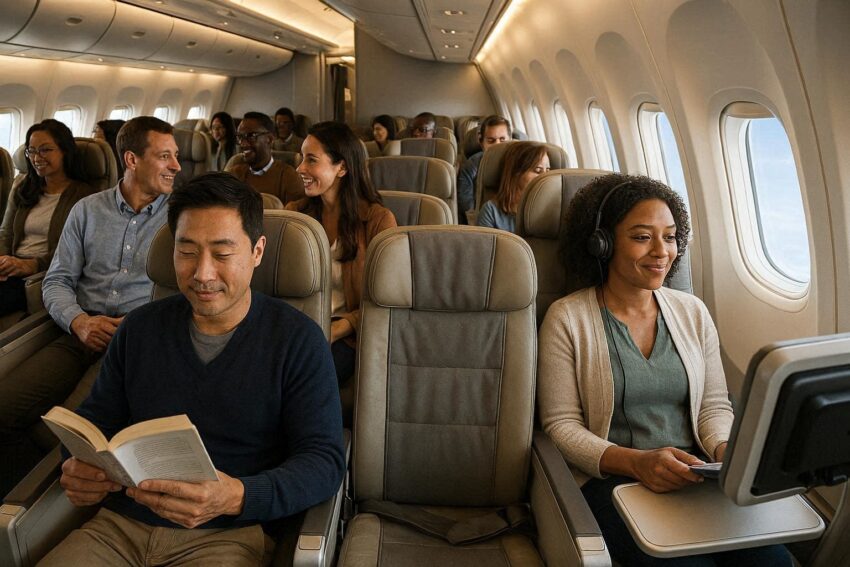
The Premium Economy cabin on the Qantas A380 is positioned on the upper deck of the aircraft. A total of 60 seats are arranged in a 2-3-2 configuration. In contrast, the economy cabin accommodates 341 seats in a denser 3-4-3 layout.
The reduction in seat density results in a noticeably quieter and less congested cabin environment. With fewer passengers sharing the same zone, ambient noise levels are typically lower, and boarding and deplaning processes are often smoother. On ultra-long-haul services between Australia and the United States or the United Kingdom, this calmer setting can significantly enhance perceived comfort.
The spatial layout alone contributes to the sense that Premium Economy is designed for endurance rather than mere transportation.
Seat Dimensions and Ergonomic Engineering
Structural seat modifications differentiate Premium Economy from standard economy more meaningfully than aesthetic changes alone. Seat width measures approximately 22.8 inches, representing an increase of roughly 10 percent over economy seating. Seat pitch expands from 32 inches in economy to 38 inches in Premium Economy.
Recline capability also increases, extending to 9 inches compared to 6 inches in economy. However, the engineering behind the recline mechanism marks a more substantial distinction.
In economy, seatbacks tilt backward in a traditional motion. This mechanism can create a forward sliding sensation, particularly for taller passengers, as body weight shifts within the seat structure. Over long-haul durations between Australia and North America or Europe, this subtle instability may contribute to discomfort.
In Premium Economy, the seat base moves forward and slightly upward during recline. Weight is kept centred within the seat bucket, reducing sliding and enhancing stability. The mechanical design supports improved posture and a more secure resting position. Although the seat does not convert into a fully flat bed like business class, improved ergonomics generally allow for more effective sleep.
A leg rest and footrest are also incorporated, supporting lower-body circulation during prolonged sitting.
Entertainment and Connectivity Features
Each Premium Economy seat is equipped with a 13-inch high-definition entertainment screen, marginally larger than the 12-inch screens installed in economy. USB charging ports and AC power outlets are provided, ensuring compatibility with personal electronic devices across long sectors linking Australia with destinations in the United States, the United Kingdom, South Africa, and Singapore.
Padded headphones are supplied, contributing to enhanced audio clarity and passive noise reduction. These incremental upgrades collectively contribute to a more refined inflight experience, particularly on overnight services.
Dining and Service Enhancements
Service elements within Premium Economy are positioned above economy standards but below the formality of business class. A welcome drink is offered prior to departure, with champagne available as an option.
Meal portions are larger than those served in economy, and presentation is elevated through improved plating and service sequencing. While the culinary offering does not replicate the multi-course business class experience, it reflects a deliberate effort to enhance onboard hospitality.
On extended routes between Australia and the United States or Europe, meal timing and quality can influence hydration levels, sleep cycles, and overall passenger wellbeing. As such, the incremental improvements are often regarded as meaningful rather than cosmetic.
Pricing Structure and Value Analysis
Premium Economy is positioned between economy and business class in terms of pricing. On return services from Sydney to Dallas, Premium Economy fares are approximately 1,677 dollars higher than economy tickets. This represents an increase of about 60 percent.
In contrast, business class fares on the same route can be approximately 11,000 dollars higher than economy, reflecting an increase of around 400 percent.
This pricing differential establishes Premium Economy as a financially balanced alternative. For passengers travelling between Australia and the United States or the United Kingdom who seek improved rest but cannot justify the premium associated with business class, the cabin often represents a compromise between cost control and comfort.
Budget-focused travellers may still prioritize economy. However, those undertaking ultra-long-haul journeys for professional commitments or immediate onward travel frequently evaluate the additional expenditure as an investment in reduced fatigue and improved post-arrival functionality.
Economy Cabin Overview for Comparison
The economy cabin aboard the Qantas A380 features a 3-4-3 configuration with 32-inch seat pitch and 6-inch recline. Each seat includes a 12-inch touchscreen entertainment system, USB charging, AC power outlets, and adjustable headrests.
The cabin is structured to prioritize affordability and efficiency across long-haul operations. While fully functional, the denser layout and more limited recline may present challenges on sectors exceeding 13 to 15 hours.
In direct comparison, Premium Economy’s increased width, pitch, recline depth, and revised seat mechanics are positioned as tangible improvements rather than superficial upgrades.
Cost Versus Comfort on Ultra-Long-Haul Routes
On routes connecting Australia with the United States, the United Kingdom, South Africa, and Singapore, flight durations frequently exceed thresholds at which physical strain becomes noticeable. In such scenarios, seating ergonomics influence not only inflight comfort but also post-flight recovery.
Premium Economy does not replicate the lie-flat functionality of business class. However, substantial gains in personal space, cabin density, recline mechanics, and onboard service are delivered relative to economy.
For travelers prioritizing sleep quality, circulation support, and a quieter cabin environment, the upgrade is frequently assessed as logical. The proportional cost increase remains significantly below that of business class, reinforcing its appeal as a middle-ground solution.
Final Assessment
Across ultra-long-haul sectors linking Australia with North America, Europe, Africa, and Asia, the Qantas A380 Premium Economy cabin is structured to provide measurable improvements in space, ergonomics, and service quality. While it does not transform into a lie-flat bed, its mechanical seat design, expanded pitch, and quieter cabin environment are positioned as meaningful advantages on flights exceeding 15 hours.
For passengers traveling between Australia and destinations such as the United States and the United Kingdom, Premium Economy is frequently regarded as a balanced compromise between financial prudence and physical comfort. In the context of extended intercontinental travel, the cabin’s design philosophy reflects a targeted response to the realities of endurance aviation.
The post Australia to United States and United Kingdom: Inside Qantas A380 Premium Economy on Ultra-Long Routes appeared first on Travel And Tour World.
Source: travelandtourworld.com


Sorry, the comment form is closed at this time.