


Beyond the Clouds: The Rise of Jawadhu Hills as Tamil Nadu’s Premier Ecotourism Sanctuary
Beyond the Clouds: The Rise of Jawadhu Hills as Tamil Nadu’s Premier Ecotourism Sanctuary
While the misty peaks of Ooty and the pine-scented trails of Kodaikanal have long dominated South Indian travel itineraries, a new chapter is unfolding in the verdant heart of the Eastern Ghats. Jawadhu Hills, a breathtaking but previously overlooked highland in the Tiruvannamalai district, is being reimagined as a flagship destination for sustainable luxury. The Tamil Nadu Tourism Development Corporation (TTDC) is leading an ambitious initiative to transform this rugged terrain into a sophisticated ecotourism hub where the thrill of the wilderness is seamlessly blended with the comforts of modern glamping.
A Vision for Sustainable Splendour
The traditional landscape of mountain tourism in Tamil Nadu is being redefined by the state’s strategic shift toward experiential travel. A 7.65-acre expanse within the Jawadhu range has been earmarked for a comprehensive facelift, focusing on low-impact infrastructure that honours the delicate local ecosystem. This development is being positioned not merely as a weekend retreat but as a testament to the government’s commitment to “green” hospitality. By prioritizing semi-permanent structures over concrete expansions, the carbon footprint of future visitors is intended to be kept at a minimum, ensuring that the hills remain as pristine as they were centuries ago.
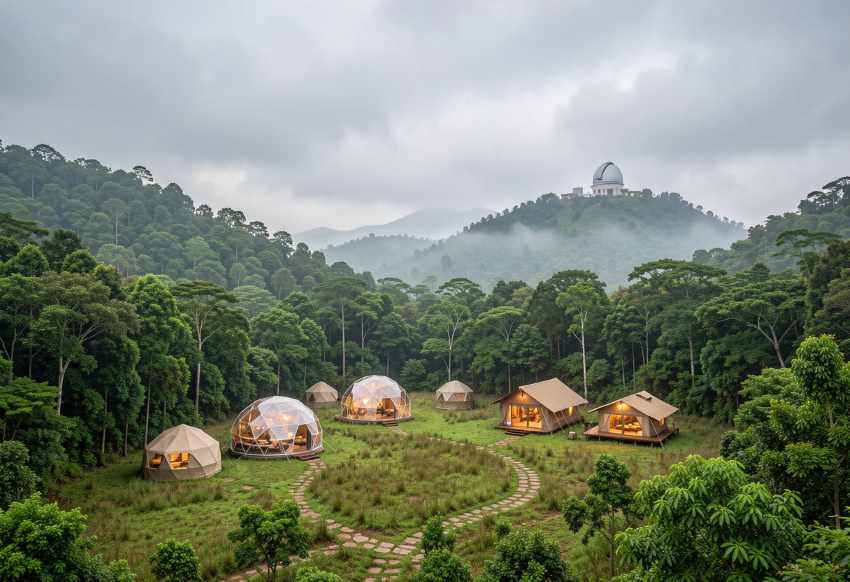
Under the Public-Private Partnership (PPP) model, a diverse array of accommodation units is being introduced. Luxury safari tents, geodesic glamping domes, and prefabricated eco-cottages are being deployed to offer travellers an immersive stay amidst the teak and sandalwood groves. These structures are designed to be harmonious with the environment, allowing the earthy fragrance of the fresh mountain soil to be experienced without the intervention of traditional hotel corridors.
Astronomy and the Allure of the Night Sky
One of the most distinctive features of Jawadhu Hills is its clarity of atmosphere, a quality that led to the establishment of the Vainu Bappu Observatory at Kavalur. As part of the new tourism roadmap, the observatory is being highlighted as a primary attraction for those seeking a “window into the cosmos”. In an era where light pollution obscures the celestial wonders in most urban centres, the twinkling stars above Jawadhu are preserved in their full glory. Night-sky observation sessions are being curated for tourists, providing an educational and romantic dimension to the camping experience. The observatory remains a cornerstone of scientific pride, and its integration into the tourism circuit is expected to draw a new demographic of science-loving travellers and astrophotographers.
Chasing Waterfalls and Solitude
Beyond the cosmic views, the geography of Jawadhu is defined by its water bodies and ancient forests. The Komutteri Lake, the largest in the region, is being prepared for enhanced leisure activities. Solitude is easily found by the lakeside, where the calm waters mirror the “romantic grey skies” that often blanket the plateau. For the more adventurous, the trek to Beemanmadavu Waterfalls remains a quintessential Jawadhu experience. The cool, cascading waters are reached via trails that cut through thickets of bamboo and mahogany, offering a sensory journey that is being meticulously preserved even as accessibility is improved.
The forest itself, a rich repository of biodiversity, is home to the Malayali tribal communities whose heritage is deeply intertwined with the land. The tourism facelift is being conducted with a sensitive approach toward these communities, ensuring that the influx of visitors translates into local economic empowerment without eroding traditional lifestyles.
A Strategic Facelift for the Modern Traveler
The logistical barriers that once kept Jawadhu Hills a “hidden gem” are being addressed through significant infrastructure upgrades. Under the Comprehensive Road Infrastructure Development Programme (CRIDP 2025-26), the tribal roads navigating the reserve forests are being widened to facilitate safer travel. However, ecological safeguards are being strictly maintained; for instance, the installation of high-intensity LED streetlights is being avoided in specific stretches to ensure the free movement of nocturnal wildlife. This balance between modern accessibility and wildlife conservation is a hallmark of the TTDC’s 2026 vision.
Furthermore, the integration of technology into the visitor experience is being prioritized. From interactive mobile applications for trekking routes to seamless online booking platforms for the new glamping sites, the digital ecosystem of Tamil Nadu tourism is being upgraded to match the physical beauty of the destinations.
The Future of Experiential Travel
As the state transitions away from the “mass tourism” models of the past, Jawadhu Hills serves as a model of what is possible when conservation meets innovation. The official stance remains clear: the future of tourism lies in models that allow for close contact with nature without causing environmental damage. Jawadhu Hills, with its unique blend of megalithic burial sites, botanical richness, and cutting-edge glamping, is no longer just an alternative to Ooty or Yercaud—it is a destination that deserves its own spot on the global map of responsible travel.
Jawadhu Hills awaits those looking for the quiet rustle of teak leaves, the cool spray of a hidden waterfall, and the silent majesty of the Milky Way. As the facelift nears completion, Tamil Nadu’s “underrated gem” can finally shine.
The post Beyond the Clouds: The Rise of Jawadhu Hills as Tamil Nadu’s Premier Ecotourism Sanctuary appeared first on Travel And Tour World.
Source: travelandtourworld.com



Sorry, the comment form is closed at this time.