


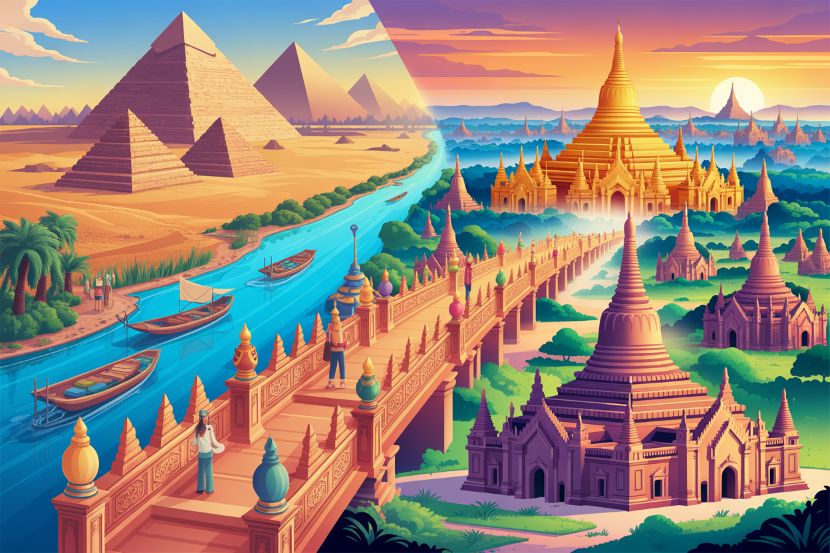
Cairo, New Administrative Capital, Yangon and Bagan Forge New Cultural Pathways as Egypt and Myanmar Advance Museum, Archaeology and Travel Partnerships Across Africa and Southeast Asia — What This Means for Global Heritage Travelers
Cairo, New Administrative Capital, Yangon and Bagan Forge New Cultural Pathways as Egypt and Myanmar Advance Museum, Archaeology and Travel Partnerships Across Africa and Southeast Asia — What This Means for Global Heritage Travelers
Egypt and Myanmar are entering a dynamic phase of cultural diplomacy, linking Cairo, the New Administrative Capital, Yangon, and Bagan through expanding partnerships in cultural tourism and heritage preservation. From book donations at Egypt’s historic Heliopolis Palace to proposed agreements on archaeological cooperation, both nations are steadily strengthening institutional and people-to-people connections.
This renewed momentum between Egypt and Myanmar is not just about diplomacy—it is about travel, shared civilisational pride, and future tourism flows between Africa and Southeast Asia. As Egypt continues to draw millions to its ancient monuments and Myanmar showcases its gilded pagodas and temple plains, collaboration between the two heritage-rich countries is opening new opportunities for museums, scholars, students, and travelers. The evolving Egypt–Myanmar partnership reflects a broader effort to position cultural tourism as a bridge between continents, traditions, and generations.
Expanding Bridges Between Two Ancient Civilisations
Egypt and Myanmar are home to some of the world’s most recognisable historical landmarks. Egypt’s Pharaonic monuments—including the pyramids of Giza, the temples of Luxor, and the treasures of the Egyptian Museum in Cairo—have long cemented the country’s global tourism appeal. Myanmar, historically known as Burma, offers equally compelling heritage sites such as the Shwedagon Pagoda in Yangon and the vast archaeological landscape of Bagan, where thousands of ancient temples dot the plains.
In recent months, cultural engagement between the two governments has intensified. A notable gesture was Myanmar’s donation of more than 100 books to the library of the Heliopolis Palace in Egypt’s New Administrative Capital. The symbolic exchange underscored a commitment to educational cooperation and cultural goodwill.
More significantly, discussions are underway to formalise agreements focused on cultural and archaeological collaboration. A proposed memorandum of understanding related to archaeological cooperation has been submitted to Egypt’s Ministry of Tourism and Antiquities for review. The scope of cooperation is expected to include collaboration between museums, exchange of conservation expertise, and shared training in the restoration of antiquities.
For tourism professionals, this is more than paperwork—it signals long-term alignment between two destinations that rely heavily on heritage-driven travel.
Museums, Monuments And Meaning: Why Archaeological Cooperation Matters For Tourism
Heritage tourism remains a cornerstone of Egypt’s economy. The country welcomed over 14 million international visitors in 2023 according to official figures, with cultural attractions accounting for a significant share of arrivals. Myanmar, while navigating its own challenges in recent years, has historically attracted visitors drawn to its religious architecture, traditional arts, and scenic lakeside communities.
By sharing expertise in preservation and restoration, Egypt and Myanmar can strengthen the visitor experience in both destinations. Conservation knowledge gained from maintaining centuries-old temples in Bagan may complement Egypt’s extensive restoration programmes at sites such as Saqqara or Abu Simbel. Likewise, Egypt’s long-standing archaeological missions and museum management systems offer valuable insights for Myanmar’s cultural institutions.
For travelers, better preservation translates into:
Enhanced access to well-maintained heritage sites
Improved museum curation and storytelling
Sustainable tourism practices that protect monuments for future generations
Such cooperation can also encourage joint exhibitions, cultural weeks, or travelling showcases, creating fresh incentives for tourists to explore both destinations.
Education, Youth Exchange And The Future Of Cultural Travel
Beyond archaeology, the two countries are investing in educational exchange. Preparations are underway for an “Open Doors” initiative that would allow reciprocal visits between Egyptian schools and Myanmar’s diplomatic mission, coordinated with Egypt’s Ministry of Education.
Youth engagement is a powerful tool in tourism diplomacy. When students learn about the Nile civilisation or the golden pagodas of Yangon, they grow up with curiosity about each other’s countries. Over time, that curiosity can translate into study tours, cultural visits, and long-haul travel.
For tour operators and travel planners, such initiatives often plant the seeds for future demand. Educational travel, heritage tours, and cross-cultural exchange programmes may eventually become structured tourism products connecting Cairo with Yangon.
Egypt Through Myanmar Eyes: A Dream Destination Rooted In History
Egypt occupies a special place in Myanmar’s cultural imagination. From an early age, students in Myanmar learn about ancient civilisations, and Egypt’s monumental legacy often features prominently in textbooks and popular culture. The idea of standing before the pyramids or cruising along the Nile carries strong aspirational value.
This perception matters for tourism marketing. Egypt has actively diversified its tourism offerings in recent years—combining archaeological exploration with Red Sea resorts in Hurghada and Sharm El Sheikh, desert adventures in the Western Desert, and urban cultural experiences in Cairo.
For Myanmar travelers considering Egypt, practical tips include:
Best visiting season: October to April offers cooler temperatures ideal for site exploration.
Visa planning: Travelers should consult official consular channels for updated requirements.
Combining experiences: Pair a historical circuit in Cairo and Luxor with leisure time along the Red Sea for a balanced itinerary.
Myanmar’s Golden Horizons: Temples, Lakes And Coastal Retreats
While Egypt’s tourism brand is globally entrenched, Myanmar’s offerings remain distinctive and spiritually immersive. The Shwedagon Pagoda in Yangon, covered in gold leaf and crowned with precious stones, remains one of Southeast Asia’s most revered religious monuments. In Bagan, sunrise balloon rides over thousands of temples once defined the country’s tourism imagery.
Natural attractions also strengthen Myanmar’s appeal. Inle Lake is known for its floating gardens and traditional leg-rowing fishermen, while Ngapali Beach offers tranquil coastal escapes along the Bay of Bengal.
For international travelers interested in Myanmar:
Cultural sensitivity is essential when visiting religious sites.
Modest attire is required at pagodas and temples.
Local cuisine, anchored by sticky rice and the fermented fish paste known as Ngapi, provides insight into daily life and culinary heritage.
As stability and infrastructure improve over time, stronger ties with Egypt could help reposition Myanmar as part of a broader intercontinental heritage circuit.
Tourism As A Strategic Connector Between Africa And Southeast Asia
The deepening engagement between Egypt and Myanmar reflects a larger global trend: cultural diplomacy is increasingly intertwined with tourism strategy. Both nations possess UNESCO-listed heritage sites and ancient traditions that resonate far beyond their borders.
Formal agreements on archaeological cooperation, museum collaboration, and educational exchange can lay the groundwork for:
Joint cultural festivals
Academic research partnerships
Tourism promotion campaigns highlighting shared civilisational narratives
Cross-marketing between African and Southeast Asian travel circuits
In an era when experiential travel is overtaking purely leisure-focused tourism, destinations that foreground authenticity and preservation gain competitive advantage.
A Shared Legacy, A New Chapter For Cultural Travel
As Egypt and Myanmar move closer to formalising their cooperation, the relationship evolves from symbolic gestures to structured partnerships. Book donations, proposed memorandums, museum collaboration, and youth exchanges all point to a broader vision: positioning cultural tourism and heritage preservation at the centre of bilateral engagement.
For global travelers, this evolving partnership offers a compelling narrative—two ancient civilisations, separated by geography yet united by history, reconnecting in ways that enrich tourism, education, and mutual understanding.
In the years ahead, the strengthening bond between Cairo and Yangon may not only protect monuments but also inspire new journeys across continents.
The post Cairo, New Administrative Capital, Yangon and Bagan Forge New Cultural Pathways as Egypt and Myanmar Advance Museum, Archaeology and Travel Partnerships Across Africa and Southeast Asia — What This Means for Global Heritage Travelers appeared first on Travel And Tour World.
Source: travelandtourworld.com


Sorry, the comment form is closed at this time.