


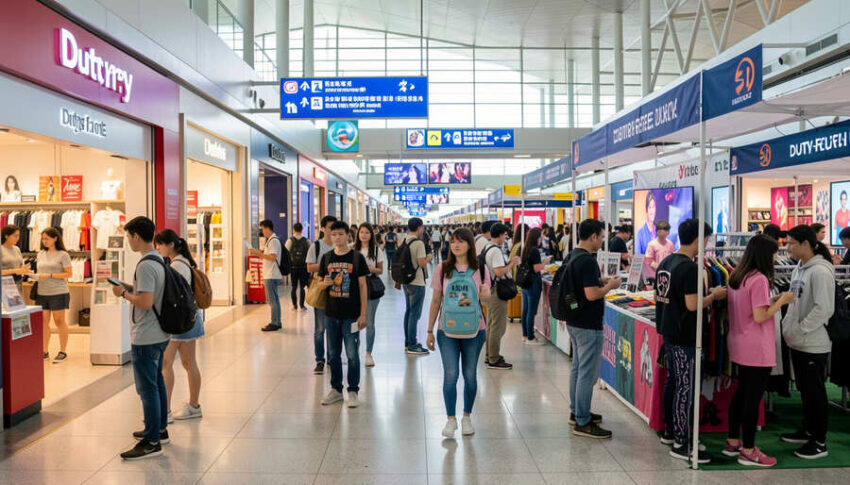
China alongside India, UAE, Saudi Arabia, Qatar and Other Leading Markets in Ushering in a New Era of Airport Retail Growth Driven by Gen Z and Millennial Shoppers Redefining Spending Habits
China alongside India, UAE, Saudi Arabia, Qatar and Other Leading Markets in Ushering in a New Era of Airport Retail Growth Driven by Gen Z and Millennial Shoppers Redefining Spending Habits
As airports worldwide adapt to a post-pandemic retail landscape, China, alongside India, the UAE, Saudi Arabia, and Qatar, is at the forefront of a transformative shift in consumer behavior. Younger generations, particularly Gen Z and Millennials, are emerging as the dominant forces reshaping airport shopping experiences. With their growing influence, these travelers are pushing airports to rethink traditional retail models, prioritizing luxury, personalized products, and digital engagement. This new era of retail growth is not just about increasing foot traffic, but about understanding and catering to the evolving expectations of today’s dynamic consumers.
A new study from Airports Council International Asia-Pacific & Middle East (ACI APAC & MID) has analyzed how the retail dynamics at airports have changed, providing insight into the evolving relationship between passenger traffic and commercial revenue. The findings show that what passengers buy and how they make purchasing decisions now matter more than how many passengers pass through the terminals. This shift signals a new era for airport retail strategies, where personalized experiences and targeted offerings are key to success.
Passenger Behavior Over Traffic Volume
Historically, the relationship between passenger traffic and retail revenue was straightforward. Airports assumed that more passengers equaled more sales. But the Travel Retail Study in the Post-Pandemic Era suggests this view is no longer accurate. The findings indicate that passenger behavior now plays a more critical role than passenger volume in determining retail success at airports.
The study analyzed data from 36 major airports in 21 countries, revealing a shift from quantity to quality when it comes to retail performance. Key takeaways include:
56% of airports report surpassing pre-pandemic commercial revenue levels, suggesting that the value of the passengers is more important than the sheer number of travelers.
44% of airports expect to see greater commercial revenue per passenger in the coming months, emphasizing the growing importance of optimizing the retail experience.
Perfumes and cosmetics were identified as the top-performing retail category since 2019, underscoring a growing interest in luxury products.
This change underscores a fundamental shift in airport commercial strategy. Retail performance no longer depends solely on how many passengers are passing through—what matters more is how airports can adapt to the evolving preferences and spending behaviors of those passengers.
Younger Generations at the Helm of Airport Retail Growth
One of the most significant findings of the study is the rising dominance of Gen Z and Millennials as airport retail spenders. These younger generations are outpacing older generations like Gen X and Boomers in terms of retail expenditure, fundamentally altering the retail environment at airports.
The study revealed:
Gen Z and Millennials are spending an average of 3.5 times more than Gen X and Boomers combined.
Gen Z travelers are four times more likely than Boomers to purchase electronics at airports.
They are 2.5 times more likely than Boomers to buy luxury products.
This shift in spending patterns is significant. Unlike older travelers, who are more price-sensitive and cautious in their shopping habits, Gen Z and Millennials are driving demand for premium products, such as luxury goods, cosmetics, and electronics. This trend reflects the broader spending habits of younger generations who prioritize quality, experience, and status in their purchasing decisions.
Moreover, Gen Z and Millennials are also attracted to local and culturally relevant products, making destination-based retail a growing focus. Airports are now curating their retail offerings to align with travelers’ desires for authenticity and cultural connection, which has further accelerated the demand for regionally sourced items.
The Role of Non-Aeronautical Revenue
Non-aeronautical revenue sources, such as retail sales and duty-free shopping, have become increasingly vital for airport financial stability. The Travel Retail Study highlights how these sources are now crucial in ensuring airports’ long-term resilience. As passenger behavior shifts, non-aeronautical revenue is playing an even larger role in airport profitability, especially as airports face high fixed costs and long-term investment challenges.
Airports that have diversified their revenue streams—particularly through innovative retail strategies—are better equipped to weather financial uncertainties and drive sustainable growth. With retail becoming a primary source of income, airports are focusing on how to enhance their offerings to meet the demands of a more selective and diverse customer base.
Regional Differences in Retail Growth
The study reveals that Asia-Pacific and the Middle East are experiencing particularly strong growth in retail spending, driven by domestic traffic increases and a growing demand for luxury and exclusive products. In Asia-Pacific, domestic traffic rose by 2% from January to October 2025, leading to a 13% increase in passenger spend compared to 2019. Notably, luxury goods sales grew by 9%, and local products saw a 7% increase.
In the Middle East, electronics sales surged by 14%, driven by tax benefits and exclusive product ranges available in airport shops. In this region, duty-free shopping remains a central pillar of retail performance. Countries like Saudi Arabia, Qatar, and the UAE have seen duty-free sales make up a substantial portion of overall airport retail revenues.
China, India, and the Gulf Region Power Retail Recovery
The strongest growth in airport retail spending has been recorded from travelers in China, India, the UAE, and Saudi Arabia. These regions have led the charge in recovery, with travelers from China making significant contributions to luxury goods spending—double the average for the Asia-Pacific region. India has also seen a substantial rise in duty-free spending, driven by increasing brand aspirations and tax advantages for outbound travelers. Travelers from the UAE and Saudi Arabia are some of the highest spenders, encouraged by high disposable incomes and a strong gift-giving culture.
The Shift to Impulse Shopping and the Digital Experience
Even with increased digital engagement, particularly among younger travelers, impulse shopping remains a dominant force in airport retail. The study found that 70% of purchases are made impulsively, indicating that traditional retail methods are still effective in airport environments. While digital engagement continues to rise, only 2% of incremental sales can be attributed to it.
Interestingly, while 65% of Gen Z travelers are willing to pay more for sustainable products, only 20% of airports currently focus on sustainability as a core part of their retail strategy. This gap between passenger expectations and airport retail practices highlights the opportunity for airports to better align their commercial strategies with the increasing demand for sustainable, ethical, and environmentally friendly products.
Key Retail Categories and Growth Strategies
Retail categories that consistently lead the way in airport performance include:
Luxury goods and perfumes and cosmetics as the top two most profitable categories across both Asia-Pacific and the Middle East.
Electronics, which holds third place in popularity, driven by pricing advantages and the convenience of purchasing last-minute gifts.
Local products performing particularly well in Asia-Pacific, while confectionery and impulse gifting dominate in the Middle East.
These categories have generated the highest net margins for airports and are key to driving the long-term success of airport retail. Airports that can align their retail offerings with passenger behaviors and market demands are likely to continue seeing strong performance.
Conclusion: Adaptation to Evolving Consumer Preferences
As the airport retail sector continues to evolve, understanding and adapting to the preferences of younger generations will be critical for success. Airports must prioritize offering premium products and culturally relevant items while also considering sustainability and personalized shopping experiences to remain competitive. By embracing these changes, airports can secure their place at the forefront of a rapidly shifting travel retail landscape, ensuring long-term growth and financial resilience.
The post China alongside India, UAE, Saudi Arabia, Qatar and Other Leading Markets in Ushering in a New Era of Airport Retail Growth Driven by Gen Z and Millennial Shoppers Redefining Spending Habits appeared first on Travel And Tour World.
Source: travelandtourworld.com



Sorry, the comment form is closed at this time.