


Emirates, Etihad, Air India, British Airways, Lufthansa, Qatar Airways, Turkish Airlines and Delta Halt Routes as Thousands from India, UK, US and Russia Are Stranded in Dubai — Burj Al Arab and Jumeirah Hotels Brace for Fallout
Emirates, Etihad, Air India, British Airways, Lufthansa, Qatar Airways, Turkish Airlines and Delta Halt Routes as Thousands from India, UK, US and Russia Are Stranded in Dubai — Burj Al Arab and Jumeirah Hotels Brace for Fallout
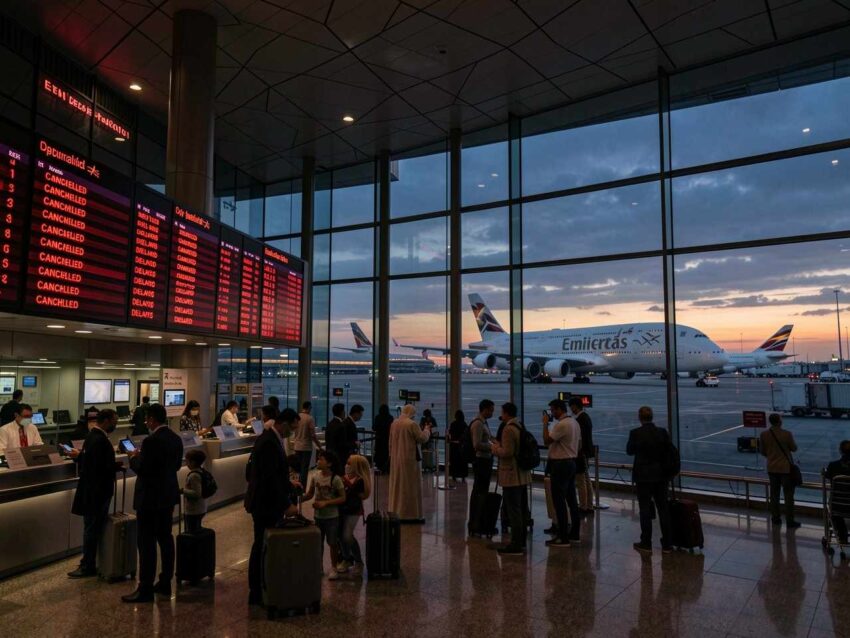
Emirates, Etihad and Air India are at the center of a sudden global travel shock as thousands of international passengers from India, the United Kingdom, the United States, Russia and beyond remain stranded in Dubai following Iranian missile and drone strikes that triggered precautionary airspace restrictions across parts of the Gulf. Dubai International Airport, which handled a record 95.2 million passengers in 2025 and serves as one of the world’s busiest international transit hubs, saw flight suspensions and reroutings ripple across networks operated by British Airways, Lufthansa, Qatar Airways, Turkish Airlines, Delta and other major carriers. Aviation data during the peak disruption window indicated a significant portion of regional flights were cancelled as airlines prioritized safety and complied with official advisories. The impact extends beyond runways: Dubai welcomed 19.59 million international overnight visitors last year, with hotel occupancy exceeding 80%, underscoring how deeply aviation, tourism and hospitality are interconnected in the emirate’s economy. As authorities coordinate passenger assistance and hotels extend stays for affected guests, the situation has become a real-time stress test for one of the world’s most resilient travel ecosystems—turning a city synonymous with seamless global connectivity into the focal point of an unfolding aviation and tourism challenge.
Emirates, Etihad, Air India, British Airways, Lufthansa, Qatar Airways, Turkish Airlines and Delta Halt Routes as Thousands from India, UK, US and Russia Are Stranded in Dubai — Burj Al Arab and Jumeirah Hotels Brace for Fallout
Dubai has built its global reputation on reliability. The city handled a record 95.2 million passengers through Dubai International Airport in 2025. It welcomed 19.59 million international overnight visitors the same year. Hotels operated at more than 80% occupancy. Aircraft departed every few minutes to cities across Europe, Asia, Africa, and the Americas.
That rhythm has now been disrupted.
Following Iranian missile and drone strikes and precautionary airspace restrictions announced by the UAE’s General Civil Aviation Authority, flight operations were suspended or heavily reduced. Major global airlines temporarily halted or rerouted services. Thousands of international travellers from India, the United Kingdom, the United States, Russia, Saudi Arabia, Pakistan, Germany, China, and other key markets suddenly found themselves stranded in one of the world’s busiest aviation hubs.
Dubai remains operational. Hotels remain open. Authorities are assisting passengers. But the shock to aviation and hospitality is significant. For travellers, this is a moment that requires calm, verified information, and practical planning.
Emirates, Etihad, Air India, British Airways, Lufthansa, Qatar Airways, Turkish Airlines and Delta Suspend Operations as Dubai’s Global Aviation Network Faces Its Biggest Stress Test in Years
Dubai International Airport (DXB) is not just a city airport. It is one of the world’s largest international transit hubs. In 2025, it recorded 95.2 million passengers and more than 450,000 flight movements. India was the largest country market with 11.9 million passengers. Saudi Arabia followed with 7.5 million. The United Kingdom accounted for 6.3 million. Pakistan recorded 4.3 million. The United States contributed 3.3 million passengers.
When airspace restrictions were implemented as a precautionary security measure, the impact was immediate. Airlines including Emirates, Etihad Airways, Air India, British Airways, Lufthansa, Qatar Airways, Turkish Airlines, Delta Air Lines, Air France, KLM, United Airlines and Singapore Airlines either suspended, rerouted, or delayed services depending on operational feasibility and safety assessments.
Aviation analytics firms reported that roughly a quarter of flights to and from parts of the Middle East were cancelled during the peak disruption window. Aircraft already airborne were rerouted. Some flights returned to origin airports. Others diverted to alternative hubs.
For a city that functions as a bridge between East and West, even short suspensions create ripple effects across continents. Missed connections in Dubai affect onward journeys to Europe, Asia-Pacific, Africa, and North America. Cargo networks are also affected, increasing costs and delivery delays.
Emirates, Etihad, Air India, British Airways, Lufthansa, Qatar Airways, Turkish Airlines and Delta Halt Routes While Burj Al Arab and Jumeirah Hotels Manage Extended Stays for Stranded Guests
Dubai’s hospitality sector is built for scale. At the end of 2025, the city offered more than 154,000 hotel rooms across 827 properties. Average occupancy reached 80.7% for the year. Nearly 45 million room nights were sold.
When flights stopped, many travellers extended their stays. Some could not depart on scheduled flights. Others chose to delay travel voluntarily until operations stabilized. The UAE government announced it would cover accommodation and essential costs for affected travellers during the disruption period. More than 20,000 passengers were reportedly assisted with lodging, meals, and rebooking support through coordinated efforts involving airports, airlines, and hotels.
Luxury properties such as Burj Al Arab, Atlantis The Palm, Jumeirah Beach Hotel, and major international brands including Hilton, Marriott, Hyatt, Accor, and Taj adapted quickly. Front desks extended bookings. Concierge teams assisted with airline communications. Security procedures were tightened at night in some central districts as a precaution.
For hospitality operators, the short-term effect is operational strain rather than collapse. Occupancy remains high because stranded travellers need rooms. The long-term effect will depend on how quickly flight schedules normalize and traveller confidence returns.
Why Dubai’s Aviation Exposure Is So Significant
Dubai’s connectivity is uniquely global. Western Europe accounts for around 21% of Dubai’s visitor base. South Asia and the GCC each contribute roughly 15%. CIS and Eastern Europe account for about 15%. MENA markets represent around 11%.
That diversity spreads economic risk. But it also means disruption affects travellers from many regions simultaneously.
India faces the largest passenger exposure because of its volume through DXB. The United Kingdom and Germany are heavily connected through leisure and business routes. Russia remains a significant leisure source market. The United States relies on Dubai as a connection hub to South Asia and Africa. China and Italy were among the fastest-growing markets in 2025.
When flights halt, these markets feel the impact almost immediately.
How Airlines Are Managing the Crisis
Airlines are following safety-first protocols. That means suspensions are not political statements. They are operational decisions based on airspace advisories and risk assessments.
Passengers should note the following:
Check your airline’s official website or app before traveling to the airport.
Do not go to DXB unless your flight status is confirmed.
Rebooking options are generally free of change penalties during disruption periods.
Refunds are available for cancelled segments.
Travel insurance claims may be processed under “force majeure” or security-related disruption clauses.
Emirates and Etihad have robust re-accommodation systems because they manage large global networks. European carriers such as Lufthansa, British Airways, and Air France are offering flexible policies. Air India and other South Asian carriers are coordinating closely with airport authorities to manage high passenger volumes.
Capacity constraints may lead to higher fares on remaining available routes once flights resume. Early rebooking is advisable once schedules reopen.
What This Means for Transit Passengers
Dubai functions as a super-connector. Many stranded travellers were not visiting the UAE. They were transiting between continents.
If you are a transit passenger:
Confirm whether your onward destination requires a visa if you leave the airport.
Check if your nationality qualifies for visa-on-arrival in the UAE.
Keep boarding passes and confirmation emails.
Ask your airline about hotel eligibility under transit disruption policies.
The UAE typically offers efficient visa-on-arrival options for many nationalities, including citizens of the US, UK, EU member states, and others. However, always confirm official rules.
Impact on Dubai’s Tourism Economy
Travel and tourism contribute roughly 13% of the UAE’s GDP. Dubai’s model depends heavily on aviation, hospitality, retail, and events.
The city recently celebrated three consecutive record-breaking years in tourism growth. 2025 marked the highest visitor number in its history.
A prolonged aviation disruption would affect:
Leisure arrivals.
Cruise connections.
Business conferences and MICE events.
Retail and luxury shopping traffic.
However, Dubai has demonstrated resilience during previous global crises, including the pandemic and regional conflicts. Infrastructure is modern. Crisis management systems are well rehearsed.
If operations resume within days rather than weeks, long-term damage may be limited.
What Tourists Currently in Dubai Should Know
Stay informed through official airline channels.
Follow instructions from hotel management and local authorities.
Avoid spreading unverified social media information.
Keep emergency contacts saved.
Ensure your passport validity and visa status remain compliant.
The UAE’s infrastructure remains functional. Public transport, metro services, taxis, restaurants, malls, and attractions continue to operate unless specific advisories are issued.
Nighttime precautionary measures in some areas are preventive rather than reactive. There is no citywide shutdown.
What Prospective Travellers Should Consider Before Booking
Monitor flight status trends over 48-hour windows.
Check your airline’s waiver policy.
Review travel insurance coverage for geopolitical events.
Consider refundable hotel rates.
Avoid non-refundable excursions until flight schedules stabilize.
Dubai remains one of the safest cities globally by crime statistics. The disruption is related to regional airspace risk rather than internal instability.
How the Hospitality Industry Is Adapting
Hotels are deploying contingency teams. Revenue management systems are adjusting dynamically. Extended stays are being negotiated at controlled rates.
Luxury properties are offering flexible check-out extensions. Business hotels are converting conference space into temporary waiting lounges for group travellers. Airport hotels are managing capacity carefully due to proximity to terminals.
If you are extending your stay, negotiate directly with the property. Many are cooperating under official assistance programs.
Will Traveller Confidence Return?
Historically, global aviation rebounds quickly once airspace restrictions lift. Demand for Dubai remains structurally strong. India, Saudi Arabia, the UK, Pakistan, Russia, Germany, the US, and China all maintain strong travel ties with the UAE.
Dubai’s role as a neutral commercial hub and tax-friendly destination has historically helped it recover faster than many competing cities.
If flight suspensions remain temporary, pent-up demand could drive a short-term surge once routes reopen.
Practical Travel Checklist for Stranded Passengers
Confirm flight status twice daily.
Document every cancellation notice.
Request written confirmation of delays for insurance purposes.
Keep receipts for meals and transport if reimbursement applies.
Stay within official guidance zones if security advisories are issued.
If your embassy issues advisories, register online for updates.
Remain patient. Aviation disruptions resolve in phases. Safety checks take time.
The Bigger Picture for Global Aviation
Dubai is a critical intercontinental bridge. When its airspace pauses, Europe-Asia traffic patterns shift. Airlines reroute over alternative corridors. Fuel costs increase due to longer paths. Crew scheduling becomes complex.
Yet the aviation industry is built to adapt. Modern fleet management, real-time air traffic coordination, and global alliances allow carriers to restore connectivity efficiently once clearance is granted.
Final Travel Outlook
Dubai’s airports, airlines, and hospitality sector are under pressure. Thousands of travellers from India, the UK, the US, Russia, Saudi Arabia, Pakistan, Germany, China, and beyond remain temporarily stranded.
But infrastructure remains intact. Assistance programs are active. Hotels are operational. Airlines are preparing to resume services once airspace stabilizes.
For travellers, this is not a collapse. It is a disruption.
Stay informed. Stay flexible. Stay calm.
Emirates, Etihad and Air India are facing a major travel disruption as Iranian missile and drone strikes triggered airspace restrictions, stranding thousands of passengers in Dubai. With Dubai International handling a record 95.2 million travellers in 2025, the sudden flight suspensions have sent shockwaves through global aviation and the city’s tourism and hospitality sectors.
Dubai’s global hub status has been tested before. And history suggests it will recover again.
The post Emirates, Etihad, Air India, British Airways, Lufthansa, Qatar Airways, Turkish Airlines and Delta Halt Routes as Thousands from India, UK, US and Russia Are Stranded in Dubai — Burj Al Arab and Jumeirah Hotels Brace for Fallout appeared first on Travel And Tour World.
Source: travelandtourworld.com



Sorry, the comment form is closed at this time.