



Emirates, Qatar Airways, Etihad, Lufthansa, Air India, IndiGo, Air France-KLM, British Airways, Turkish Airlines, Delta & United Cancel 700+ Flights as United States–Israel–Iran Tensions Shut West Asia Skies — Dubai’s Marriott, Hilton and Jumeirah Brace for Tourism & Hospitality Shockwaves!
Emirates, Qatar Airways, Etihad, Lufthansa, Air India, IndiGo, Air France-KLM, British Airways, Turkish Airlines, Delta & United Cancel 700+ Flights as United States–Israel–Iran Tensions Shut West Asia Skies — Dubai’s Marriott, Hilton and Jumeirah Brace for Tourism & Hospitality Shockwaves!
Emirates, Qatar Airways and Etihad are at the center of a fast-escalating aviation crisis after United States–Israel–Iran tensions forced sweeping airspace restrictions across parts of West Asia, triggering more than 700 global flight cancellations and widespread rerouting that has disrupted international travel networks from Europe to Asia and North America. In the span of days, major carriers including Lufthansa, Air India, IndiGo, British Airways, Air France-KLM, Turkish Airlines, Delta and United adjusted schedules or suspended services as airspace over Iran and Israel tightened and key Gulf corridors faced operational constraints. Aviation data has shown that on one of the peak disruption days, close to a quarter of scheduled arrivals into parts of the Middle East were cancelled, underscoring how heavily global long-haul connectivity depends on transit hubs such as Dubai, Doha and Abu Dhabi. With Dubai International handling more than 95 million passengers in 2025 and projecting even higher volumes this year, and Qatar reporting over five million international visitors last year with a majority arriving by air, the ripple effects are immediate for airlines, tourism boards and hospitality giants alike. Longer flight paths, rising fuel costs linked to oil price volatility and mounting insurance considerations are adding financial pressure to carriers, while hotels across the UAE and Qatar are managing both stranded passengers and sudden booking uncertainty. For travelers, the message is clear: flexibility, vigilance and real-time flight monitoring are now essential as one of the world’s most critical aviation crossroads navigates renewed geopolitical turbulence.
Emirates, Qatar Airways, Etihad, Lufthansa, Air India, IndiGo, Air France-KLM, British Airways, Turkish Airlines, Delta & United Cancel 700+ Flights
Escalating tensions involving the United States, Israel and Iran have triggered one of the most disruptive aviation crises in the Middle East since the pandemic era. Airspace closures across Iran, Israel and parts of the wider Gulf have forced global airlines to cancel or reroute hundreds of services. More than 700 flights were cancelled globally in the early phase of the crisis, while aviation analytics firms reported that on one peak day nearly 23 percent of scheduled arrivals into parts of the Middle East were scrapped. The shock has rippled across aviation, tourism and hospitality, particularly in transit-dependent hubs such as Dubai, Doha and Abu Dhabi. For travelers, the disruption is immediate. For airlines and hotels, the financial implications are mounting.
Emirates, Qatar Airways, Etihad, Lufthansa and Air India Suspend Routes as US–Israel–Iran Escalation Forces Airspace Shutdowns Across Iran, Israel, UAE and Qatar
Major Gulf carriers are at the center of the disruption. Emirates and Etihad operate through the United Arab Emirates, one of the world’s most important long-haul connecting points. Qatar Airways depends heavily on Doha’s Hamad International Airport as a Europe-Asia-Americas bridge. Lufthansa, Air France-KLM and British Airways rely on Gulf overflight corridors for efficient routing between Europe and Asia. When airspace over Iran and Israel became restricted, airlines immediately began suspending services or taking long detours.
Indian carriers have been particularly affected. Air India and IndiGo operate dense schedules to Gulf cities, serving both migrant worker traffic and onward long-haul connections. Bengaluru airport alone reported dozens of cancellations tied to West Asia routes in a short span. Air India extended suspensions and rerouted Europe-bound flights to avoid restricted airspace, increasing journey times by up to 90 minutes on certain sectors. IndiGo cancelled hundreds of flights over several days, mainly on Gulf routes.
US carriers Delta and United adjusted Middle East services and evaluated crew safety and insurance exposure. Turkish Airlines, a major connector between Europe and Asia, began rerouting around Iranian airspace, adding flight time and fuel burn. These changes reflect both safety considerations and compliance with international aviation advisories.
Air France-KLM, British Airways, Turkish Airlines, Delta and United Reroute Europe–Asia Flights as 1,800+ Regional Cancellations Shake Global Networks
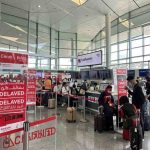
The disruption is not limited to direct Middle East services. Aviation data shows that thousands of flights were either cancelled or diverted during the initial days of closure. On one high-impact day, nearly 1,000 scheduled arrivals into parts of the Middle East were cancelled. That figure represents a significant percentage of daily traffic into Gulf hubs.
Why does this matter globally? Because Dubai, Doha and Abu Dhabi are not merely destinations. They are connectors. Dubai International Airport handled over 95 million passengers in 2025 and is projected to approach 100 million in 2026. A large share of those passengers are transit travelers flying between Europe and Asia, Africa and North America. When Gulf airspace narrows, global itineraries unravel.
Flights between London and Mumbai, Paris and Bangkok, Frankfurt and Singapore, and even New York and Johannesburg can be affected by rerouting decisions. Aircraft must avoid conflict zones. Pilots must carry extra fuel. Crew duty times can be exceeded. All of this triggers cancellations and delays beyond the region.
Longer routings also raise fuel costs. Brent crude recently climbed sharply amid geopolitical tensions, adding financial strain to airlines already navigating tight margins. Even a modest increase in fuel prices significantly affects long-haul profitability. The combination of higher fuel burn and extended flight times reduces operational efficiency and increases ticket price pressure.
Dubai’s Marriott, Hilton and Jumeirah Feel Immediate Impact as Transit-Driven Tourism Faces Sudden Slowdown
Hospitality operators in Dubai and Doha are closely watching developments. Dubai welcomed nearly 19.6 million overnight international visitors in 2025, achieving hotel occupancy rates above 80 percent. That performance was built on strong connectivity and a reputation for stability. When flights are cancelled, occupancy drops quickly.
UAE authorities have reported assisting more than 20,000 stranded travelers by covering hotel stays and meals during the crisis. This emergency support stabilizes the immediate situation but does not eliminate revenue risk. When connecting passengers cancel onward journeys, leisure stays shorten. Corporate bookings pause. Conferences reconsider travel plans.
Hotel groups such as Marriott, Hilton and Jumeirah operate significant room inventory in Dubai and Abu Dhabi. Doha’s hotel market, with more than 40,000 keys and occupancy above 70 percent in 2025, is similarly exposed to fluctuations in air arrivals. In Qatar, more than 60 percent of visitors arrive by air. If air connectivity drops, visitor numbers follow.
Short-term effects may include increased occupancy from stranded travelers. However, medium-term concerns center on cancellations, insurance claims and future booking hesitancy. The hospitality industry is acutely sensitive to geopolitical headlines.
India, United Kingdom, Russia, Saudi Arabia and China Among Most Exposed Travel Markets
Certain source markets face greater disruption than others. India is one of the largest inbound markets for Dubai. The United Kingdom consistently ranks among top European contributors. Russia recorded more than 2 million visits to the UAE in 2025, reflecting strong leisure demand. Saudi Arabia remains a major regional feeder. China’s recovery in outbound travel has also strengthened Gulf tourism.
Travelers from these countries often rely on Gulf hubs for connections beyond the Middle East. A UK traveler heading to Australia via Dubai, an Indian passenger flying to Europe through Doha, or a Russian tourist transiting Abu Dhabi for Southeast Asia may face schedule changes.
For Indian travelers especially, the impact is layered. Gulf routes support both tourism and employment migration. Suspensions disrupt family visits, business travel and onward transatlantic flights.
What This Means for Travelers: Delays, Reroutes and Flexible Ticket Policies
Airlines have begun offering flexible rebooking and cancellation options. Many carriers are allowing fee-free changes within defined time windows. However, rebooking capacity can be limited when multiple flights are cancelled simultaneously.
Travelers should expect longer travel times on Europe-Asia routes. Rerouting around restricted airspace can add up to two hours to certain flights. This may cause missed connections, especially on tightly scheduled itineraries.
Travel insurance policies vary in coverage for geopolitical disruptions. Travelers should review terms related to force majeure and government advisories.
Airline Financial Pressure Builds as Fuel Prices Rise and Insurance Costs Increase
Beyond passenger inconvenience lies significant financial exposure. Insurance premiums typically rise during conflict-related airspace closures. Aircraft leasing agreements and crew rotations become more complex. Airlines must reposition aircraft and absorb additional fuel expenses.
The Gulf’s role as a global aviation crossroads magnifies the financial stakes. Emirates and Qatar Airways operate extensive widebody fleets optimized for hub-and-spoke efficiency. Rerouting undermines that model.
European carriers such as Lufthansa and Air France-KLM also face network distortion. US carriers with limited Middle East presence still experience indirect effects through alliance connections and code shares.
Tourism Outlook: Temporary Shock or Prolonged Uncertainty?
The key question for tourism boards is duration. If airspace restrictions remain short-term, recovery may mirror past regional crises. Dubai and Doha have previously rebounded quickly due to strong infrastructure and global brand positioning.
However, prolonged instability could deter event organizers and long-haul leisure travelers. The Gulf hosts major exhibitions, trade fairs and sporting events that rely on predictable connectivity.
Hotel occupancy may fluctuate sharply in the coming weeks. Forward bookings for spring travel could soften if uncertainty persists.
Travel Tips for Tourists Planning Gulf or Transit Trips
Confirm flight status directly with airlines before heading to the airport. Monitor airline apps for real-time updates. Avoid tight layovers in transit hubs during periods of operational volatility.
Consider alternative routings through Istanbul, Cairo or European hubs if available. Evaluate travel insurance coverage carefully. Keep digital and printed copies of tickets and hotel confirmations.
If stranded in the UAE or Qatar, inquire about airline-provided accommodation support. Authorities have previously coordinated assistance for affected passengers.
The Bigger Picture: Aviation’s Fragile Interdependence
This crisis underscores how interconnected global aviation has become. A closure over one region can disrupt travel across continents. The Middle East’s geographic position between Europe, Asia and Africa makes it indispensable to long-haul routing.
Airlines are trained to adapt quickly. Safety remains the top priority. But financial and tourism implications follow closely behind.
For now, travelers should prepare for continued volatility. Airlines and hotels are adjusting daily. Governments are issuing advisories. The next phase will depend on geopolitical developments.
The aviation and hospitality industries have demonstrated resilience before. Yet the scale of this disruption reminds the world how sensitive global travel remains to geopolitical shocks.
As Emirates, Qatar Airways, Etihad, Lufthansa, Air India, IndiGo and their global peers recalibrate operations, the travel ecosystem watches closely. Dubai’s Marriott, Hilton and Jumeirah, along with hotels across Doha and Abu Dhabi, stand at the frontline of the tourism impact.
Emirates, Qatar Airways and Etihad are facing mounting disruption as United States–Israel–Iran tensions trigger sweeping airspace closures across West Asia, forcing more than 700 flight cancellations and widespread reroutes worldwide. As Gulf transit hubs like Dubai and Doha absorb the shock, airlines, hotels and millions of global travelers are bracing for ripple effects across international tourism and long-haul connectivity.
For travelers, flexibility is essential. For airlines, operational agility is critical. And for the Gulf’s tourism economy, stability in the skies will determine how quickly confidence returns.
The post Emirates, Qatar Airways, Etihad, Lufthansa, Air India, IndiGo, Air France-KLM, British Airways, Turkish Airlines, Delta & United Cancel 700+ Flights as United States–Israel–Iran Tensions Shut West Asia Skies — Dubai’s Marriott, Hilton and Jumeirah Brace for Tourism & Hospitality Shockwaves! appeared first on Travel And Tour World.
Source: travelandtourworld.com


Sorry, the comment form is closed at this time.