


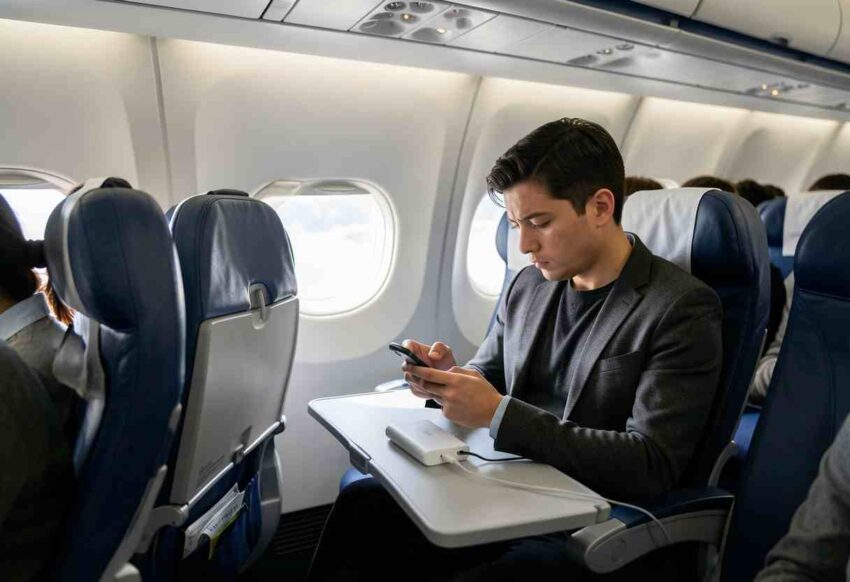
From Japan to Australia: Why More Countries Are Banning In‑Flight Power Bank Use and What Travelers Must Know
From Japan to Australia: Why More Countries Are Banning In‑Flight Power Bank Use and What Travelers Must Know
A rapid increase in lithium battery incidents in aircraft cabins has led to tighter controls on power banks across multiple aviation markets. The use of these devices to charge phones, laptops or other electronics in the air is now being either fully prohibited or heavily restricted by regulators and airlines in several countries. A clear distinction is being drawn between simply carrying power banks on board and actively using them during flight, with the latter increasingly being treated as an unacceptable safety risk.
As a result, passengers are being required to adapt to a new reality in which power banks must be treated as hazardous items rather than convenient travel accessories. These changes are being driven by national aviation authorities such as the Directorate General of Civil Aviation and the Ministry of Land, Infrastructure, Transport and Tourism, as well as by major airline groups in South Korea, Australia, Singapore, Taiwan, Thailand, Malaysia, the United Arab Emirates and Europe. A patchwork of rules is therefore emerging that is creating an increasingly restrictive environment for the in‑flight use of power banks.
Nationwide in‑flight bans: India and Japan
In India, a decisive regulatory stance has been taken by the Directorate General of Civil Aviation. The use of power banks for charging devices during flights has been banned, including the use of seat power outlets for this purpose. Power banks and spare batteries have been allowed only in hand luggage, and their placement in overhead bins has been explicitly disallowed. At the same time, their use at any point during the flight has been prohibited. By applying these rules to all Indian carriers and all flights operating under Indian regulations, a nationwide operational ban on in‑flight power bank use has effectively been put in place.
Japan is moving in a similar direction, although the measure is being introduced on a defined timeline. The Ministry of Land, Infrastructure, Transport and Tourism has planned a ban on the use of power banks on airplanes, with implementation expected as early as April 2026. Under the Japanese framework, passengers will be limited to two power banks per person, and the in‑flight use of these devices will be prohibited on all domestic services as well as on international flights to and from Japan, regardless of airline. Earlier guidance that focused on keeping batteries visible and out of checked baggage is therefore being replaced by a formal, nationwide ban on their use during flight.
De‑facto regional bans: South Korea and Australia
In South Korea, a coordinated shift has been observed at the airline level. All major South Korean carriers, including Korean Air, Asiana Airlines, Jin Air, Air Busan, Air Seoul and T’way Air, have now forbidden the in‑flight use of power banks to charge devices, while continuing to permit their carriage in cabin baggage. Policies commonly require that power banks be kept within reach, such as on the person or in the seat area, and not placed in overhead bins. These devices are expected to remain unused for the entire duration of the flight.
Because the same approach has been adopted across all principal South Korean carriers, the market has effectively become one in which a strict in‑flight use ban is being enforced in practice, even though a single nationwide circular comparable to that of the Directorate General of Civil Aviation has not yet been published. From a passenger’s perspective, South Korea is now functioning as a jurisdiction where power banks may be carried but not used in the air.
A similar trend is being observed in Australia. Based on airline disclosures and national reporting, Qantas, QantasLink and Jetstar have implemented rules under which passengers may carry up to two power banks not exceeding 160 Wh in cabin baggage only, while being barred from using or charging them during flight. Virgin Australia has introduced a comparable framework, allowing power banks solely in cabin luggage, subject to capacity limits, and imposing an explicit prohibition on in‑flight use and charging. Because these airline groups account for the vast majority of commercial passenger operations in the country, Australia has effectively become another key market where all major carriers enforce a strict ban on the in‑flight use of power banks.
Markets with multiple airline‑level bans
Beyond these nationwide or near‑universal markets, a growing number of countries are seeing consistent airline‑level bans on in‑flight power bank use. In Singapore, both Singapore Airlines and its low‑cost arm Scoot permit power banks only in hand luggage, but prohibit their use to charge devices or to be charged mid‑flight. Capacity limits and approval requirements above 100 Wh have also been put in place. As these rules apply across the main full‑service and low‑cost brands based in the country, the Singapore market is now widely regarded as operating under a full in‑flight use ban in practical terms.
In Taiwan, similar restrictions are being implemented. EVA Air and China Airlines allow power banks only in cabin baggage and explicitly ban their use or charging during flights. Starlux Airlines and Tigerair Taiwan have adopted policies that echo this carry‑only, no in‑flight use approach. This consistency across the main Taiwanese carriers means that travellers are being subject to effectively uniform expectations, regardless of the specific airline selected.
Thailand has followed the same general pattern. Under updated dangerous‑goods rules from Thai Airways, power banks may be carried in cabin baggage but must not be used or charged during the flight. In Malaysia, Malaysia Airlines, Firefly and MASwings have permitted power banks solely in the cabin, required that they be kept under the seat rather than in overhead bins, and prohibited their charging in‑flight. Across these markets, a clear shift is being registered from simple carriage restrictions to active bans on use.
Middle East and European airline policies
In the Middle East and Europe, strong positions are also being adopted at airline group level. Emirates has banned the use of power banks on all flights, while continuing to allow only limited‑capacity units in carry‑on baggage. The charging of these devices and their use to power passenger electronics have been prohibited. This stance effectively treats power banks as items that may be transported in a controlled manner but not operated during flight.
Within Europe, Lufthansa Group has moved in the same direction. Lufthansa and some of its subsidiaries have restricted passengers to two power banks and banned their in‑flight use and charging. Clear guidance has also been given that these devices must be kept on the person or in the immediate seat area and not placed in overhead bins. Several other carriers within the group, such as SWISS, have been following similar policies characterised by a strict no‑use approach combined with carriage under defined conditions.
Limits of global standardisation
Despite these converging practices, full global harmonisation has not yet been achieved. The International Civil Aviation Organization and the International Air Transport Association have been issuing guidance on lithium batteries, but a comprehensive global matrix of which countries or airlines ban in‑flight power bank use has not been published. Instead, each regulator and airline has continued to release its own dangerous‑goods policy, creating a fragmented but increasingly restrictive regulatory landscape.
Because of this decentralised system, only measures that can be traced back to a regulator or government notice, such as those of the Directorate General of Civil Aviation and the Ministry of Land, Infrastructure, Transport and Tourism, or to official airline safety pages and well‑established news agencies, can be considered fully verifiable. Many carriers are still updating their rules in anticipation of wider changes linked to international standards expected around 2026. The list of markets with strict in‑flight use bans is therefore likely to expand as further policies are announced.
Key takeaways for travellers
For travellers and travel professionals, a cautious and conservative interpretation of these developments is being recommended. When references are needed to countries that strictly ban the in‑flight use of power banks, India can be safely identified as having a nationwide ban through the Directorate General of Civil Aviation, while Japan can be cited for the Ministry of Land, Infrastructure, Transport and Tourism decision to prohibit in‑flight use from around April 2026 on all flights to, from and within Japan. South Korea and Australia can be described as markets where all major airlines now ban in‑flight use, provided that the relevant carriers and their published rules are referenced rather than a formal statutory ban being claimed.
In practical terms, travellers should be assuming that power banks will be allowed only in cabin baggage, that overhead storage will be discouraged or restricted, and that actual use of these devices during flight will either be banned outright or heavily constrained. By planning around these rules in advance, disruptions at boarding and in the cabin can be reduced, and compliance with the emerging global safety consensus on lithium batteries can be maintained.
The post From Japan to Australia: Why More Countries Are Banning In‑Flight Power Bank Use and What Travelers Must Know appeared first on Travel And Tour World.
Source: travelandtourworld.com



Sorry, the comment form is closed at this time.