


Frozen Paradise: How Legal Wars and Political Limbo Stranded Huatulco’s Biggest Tourism Projects
Frozen Paradise: How Legal Wars and Political Limbo Stranded Huatulco’s Biggest Tourism Projects
Huatulco, the jewel of the Oaxacan coast, was built on a promise: a “Planned Integrated Center” where nature and luxury could coexist. For decades, it was a model of sustainable development. But today, if you walk along the Chahué Marina or peer through the fences of the Tangolunda fairways, you’ll see a different story. You’ll see the “elefantes blancos”—white elephants—of a political and legal war that has left millions of dollars in infrastructure rotting in the Pacific sun.
As of February 2026, two of Huatulco’s most vital tourism assets—the Huatulco Convention Center and the Tangolunda Golf Course—remain paralyzed. These are not failures of the market, nor are they victims of a lack of interest. They are “stranded assets,” caught in a grinding stalemate between private interests, state investigations, and federal ideology.
The Shell on the Shore: The Huatulco Convention Center
In 2019, the vision was grand. An 11,000-square-meter facility was designed to anchor the Chahué Marina, featuring a 1,285-seat auditorium with world-class acoustics. It was meant to be the engine that drove “MICE” tourism (Meetings, Incentives, Conferences, and Exhibitions) to Oaxaca, extending the tourist season into the quiet winter months.
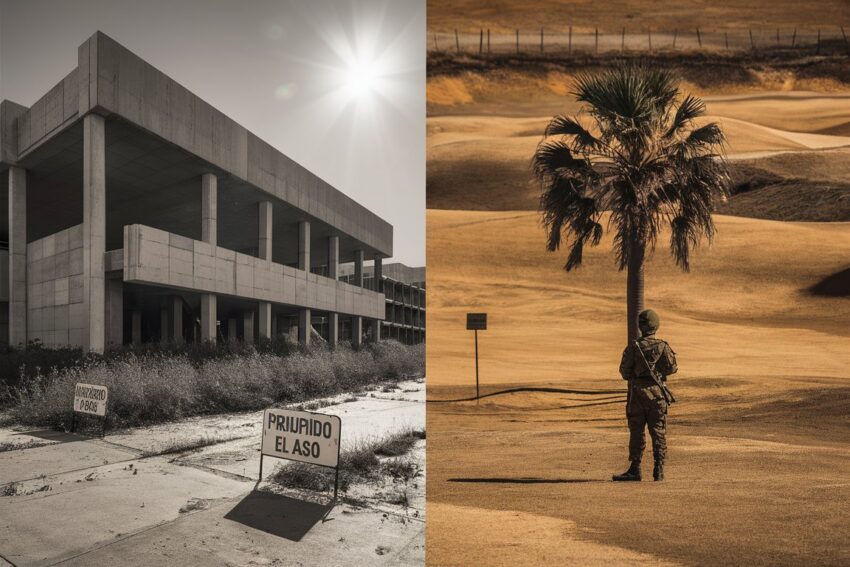
However, the reality is a stark skeletal structure. What began as a 70-million-peso budget ballooned to over 323 million pesos (US $16.1 million) by the time construction hit full swing in 2022. Just 48 hours before his term ended, former Governor Alejandro Murat “inaugurated” the building. It was a ribbon-cutting for a shell: no electricity, no equipment, and no connection to the grid.
Today, the building is no longer a construction site; it is a crime scene. Designated as evidence by the Specialized Anti-Corruption Prosecutor’s Office of Oaxaca, the site is legally immobilized. For the local community, it is a painful symbol of accountability deferred. While the government investigates “irregularities,” the building stands idle, an expensive monument to political transition where justice and development seem to be at odds.
The Fairways of Discord: The Tangolunda Golf Course
Six kilometers to the east lies the Tangolunda Golf Course, an 18-hole green expanse that has become the frontline of a public feud between the federal government and billionaire Ricardo Salinas Pliego.
The dispute reached a boiling point in early 2024 when the federal government refused to renew the concession held by Salinas Pliego’s Grupo Salinas. In a dramatic move, the National Guard was sent in to secure the property after it was declared a National Park by presidential decree.
The government’s argument? The course was a “bad public business” that used more water than the entire population of Huatulco for two years. The counter-argument from Salinas? The government is “rotting and destroying” a vital tourism asset out of spite.
As we move through 2026, the course is in a state of ecological and legal decay. While a judge recently granted a “definitive suspension” against its total closure, the Environment Ministry (SEMARNAT) maintains that the decree still prohibits golf. The result is a brown, drying landscape that serves neither as a world-class resort feature nor as an accessible public park.
The Human Cost of Limbo
For the people of Huatulco, these aren’t just legal filings—they are lost livelihoods. Every year these projects sit frozen represents:
Foregone Employment: Hundreds of jobs in hospitality, maintenance, and event management that simply don’t exist.
Eroding Confidence: Potential investors are wary of a region where a presidential decree or a provincial audit can turn a thriving business into a “stranded asset” overnight.
Lost Revenue: Local businesses—taco stands, boutiques, and transport services—built their business plans around the influx of people these facilities were supposed to bring.
The Path Forward: A New Wave?
Huatulco is currently undergoing a massive transition as FONATUR (the national tourism fund) hands over governance to the State of Oaxaca and the local municipality. This “hand-off” provides a rare window for a pragmatic reset.
President Claudia Sheinbaum has emphasized sustainability and “deepening the transformation.” For Huatulco, this could mean repurposing these assets. Could the Convention Center finally be completed as a community-led cultural hub? Could the golf course be reimagined as a low-impact eco-park that respects water limits while still drawing visitors?
Until a “timely resolution” is found, these projects remain a test of whether Mexican governance can reconcile political accountability with the practical, daily needs of the communities it serves. Huatulco is ready to ride the next wave—it just needs the legal anchors to be lifted.
The post Frozen Paradise: How Legal Wars and Political Limbo Stranded Huatulco’s Biggest Tourism Projects appeared first on Travel And Tour World.
Source: travelandtourworld.com



Sorry, the comment form is closed at this time.