


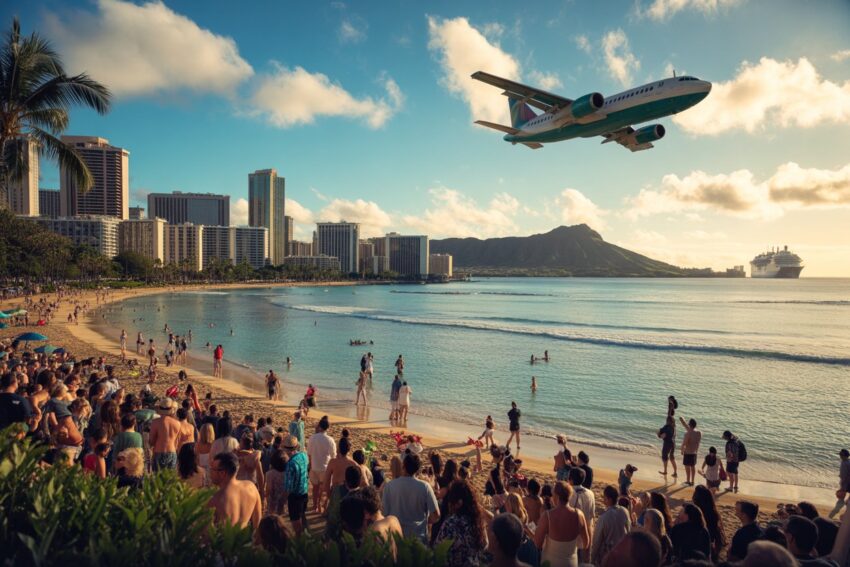
Hawai‘i Tourism Soars: More Than Two Billion USD January Windfall as US Travel Boom Ignites Islands
Hawai‘i Tourism Soars: More Than Two Billion USD January Windfall as US Travel Boom Ignites Islands
Hawai‘i’s tourism economy opened 2026 with emphatic force, as fresh preliminary data from the Department of Business, Economic Development and Tourism (DBEDT) revealed a striking surge in visitor spending, arrivals and hotel occupancy across the islands.
In January 2026 alone, total visitor spending reached $2.26 billion in nominal terms — a powerful 19.0 per cent rise compared to January 2025. This sharp uplift was driven by a 10.4 per cent increase in total arrivals, alongside a notable rise in average daily expenditure. Combined, these indicators point to a travel sector not merely stabilising, but accelerating with renewed confidence.
Visitor Arrivals Break Higher
A total of 874,358 visitors travelled to the Hawaiian Islands in January 2026. Of these, 858,693 arrived by air, primarily from the United States West and East markets. A further 15,665 visitors arrived aboard out-of-state cruise ships.
In January 2025, Hawai‘i welcomed 773,149 air arrivals and 19,028 cruise passengers. While cruise visitation declined by 17.7 per cent year-on-year, the strength of air travel more than compensated, reflecting shifting travel patterns and greater airline seat availability.
Air capacity also expanded. There were 5,219 transpacific flights operating in January 2026, offering 1,162,771 seats — a 3.3 per cent increase in both flights and seats compared to the same month last year. This increase in lift capacity supported the higher inbound numbers and signals sustained airline confidence in Hawai‘i’s core markets.
Spending Power Intensifies
The growth story extends beyond headcounts. Average daily spending rose to $276 per person, marking an 11.3 per cent increase compared to January 2025. Even though visitors stayed slightly fewer days on average — 9.34 days versus 9.65 days last year — the higher daily expenditure more than offset the marginal reduction in trip length.
The statewide average daily census stood at 263,525 visitors, up 6.9 per cent year-on-year. In practical terms, this means more people present in the islands on any given day, fuelling hotels, restaurants, transport operators, retail outlets and entertainment venues.
U.S. West: The Dominant Engine
The U.S. West market emerged as a primary growth driver. In January 2026, 419,156 visitors arrived from western U.S. states — a 13.9 per cent increase compared to January 2025.
These travellers stayed longer, averaging 9.50 days, and spent significantly more on a daily basis. Total spending from this market reached $1.06 billion, a dramatic 30.7 per cent jump from $812 million the previous year.
Daily spending rose from $240 per person in January 2025 to $267 in January 2026. Increases were recorded across all categories, with the largest gains seen in lodging, food and beverage, and transportation. This suggests not only higher prices but also stronger discretionary consumption patterns.
U.S. East: High-Value Growth
Visitor numbers from the U.S. East climbed even more sharply. Hawai‘i welcomed 255,548 visitors from eastern states, up 23.1 per cent year-on-year.
These travellers are among the highest daily spenders. In January 2026, U.S. East visitors spent $312 per person per day, compared with $264 a year earlier — an 18.1 per cent increase. Total spending reached $749.7 million, up 24.6 per cent from $601.8 million in January 2025.
As with the West Coast market, expenditure growth was broad-based. Food and beverage, lodging and transportation recorded the strongest increases, reinforcing the central role of the U.S. mainland in Hawai‘i’s tourism resurgence.
Japan: Stabilising After Long Recovery
The Japanese market, historically one of Hawai‘i’s most important international sources, continued its gradual recovery. Visitor arrivals rose 4.5 per cent to 56,731 in January 2026.
Although Japanese visitors stayed slightly fewer days on average — 5.87 days compared with 6.18 days in January 2025 — their daily spending edged higher to $250 per person. Overall visitor spending totalled $83.2 million, effectively flat compared to last year.
Spending patterns shifted modestly. Japanese travellers spent more on food and beverage, slightly less on lodging and transportation, while shopping and entertainment expenditure remained broadly stable.
Canada: Ongoing Headwinds
In contrast, the Canadian market faced continued challenges. Arrivals fell 8.7 per cent to 49,616 visitors. Total spending declined 10.3 per cent to $134.6 million.
Despite this contraction, daily spending ticked up slightly to $229 per person. Canadians spent less on lodging but more on transportation, shopping, and recreation. Social and political factors were cited as ongoing pressures affecting outbound Canadian travel to Hawai‘i.
Other International Markets
Visitors from all other international markets — including Oceania, Other Asia, Europe, Latin America, Guam, the Philippines and Pacific Islands — totalled 77,641 in January 2026. This represented a 12.6 per cent decline compared with 88,878 visitors in January 2025.
The data reflects a tourism recovery that remains uneven internationally, even as domestic U.S. demand surges.
Maui’s Recovery Momentum
Tourism on Maui continued to rebuild following the devastating August 2023 wildfires. January 2026 data shows meaningful progress.
Total arrivals to Maui reached 236,180 visitors, up 16.7 per cent year-on-year. Visitor spending climbed 24.3 per cent to $664.7 million.
Hotel occupancy in Maui County improved substantially, rising to 71.2 per cent compared with 62.0 per cent in January 2025. Increased arrivals supported by the Maui tourism recovery campaign have played a pivotal role in restoring market confidence.
O‘ahu Maintains Strength
O‘ahu also posted solid gains. Visitor numbers increased 15.3 per cent, while total spending reached $937 million, up 21.4 per cent compared to January 2025.
Hotel occupancy on O‘ahu edged up to 77.9 per cent from 77.7 per cent a year earlier, signalling sustained demand in the state’s most visited island and primary gateway.
A Strong Opening to 2026
January’s results position Hawai‘i’s tourism sector on firm footing at the start of 2026. Growth is being driven primarily by robust U.S. mainland demand, particularly from the West and East coasts, where travellers are staying longer and spending more per day.
While international recovery remains mixed — especially from Canada and several global markets — the steady rebound from Japan and growth from Korea suggest incremental improvement abroad.
With expanded air capacity, rising occupancy rates and strengthening consumer spend, Hawai‘i’s visitor industry appears to be entering 2026 with renewed resilience and economic momentum.
The post Hawai‘i Tourism Soars: More Than Two Billion USD January Windfall as US Travel Boom Ignites Islands appeared first on Travel And Tour World.
Source: travelandtourworld.com



Sorry, the comment form is closed at this time.