


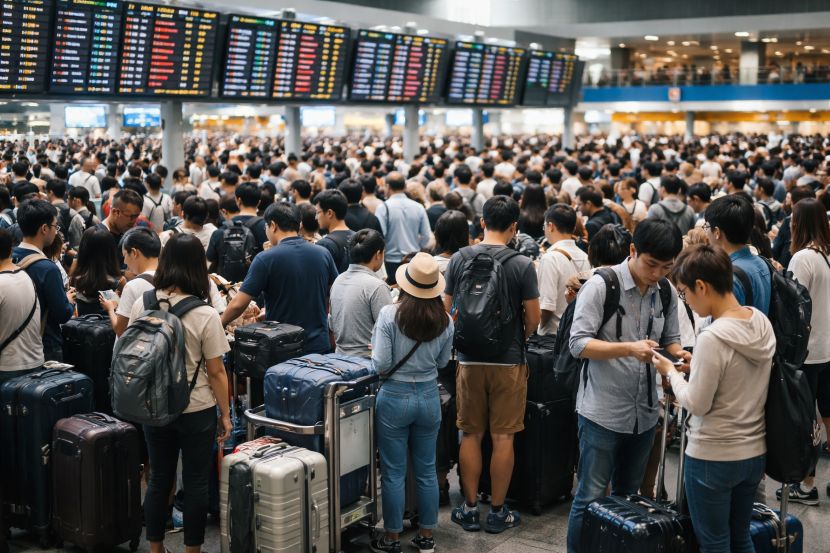
Hundreds of Passengers Left Stranded as Japan Airlines, ANA, Korean Air and Jeju Air Face 538 Delays and 55 Cancellations, Disrupting Travel in Tokyo, Sapporo, Fukuoka, Kushiro and Seoul
Hundreds of Passengers Left Stranded as Japan Airlines, ANA, Korean Air and Jeju Air Face 538 Delays and 55 Cancellations, Disrupting Travel in Tokyo, Sapporo, Fukuoka, Kushiro and Seoul
Japan and South Korea faced major air travel disruptions today. The airports that are experiencing the most flight cancellations and delays are Narita and New Chitose, and those in Fukuoka, Kushiro, and South Korea’s Incheon. These major delays are happening for both domestic and international flights in and out of Tokyo, Sapporo, Fukuoka, and Kushiro.
Japan’s Ministry of Land, Infrastructure, and Transport and South Korea’s Ministry of Land, Infrastructure and Transport are the governments that manage the data referenced. After disruptions have been reported, the airports and airlines are continuing to manage the flow of passengers.
Major Asian Airports Record Delays and Cancellations
The largest concentration of disruptions occurred at several busy airports in East Asia.
At Narita International Airport, one of Japan’s primary gateways for international travel, 112 flights were delayed while 7 flights were cancelled. Narita handles a large volume of long-haul international flights linking Japan with North America, Europe, and other Asian destinations, making operational delays particularly noticeable for global travelers.
Further north in Hokkaido, New Chitose Airport, the main airport serving Sapporo, reported 77 delayed flights and 23 cancellations. This airport is an important hub for domestic travel within Japan and also supports a growing number of international routes.
In southern Japan, Fukuoka Airport, one of the busiest airports in the Kyushu region, recorded 133 flight delays and 6 cancellations. Fukuoka is a key regional gateway connecting Japan with destinations across East Asia.
Smaller but still significant disruptions were reported at Kushiro Airport in Hokkaido, which experienced 3 delayed flights and 13 cancellations, affecting regional air connectivity.
Across the Sea of Japan, Incheon International Airport in Seoul, South Korea’s largest airport and one of Asia’s major global transit hubs, reported 213 delayed flights and 6 cancellations, making it the most heavily affected airport among those listed.
Airlines Operating Through the Affected Airports
A wide range of domestic and international airlines operate through these airports. Carriers typically present at these hubs include Japanese airlines such as Japan Airlines, All Nippon Airways, Peach Aviation and Jetstar Japan, along with international airlines from across Asia, Europe, and North America.
At Incheon International Airport, airlines such as Korean Air, Asiana Airlines, Jeju Air, T’way Air, and many international carriers operate extensive networks linking Seoul to global destinations.
Because these airports serve as critical connection points in Asia’s aviation network, disruptions can spread across airline schedules, affecting both inbound and outbound flights.
Affected Cities and Travel Corridors
The disruptions have impacted several major cities and tourism centers in East Asia:
Tokyo, Japan – served by Narita International Airport
Sapporo, Hokkaido, Japan – served by New Chitose Airport
Fukuoka, Japan – served by Fukuoka Airport
Kushiro, Hokkaido, Japan – served by Kushiro Airport
Seoul, South Korea – served by Incheon International Airport
These cities are among the most important travel destinations in the region, attracting millions of domestic and international tourists annually.
Estimated Passenger Impact
Airports such as Narita and Incheon handle tens of thousands of passengers daily, according to operational statistics published by MLIT and MOLIT. With hundreds of flights experiencing delays across multiple airports, thousands of passengers are likely to have experienced schedule disruptions including longer wait times, missed connections, or flight rebookings.
While airport authorities and airlines generally implement contingency plans during operational disruptions, even limited cancellations can significantly affect travelers during peak travel periods.
Passengers are often advised to monitor airline notifications, check airport information systems, and allow extra time for airport procedures during periods of operational disruption.
Implications for Tourism and Travel Planning
Japan and South Korea are among Asia’s most visited destinations, and air connectivity plays a crucial role in sustaining tourism flows. Cities like Tokyo, Seoul, Sapporo, and Fukuoka rely heavily on international arrivals and domestic air travel to support tourism, hospitality, and business activity.
Short-term disruptions at airports can create temporary uncertainty for travelers planning trips to these destinations. However, aviation authorities in both countries maintain strong operational frameworks designed to restore normal flight schedules as quickly as possible.
Government aviation agencies continue to emphasize passenger safety, operational transparency, and coordination with airlines and airport operators to manage such disruptions.
Aviation Authorities Monitor Operations
Authorities such as Japan’s MLIT Civil Aviation Bureau and South Korea’s MOLIT aviation division oversee airport operations and air traffic systems to ensure aviation safety and operational stability. These agencies regularly publish operational guidelines and airport statistics through official government portals.
Air traffic management systems and airport coordination centers play a key role in managing congestion and minimizing cascading delays when disruptions occur.
Conclusion
There have been recent operational challenges at Narita, New Chitose, Fukuoka, Kushiro, and Incheon airports, and seeing how quickly it leads to a cascade effect for the rest of the East Asia aviation network is a good indicator of how integrated these airports are. Hundreds of flights were affected, and travelers in East Asia, and northern South Korea, had to continuously adjust their flights throughout the day.
Challenges of this nature are to be expected and both the authorities in aviation as well as the airlines are able to work on re-establishing the system as it is required to provide the safety standards for air travel. Air travel demand is strong even at this point and with sufficient collaboration between the authorities of the states in question, the airlines, and the airport managers, air travel would be able to be made as uncomplicated as possible for travelers in the East Asia region.
Source: FlightAware
The post Hundreds of Passengers Left Stranded as Japan Airlines, ANA, Korean Air and Jeju Air Face 538 Delays and 55 Cancellations, Disrupting Travel in Tokyo, Sapporo, Fukuoka, Kushiro and Seoul appeared first on Travel And Tour World.
Source: travelandtourworld.com


Sorry, the comment form is closed at this time.