


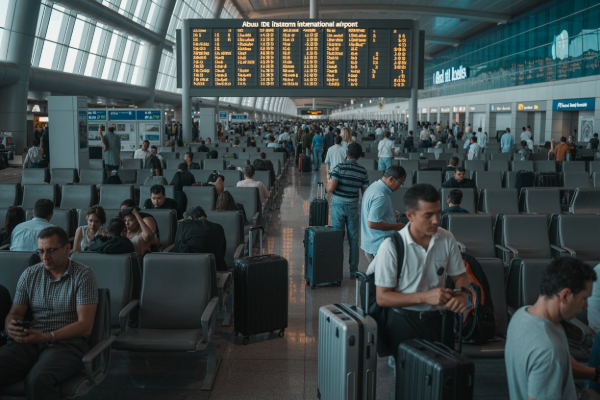
Hundreds Of Passengers Stranded At Abu Dhabi International Airport As Ethiad Airways, Gulf Air, Royal Jordanian, Air Arabia, Qatar Airways Cancel 60 Flights And Delay 37 Others In Muharraq, Amman, Sharjah, Doha, Showing Its Ripple Effects On Travel Connectivity Across UAE, Bahrain, Jordan, Qatar And More
Hundreds Of Passengers Stranded At Abu Dhabi International Airport As Ethiad Airways, Gulf Air, Royal Jordanian, Air Arabia, Qatar Airways Cancel 60 Flights And Delay 37 Others In Muharraq, Amman, Sharjah, Doha, Showing Its Ripple Effects On Travel Connectivity Across UAE, Bahrain, Jordan, Qatar And More
Large-scale flight disruptions at Abu Dhabi International Airport have left hundreds of passengers stranded after several airlines cancelled flights and delayed dozens more across key Middle Eastern aviation hubs.
Airlines including Etihad Airways, Gulf Air, Royal Jordanian, Air Arabia, and Qatar Airways have been impacted by the disruptions.
Flight monitoring data from FlightAware shows around 60 cancellations connected to Abu Dhabi along with 37 flight delays affecting regional routes.
The disruptions have also impacted important regional airports including Bahrain International Airport, Queen Alia International Airport, Sharjah International Airport, and Hamad International Airport.
Together, these disruptions are creating ripple effects across travel connectivity throughout United Arab Emirates, Bahrain, Jordan, and Qatar.
Major Disruptions Recorded at Abu Dhabi’s Main Aviation Hub
The center of the disruption remains Abu Dhabi International Airport, the main operating hub for Etihad Airways.
Flight tracking records indicate that several Etihad flights scheduled to depart from or arrive in Abu Dhabi were cancelled.
Examples from FlightAware’s cancellation database include services connecting Abu Dhabi with major international destinations such as Manchester, Barcelona, Amsterdam, Islamabad, Ahmedabad, and Cairo.
These routes form part of Etihad’s global network linking the Middle East with Europe, Asia, and Africa.
When multiple flights on such routes are cancelled, the disruption quickly spreads across international travel itineraries.
Passengers waiting inside Abu Dhabi’s terminal reported constant schedule changes and extended waiting times as departure boards updated throughout the day.
Airport service counters became crowded as travelers attempted to rebook flights or find alternative routes.
37 Flight Delays Compound Travel Chaos
While cancellations drew the most attention, flight delays also contributed heavily to passenger disruption.
According to aviation monitoring data, 37 flights were delayed across the affected regional network.
Delays ranged from short operational adjustments to several hours.
Such delays are often caused by aircraft rotation issues, late arrivals from previous routes, or restrictions in regional airspace.
Because many aircraft operate multiple segments each day, a delayed arrival often pushes the next scheduled departure later.
This chain reaction spreads delays throughout the airline network.
For passengers connecting through Abu Dhabi, even a delay of one or two hours can result in missed onward flights.
Regional Airports in Muharraq, Amman, Sharjah and Doha Also Affected
The disruption has extended beyond Abu Dhabi to several important Middle Eastern airports.
Flights connected to Bahrain International Airport in Muharraq have been affected, impacting operations of Gulf Air.
This airport serves as Bahrain’s main international gateway and connects travelers to destinations across Asia, Europe, and the Middle East.
In Jordan, operations linked to Queen Alia International Airport in Amman experienced disruptions affecting Royal Jordanian flights.
Queen Alia Airport handles the majority of Jordan’s international passenger traffic.
At Sharjah International Airport, several flights operated by Air Arabia experienced delays or schedule adjustments.
Sharjah’s airport serves as a major hub for low-cost travel across South Asia, Central Asia, and the Middle East.
Meanwhile, flights connected to Hamad International Airport in Doha—the main hub for Qatar Airways—also reported delays and operational adjustments.
Hamad International Airport is widely regarded as one of the world’s busiest transit hubs.
Even small operational disruptions there can affect long-haul connections between Europe, Asia, Africa, and Australia.
Global Aviation Network Feels the Ripple Effect
The Middle East functions as a central bridge in global aviation.
Airports such as Abu Dhabi, Doha, and Bahrain act as transfer hubs linking continents.
Millions of passengers each year use these airports to connect flights between Europe and Asia.
When cancellations occur at these hubs, the disruption quickly spreads through international travel networks.
For example, a traveler flying from London to Sydney via Abu Dhabi may miss their onward connection if the first flight is delayed.
Similarly, a passenger traveling from India to Europe via Doha may face hours of delay if the connecting flight is cancelled.
This interconnected system means that a disruption in one city can affect travelers thousands of kilometers away.
Airlines Adjust Schedules to Manage Operational Challenges
Airlines across the region have begun adjusting their schedules to manage the situation.
Etihad Airways has cancelled or rescheduled several flights linked to Abu Dhabi.
Gulf Air has modified operations connected to Bahrain International Airport.
Royal Jordanian flights through Amman have also faced adjustments.
Air Arabia flights from Sharjah have experienced delays due to network disruptions.
Qatar Airways has adjusted some operations through Doha while monitoring regional aviation conditions.
Airlines are working to rebook affected passengers and restore schedules as quickly as possible.
However, available seats on replacement flights remain limited during peak disruption periods.
Hundreds of Passengers Left Waiting Inside Airport Terminals
For travelers, the disruption has created hours of uncertainty.
Many passengers at Abu Dhabi airport reported waiting for extended periods while airline staff processed rebooking requests.
Transit passengers faced additional complications because their journeys involved multiple connecting flights.
Hotels near the airport also reported increased demand from travelers forced to stay overnight.
Airport authorities deployed additional staff to assist passengers with information and customer support.
Despite these efforts, the sudden nature of cancellations created significant congestion at airline counters.
Why Aviation Disruptions Spread So Quickly in the Gulf
The Middle East aviation network relies heavily on hub-and-spoke systems.
In this system, airlines route passengers through major hubs before sending them onward to final destinations.
This model allows airlines to connect hundreds of cities efficiently.
However, it also means disruptions spread rapidly.
A delayed aircraft arriving from Europe may affect a connecting flight to Asia.
Similarly, crew scheduling changes can impact multiple flights scheduled later in the day.
Because aircraft rotations are tightly planned, even a small operational disruption can escalate quickly.
What Travelers Should Do Next
Travel experts recommend several precautions for passengers planning trips through Middle Eastern hubs.
Travelers should always check flight status before leaving for the airport.
Using airline apps and real-time tracking services can provide early warnings about cancellations.
Passengers should also allow longer connection times when booking flights through major transit hubs.
Flexible tickets can help travelers adjust plans without heavy penalties if schedules change unexpectedly.
Travel insurance can also offer financial protection during major disruptions.
For travelers planning non-essential trips, postponing travel to the Middle East may be a practical option until airline schedules stabilize.
Because the region functions as a global aviation crossroads, disruptions can quickly affect multiple airlines and destinations.
By monitoring airline updates, planning flexible itineraries, and choosing alternative routes where possible, travelers can reduce the risk of being caught in unexpected flight cancellations and delays.
The post Hundreds Of Passengers Stranded At Abu Dhabi International Airport As Ethiad Airways, Gulf Air, Royal Jordanian, Air Arabia, Qatar Airways Cancel 60 Flights And Delay 37 Others In Muharraq, Amman, Sharjah, Doha, Showing Its Ripple Effects On Travel Connectivity Across UAE, Bahrain, Jordan, Qatar And More appeared first on Travel And Tour World.
Source: travelandtourworld.com



Sorry, the comment form is closed at this time.