


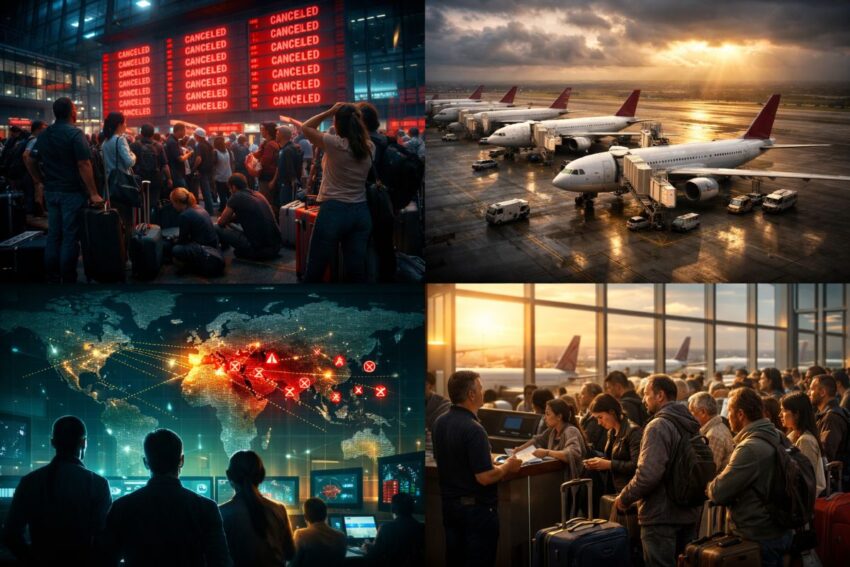
Hundreds of Thousands of Passengers Stuck as Qatar Airways Cancels 497 Flights and Delays 5 at Doha, Dubai, and Sharjah Airports, Leading to Travel Disruptions in Qatar, the United Arab Emirates, Saudi Arabia, Oman, and Many Other Countries: All You Need To Know
Hundreds of Thousands of Passengers Stuck as Qatar Airways Cancels 497 Flights and Delays 5 at Doha, Dubai, and Sharjah Airports, Leading to Travel Disruptions in Qatar, the United Arab Emirates, Saudi Arabia, Oman, and Many Other Countries: All You Need To Know
Due to the ongoing regional conflict and related missile and drone threats, civil aviation authorities across the Middle East have restricted or closed key airspaces, leading to significant disruptions in air travel. Notices to Airmen (NOTAMs) and safety bulletins highlight the heightened risk to civilian aircraft from missile strikes, interception operations, and falling debris, prompting operators to either avoid or severely limit the use of specific flight regions. In response, numerous airlines have canceled large numbers of flights, while others are operating only limited relief and repatriation services, authorized by the relevant aviation authorities.
Qatar’s airspace has been closed, and Qatar Airways has announced that its scheduled flights will remain temporarily suspended until the Qatar Civil Aviation Authority confirms it is safe to reopen the airspace. Similar measures have been implemented or recommended in surrounding countries, with Indian and regional regulators advising airlines to avoid several Middle Eastern airspaces during the peak of the crisis.
Qatar Airways: A Network in Suspension
Qatar Airways, typically one of the world’s most connected carriers, has been uniquely impacted by the total closure of its home airspace. Official statements from the airline confirm that scheduled commercial operations were halted on March 1, 2026. While the carrier reported a staggering peak cancellation rate of over 80% earlier in the week, it has since pivoted to “humanitarian mode.”
As of March 7 and 8, the airline has begun coordinating a limited number of special relief flights. These services are operating out of alternative hubs like Muscat and Riyadh to transport the most vulnerable stranded passengers to London, Rome, Paris, and Frankfurt. However, the airline has issued a strict advisory: travelers must not proceed to any airport unless they have received a direct, verified notification of a confirmed seat on a relief mission.
The Logistics of a Global Diversion
The operational strain on the aviation industry is unprecedented. Under normal conditions, a flight from London to Singapore would traverse the now-closed Iranian or Iraqi airspace. Today, that same flight must either swing north over the Caucasus and Central Asia or south across the Red Sea and Egypt.
This rerouting has several critical consequences:
Fuel Constraints: The extended flight times require significantly more fuel, often exceeding the maximum takeoff weight of certain aircraft types.
Crew Fatigue: Flight crews are reaching their legal “duty hours” before reaching their destinations, necessitating unscheduled stops in cities like Warsaw or Budapest.
Economic Impact: Global oil prices have surged due to the conflict, with Brent crude reaching over $85 per barrel, further inflating the operational costs for airlines already struggling with logistics.
Legal Rights and Passenger Protection
For those caught in the chaos at European airports, the European Flight Compensation Regulation (EU261) remains the primary shield. Even though the conflict is classified as “extraordinary circumstances”—meaning airlines are generally exempt from paying fixed cash compensation—the “Duty of Care” remains absolute.
Under these regulations, airlines are legally obligated to provide:
Sustenance: Vouchers for food and drinks appropriate to the length of the delay.
Communication: Access to phone calls or emails.
Accommodation: Hotel rooms and transportation if an overnight stay is required.
Government websites across the EU have reiterated that airlines cannot waive these responsibilities, regardless of the cause of the disruption. Passengers are encouraged to keep all receipts for essential expenses to claim reimbursement later.
While there are reports of some airspace corridors in the UAE cautiously reopening, the core conflict zone remains volatile. The International Air Transport Association (IATA) suggests that even if a ceasefire were declared today, it would take at least 10 to 14 days to reposition aircraft and crews to resume a standard global schedule.
Travelers are urged to maintain constant contact with their carriers through official apps and to verify any “Relief Flight” offers against government-verified portals to avoid misinformation during this high-stress period.
Here are three separate tables reproducing the information in the screenshot, cleaned and aligned.
By airline
AirlineCancelled #Cancelled %Delayed #Delayed %Qatar Airways49783%50%IndiGo1074%713%Gulf Air9770%00%FlyDubai8023%3710%Delta Air Lines6513%802%SkyWest572%471%PSA Airlines (AAL)445%20%United341%250%Emirates203%6512%American Airlines200%431%Spirit193%91%Saudia183%264%Mesa (UAL)177%00%WestJet Encore169%53%Egypt Air164%153%WestJet145%62%Commuter Air (UAL)183%21%El Al121%51%KLM121%163%Oman Air116%2012%SpiceJet106%00%British Airways108%97%Royal Jordanian91%689%Air India912%00%interCaribbean Airways92%10%Pegasus Airlines87%51%Sichuan Airlines810%526%
Qatar Airways has temporarily suspended most of its scheduled passenger and cargo flights after Qatari airspace was closed due to a sharp rise in regional security risks. The closure comes in response to heightened tensions and military activity in parts of the Middle East, including missile and drone strikes that could threaten civilian aircraft. Because the airline’s global network is built around its hub in Doha, shutting the airspace effectively freezes normal operations to and from Qatar.
The carrier has stated that it will not return to its usual timetable until national aviation authorities confirm that the airspace is safe for commercial overflights and landings. Until that safety assurance is given, only a very limited number of specially approved services can operate.
Why the Civil Aviation Regulator’s Role Is Crucial
In Qatar, decisions on when and how to open or close airspace rest with the national civil aviation regulator. This authority is responsible for assessing military activity, tracking potential threats, coordinating with international air‑traffic management bodies, and deciding whether routes are safe for civilian use.
Qatar Airways has made clear that it is following those regulatory instructions. The airline cannot unilaterally resume normal flying: it must wait for formal clearance that key approach paths and overflight corridors no longer pose unacceptable risk. The same process is being followed by other states in the region, some of which have also restricted or closed their skies during the current crisis.
Because the Gulf region is a major crossroads between Europe, Asia, and Africa, these regulatory decisions have global consequences. When authorities impose restrictions, airlines must rapidly redesign routes, cancel flights, or suspend operations altogether.
Destination airport (IATA)Cancelled #Cancelled %Delayed #Delayed %Hamad Int’l (DOH)27474%10%Dubai Int’l (DXB)9415%7712%Bahrain Int’l (BAH)5559%00%Houston Bush Int’l (IAH)538%121%Dallas–Fort Worth (DFW)423%382%Hartsfield–Jackson ATL (ATL)327%353%King Khalid Int’l (RUH)339%92%Abu Dhabi Int’l (AUH)2911%91%Chicago O’Hare Int’l (ORD)221%292%Ben Gurion Int’l (TLV)198%00%Chhatrapati Shivaji Int’l (BOM)173%214%Amsterdam Schiphol (AMS)162%313%King Abdulaziz Int’l (JED)156%73%Calgary Int’l (YYC)153%73%Cairo Int’l (CAI)153%51%Detroit Metro Wayne Co (DTW)159%10%King Fahd Int’l (DMM)151%91%Kuwait Int’l (KWI)1415%00%Indira Gandhi Int’l (DEL)141%415%London Heathrow (LHR)121%152%Seeb Int’l (MCT)119%141%Queen Alia Int’l (AMM)1111%40%Reagan National (DCA)91%41%Montreal–Trudeau (YUL)95%31%Cochin Int’l (COK)93%30%Denver Int’l (DEN)85%20%Sardar Vallabhbhai Patel (AMD)85%31%
Limited Relief Flights Using Safe Corridors
Although the regular schedule is on hold, Qatar Airways has begun operating a handful of relief flights through corridors that have been assessed as safe and approved by regulators. These flights are focused on helping stranded passengers reach Doha and then connect to a few key destinations.
For example, some relief services have been arranged from nearby regional cities such as Muscat and Riyadh, with onward flights from Doha to major European hubs including London, Berlin, Copenhagen, Madrid, Rome, Amsterdam, and Frankfurt. These operations are tightly controlled: each flight requires specific authorization, and the airline cannot simply open bookings to the general public.
Seats on relief flights are limited, and priority is typically given to travellers whose journeys were disrupted when the airspace closed—such as those who were already in transit, holding near‑term tickets, or needing to return home. Passengers are advised not to go to the airport unless they have a confirmed seat on one of these flights and have received direct notification from the airline or their travel agent.
How Qatar Airways Is Supporting Impacted Passengers
Qatar Airways has emphasised that passenger safety is its primary concern and that its staff are engaged in around‑the‑clock efforts to assist affected customers. Additional teams have been deployed at Hamad International Airport and at major outstations to manage passenger flows, coordinate rebookings, and provide information.
Depending on the type of ticket and the specific circumstances, passengers are generally being offered several options:
Rebooking for a later date once flights resume, subject to available seats on the chosen route.
Rerouting through other hubs or carriers where alternative safe routings exist and interline agreements allow.
Refunds or travel credits, especially where the airline has issued special waivers recognising the extraordinary nature of the disruption.
Travellers who booked via third‑party agents or online platforms usually must work with those intermediaries, as they control the original ticket. Direct bookings with Qatar Airways can be managed through the airline’s website, mobile app, call centres, or ticket offices. In all cases, the carrier is urging customers to use official channels only, as this helps them process requests efficiently and reduces the risk of misinformation.
Government Travel Advice and Passenger Safety
Several governments have updated their travel advisories for parts of the Middle East, warning citizens about the volatile security situation and advising against non‑essential travel to certain countries. These advisories are based on assessments by foreign ministries, defence departments, and security agencies, and they feed into the risk calculations made by civil aviation regulators.
For passengers, this means two things. First, they should always check their own government’s official travel advice before planning journeys to or through the region. Second, they should understand that advisories and airspace restrictions can change quickly, sometimes with only a few hours’ notice. A route that is available today may be suspended tomorrow if the situation deteriorates.
Because of this uncertainty, travellers are encouraged to build flexibility into their plans: allow longer connection times, consider fully changeable fares if travel is essential, and make sure they have travel insurance that clearly covers conflict‑related disruption where available.
The shutdown of Qatari airspace is part of a broader wave of interruptions affecting airlines around the Middle East. Carriers based in neighbouring states have cancelled or rerouted hundreds of flights as they avoid areas of potential conflict or comply with new regulations. On some days, reports indicate that more than 700 flights across multiple airlines and airports have been cancelled or severely delayed.
Qatar Airways, as one of the largest global carriers, plays a central role in linking Europe, Asia, Africa, and Oceania. When its network is constrained, ripple effects spread through global aviation: connection options shrink, journey times increase, and other hubs become more crowded as they absorb diverted traffic. Even when restrictions begin to ease, it takes time for airlines to reposition aircraft and crew, rebuild schedules, and clear the backlog of disrupted itineraries.
Travellers should therefore expect that, even after Qatari airspace reopens, timetables may change with little notice and certain frequencies could be reduced for a period while operations stabilise.
Practical Steps for Affected Travellers
For anyone holding a Qatar Airways ticket during this disruption, several practical steps can reduce stress and improve the chances of smooth re‑accommodation:
Keep contact details in the booking up to date so the airline can reach you with rebooking offers or information about relief flights.
Regularly check the airline’s official travel alert pages or app rather than relying on social media posts or unofficial websites.
If your trip is not urgent, consider voluntarily postponing travel until the situation becomes more stable and a normal schedule has been restored.
If you must travel, work with your airline or travel agent to explore alternative routings through hubs that remain fully operational.
Corporate travel managers should review company policies on duty of care, ensure travellers are registered with their embassy’s alert systems where available, and maintain clear internal lines of communication so staff know who to contact if plans change unexpectedly.
Looking Ahead: When Might Normal Flights Resume?
The key factor determining when Qatar Airways can fully resume operations is the safety assessment made by the national civil aviation authority and allied air‑traffic management bodies. Once they conclude that missile and drone threats no longer pose unacceptable risks and that reliable de‑confliction mechanisms are in place, they can authorise the reopening of airspace and major routes.
Qatar Airways has committed to providing regular updates, often at a set time each day, so passengers and partners can plan around the latest information. However, until the regulator confirms that it is safe to reopen key corridors, the airline’s network will remain significantly reduced.
For now, passengers should prepare for an extended period of uncertainty, stay closely informed through official channels, and prioritise flexibility over rigid travel plans. When services eventually return to normal, they will do so under the guidance of regulators whose primary mission is to ensure that every flight through the region’s skies is as safe as possible.
The post Hundreds of Thousands of Passengers Stuck as Qatar Airways Cancels 497 Flights and Delays 5 at Doha, Dubai, and Sharjah Airports, Leading to Travel Disruptions in Qatar, the United Arab Emirates, Saudi Arabia, Oman, and Many Other Countries: All You Need To Know appeared first on Travel And Tour World.
Source: travelandtourworld.com



Sorry, the comment form is closed at this time.