


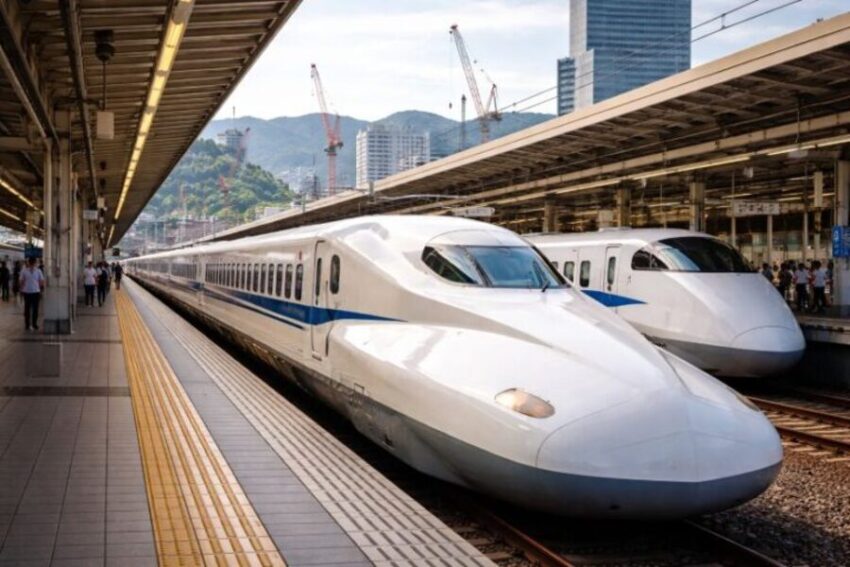
India to Revolutionize Rail Travel with Sixteen New Bullet Trains and Japan Shinkansen Partnership
India to Revolutionize Rail Travel with Sixteen New Bullet Trains and Japan Shinkansen Partnership
India is set to revolutionize rail travel with the introduction of sixteen new bullet trains, a significant leap toward modernizing its transport infrastructure. This ambitious project will be powered by a key partnership with Japan, bringing in advanced Shinkansen technology to enhance the country’s high-speed rail capabilities. The new bullet trains will primarily serve the Mumbai-Ahmedabad corridor, drastically reducing travel times and offering passengers an upgraded, efficient travel experience. With Japan’s expertise and financial support, this collaboration positions India at the forefront of high-speed rail innovation, marking a bold step in the nation’s commitment to transforming its transportation landscape.
India is accelerating its move towards high-speed rail travel with the announcement of plans to acquire 16 domestically produced bullet trains. These trains will serve the Mumbai-Ahmedabad High-Speed Rail (MAHSR) corridor, a landmark 508-kilometre project, further enhancing the nation’s railway infrastructure. The project will also be complemented by two E-5 Shinkansen trains from Japan, expected to arrive between 2029 and 2030.
India’s Vision for High-Speed Rail: Transforming Travel
The MAHSR corridor, which will link Mumbai and Ahmedabad, is set to transform travel in India. With speeds exceeding 250 km/h, these trains will align with global standards like the French TGV and the Japanese Shinkansen. The corridor will provide passengers with a faster, more comfortable, and reliable mode of transport between two major economic hubs, significantly reducing travel time.
Japan’s financial and technical support plays a crucial role in the project, with JICA providing Rs 59,396 crore in soft loans since 2017. The partnership brings Japanese expertise to India, with Shinkansen engineers collaborating with the National High-Speed Rail Corporation Limited (NHSRCL) to ensure the success of this ambitious initiative.
Steady Progress: Infrastructure and Station Development
As part of the development, foundation works have been completed at eight out of the 12 planned stations. This progress reflects the strong collaboration between India and Japan, keeping the project on track. Recent evaluations have expressed satisfaction with the pace of construction, signaling efficient and committed progress towards launching India’s first high-speed rail system.
Manufacturing and Technological Advancements in India
In line with India’s push for self-reliance, the country is focusing on local manufacturing of bullet trains. BEML, a defense public sector undertaking, is tasked with producing the rolling stock for the project. The new trains will operate at a speed of 280 km/h, with two fully air-conditioned chair car configuration trains being built at BEML’s Bengaluru facility. These trains are scheduled for delivery by the end of 2026.
The cost of each trainset stands at Rs 866.87 crore, with each coach priced at Rs 27.86 crore. These figures encompass design, development, and testing, ensuring that the trains adhere to international standards of safety, comfort, and operational efficiency. The domestically manufactured bullet trains are a significant step towards enhancing India’s capabilities in high-speed rail production.
Expanding India’s High-Speed Rail Network
The Mumbai-Ahmedabad corridor is just the beginning. In the Budget 2026-27, plans for seven additional bullet train corridors were announced, signaling India’s commitment to expanding its high-speed rail network. These new corridors will further enhance connectivity across the country, offering faster, greener, and more efficient alternatives to long-distance travel.
The project is also accelerating India’s expertise in rail technology, including track construction, advanced signaling systems, and the manufacture of rolling stock. The successful completion of the MAHSR corridor will provide a valuable blueprint for future high-speed rail developments in India.
A Bright Future for India’s Railways
India’s growing high-speed rail network represents a monumental shift in the nation’s transportation infrastructure. The introduction of 16 new domestically made bullet trains, coupled with the arrival of Shinkansen technology, will redefine the travel experience for millions of Indians. This modernized rail system is not only a boost to the country’s infrastructure but also a step towards creating a more sustainable, efficient, and future-ready transportation ecosystem.
India is set to revolutionize rail travel with the introduction of sixteen new bullet trains for the Mumbai-Ahmedabad corridor, powered by a key partnership with Japan and advanced Shinkansen technology, drastically improving travel speed and efficiency.
As India continues to push forward with its high-speed rail plans, the collaboration with Japan and the focus on self-reliance are propelling the nation towards a new era of connectivity. With the first high-speed trains on track to begin operating in the coming years, India’s commitment to creating a state-of-the-art, world-class railway system is clearer than ever.
The post India to Revolutionize Rail Travel with Sixteen New Bullet Trains and Japan Shinkansen Partnership appeared first on Travel And Tour World.
Source: travelandtourworld.com



Sorry, the comment form is closed at this time.