


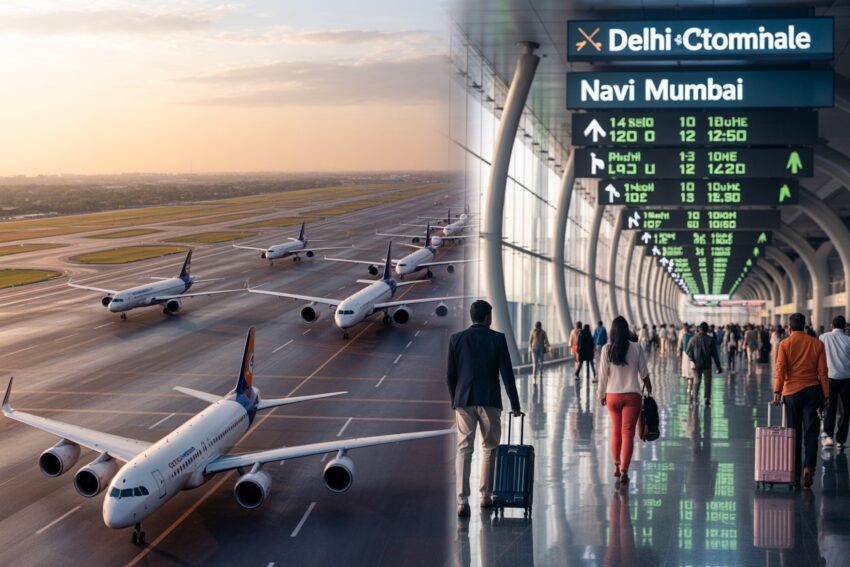
India’s Alternate Airports to Reach Forty Million Passenger Capacity by 2026, Driving Multi-Airport Tourism Growth
India’s Alternate Airports to Reach Forty Million Passenger Capacity by 2026, Driving Multi-Airport Tourism Growth
A New Multi-Airport Era for India’s Fast-Growing Aviation Market
India’s aviation sector is entering a structural transformation as alternate airports across major metro regions are projected to collectively handle around 40 million passengers annually by the end of 2026. According to a Crisil Ratings analysis, this capacity could further expand to 45–50 million passengers by fiscal 2030 as additional infrastructure becomes operational and airline connectivity strengthens.
These alternate airports — developed alongside space-constrained metro hubs — are designed to ease congestion and unlock latent travel demand. Located in regions such as the Delhi National Capital Region, the Mumbai Metropolitan Region, and Goa, they represent a strategic shift toward a multi-airport system that could redefine tourism flows across India.
With overall passenger traffic forecast to rise sharply over the next decade, these new facilities are not merely supplementary assets — they are becoming central pillars of India’s travel and tourism growth strategy.
Understanding “Alternate Airports” in India’s Aviation Strategy
Alternate airports are secondary or newly operational facilities built within the same metropolitan region as established primary hubs. Their core function is to redistribute traffic, relieve capacity bottlenecks, and accommodate long-term passenger growth.
Delhi NCR: Expanding Beyond IGI
The Delhi National Capital Region has historically relied on Indira Gandhi International Airport as its primary aviation gateway. Operating near saturation with utilisation around 87%, expansion options are limited by land constraints.
To address this, the upcoming Noida International Airport in Jewar is being developed as a complementary hub. Once operational, it is expected to significantly redistribute traffic across the NCR, particularly for domestic and regional routes.
Mumbai Metropolitan Region: Navi Mumbai’s Role
In western India, Chhatrapati Shivaji Maharaj International Airport faces similar capacity pressures. The long-awaited Navi Mumbai International Airport aims to ease congestion, enhance international connectivity, and stimulate tourism across Maharashtra.
Goa’s Dual-Airport Model
Goa’s tourism-driven aviation landscape now operates under a dual-airport system with the new Manohar International Airport complementing the older Dabolim facility. The shift reflects growing inbound tourism demand and the need for diversified capacity.
Metro Airport Saturation: Why Expansion Is Urgent
India’s metro airports have been operating close to their design limits. Utilisation levels approaching 87% at major hubs leave little room for operational flexibility.
Land acquisition challenges and urban density make the physical expansion of legacy airports increasingly difficult. Without alternate facilities, India risks:
Slot shortages are limiting airline expansion
Delays affecting passenger satisfaction
Constrained international route growth
Lost tourism opportunities
The multi-airport model addresses these challenges by distributing traffic across regional infrastructure, much like global cities such as London and New York.
Passenger Traffic Forecast: Growth Momentum Toward 2030
India’s total air passenger traffic is forecast to grow from approximately 415 million this fiscal year to around 580 million by FY2030, reflecting an estimated 8–9% compound annual growth rate.
While short-term headwinds have tempered immediate growth to 0–1% this fiscal — influenced by operational disruptions including aircraft incidents and temporary airbase closures — analysts expect recovery to 6–7% growth next fiscal as constraints ease.
The addition of alternate airports is critical in sustaining this long-term upward trajectory.
Unlocking Latent Travel Demand
One of the most significant advantages of alternate airports is their ability to absorb pent-up travel demand.
Primary metro hubs often face slot shortages that prevent airlines from adding new routes. With new airports operational, carriers gain flexibility to:
Launch new domestic connections
Introduce international services
Increase flight frequencies
Expand low-cost carrier networks
This expanded connectivity directly benefits tourism. Regions previously underserved by direct flights gain greater accessibility, encouraging both domestic and inbound travel.
Regional Connectivity and Tourism Spillover
Alternate airports strengthen India’s regional connectivity framework. Enhanced access allows travelers to bypass congested metros and directly reach emerging tourism destinations.
For example:
Travelers landing at Noida International Airport could access heritage cities in Uttar Pradesh more easily.
Navi Mumbai could open coastal Maharashtra to new international markets.
Mopa Airport supports north Goa’s tourism clusters and neighboring regions.
By decentralizing air access, tourism revenue disperses beyond traditional metro centers, supporting local economies and infrastructure development.
Multi-Airport Model: A Structural Evolution
The shift toward a multi-airport system aligns India with global aviation hubs. Rather than relying on a single mega-airport, metropolitan regions distribute traffic across complementary facilities.
Benefits include:
Reduced congestion and delays
Improved passenger experience
Greater operational resilience
Increased route diversity
This structural change strengthens India’s competitiveness as an international travel destination.
Risks and Execution Challenges
Despite promising projections, the success of alternate airports depends on several factors.
Ramp-Up Speed
New airports require rapid airline deployment and strong route networks to reach projected utilisation levels. Slow ramp-up could weaken financial viability and delay tourism benefits.
Competition with Established Hubs
Older airports often enjoy proximity advantages and established airline relationships. If tariff structures or accessibility favor legacy hubs, alternate facilities may face slower adoption.
Aircraft and Operational Constraints
India’s aviation expansion also depends on timely aircraft deliveries and global supply chain stability. Delays in fleet induction could limit route launches.
Geopolitical or health-related disruptions could further influence traffic growth trajectories.
Investment Signals and Economic Implications
The development of alternate airports signals long-term infrastructure commitment. Large-scale airport projects involve billions in capital expenditure, generating employment and stimulating regional economies.
Beyond aviation, these projects catalyze:
Hospitality development
Real estate expansion
Logistics and cargo growth
Tourism infrastructure upgrades
By 2030, as passenger capacity approaches 50 million annually across alternate airports, India’s aviation ecosystem may experience structural rebalancing in favor of distributed growth.
Current Effects on Travelers
In the present scenario, passengers may initially experience route realignments as airlines optimize operations between primary and alternate airports.
Benefits may include:
Shorter travel times for suburban residents
Reduced congestion at metro hubs
Potentially competitive fares due to expanded slot availability
Over time, improved connectivity could increase direct international links from secondary airports, reducing dependence on major transit hubs.
Future Outlook: Toward 2030 and Beyond
Looking ahead, alternate airports could play a defining role in sustaining India’s projected passenger growth to 580 million by FY2030.
Key expectations include:
Increased international direct routes
Greater low-cost carrier expansion
Enhanced tourism access to tier-2 and tier-3 cities
Improved resilience during operational disruptions
As infrastructure matures, alternate airports may evolve from relief facilities into fully integrated regional hubs.
Strategic Importance for Tourism Growth
India’s tourism sector relies heavily on air connectivity. With rising disposable incomes, expanding middle-class travel, and growing inbound tourism interest, accessible aviation infrastructure is essential.
Alternate airports help:
Distribute tourist inflows
Promote regional tourism clusters
Reduce environmental strain at mega-hubs
Enhance visitor experience through reduced congestion
The strategy aligns with broader national objectives of improving infrastructure while sustaining economic growth.
Conclusion: Building Capacity for a High-Growth Travel Future
India’s alternate airports are emerging as critical infrastructure assets in the country’s aviation transformation. With collective capacity projected to reach 40 million passengers annually by 2026 — and potentially 50 million by 2030 — they represent a strategic response to metro congestion and rising travel demand.
The multi-airport model positions India to sustain long-term aviation expansion while promoting balanced tourism growth across regions. However, the pace of connectivity rollout, airline participation, and operational execution will determine whether projected capacity translates into realized passenger throughput.
If successfully implemented, alternate airports will not only relieve pressure on saturated metro hubs but also unlock new travel corridors, stimulate tourism economies, and reshape India’s aviation landscape for decades to come.
The post India’s Alternate Airports to Reach Forty Million Passenger Capacity by 2026, Driving Multi-Airport Tourism Growth appeared first on Travel And Tour World.
Source: travelandtourworld.com



Sorry, the comment form is closed at this time.