


Mexico Tourism Braces for Record 2026 Sargassum Season: Early Arrival and Defense Plans
Mexico Tourism Braces for Record 2026 Sargassum Season: Early Arrival and Defense Plans
For travelers who dream of the Mexican Caribbean, the image is usually crystal clear: turquoise waters meeting powdery white sand. But as we move into February 2026, a familiar, earthy-brown challenger is appearing on the horizon earlier than ever. Mexico’s tourism sector is officially bracing for what scientists predict could be a record-breaking sargassum season.
While the “brown tide” of macroalgae typically waits until the heat of late spring to make its move, 2026 is proving to be an outlier. Satellite data and naval reports indicate that the massive floating mats of seaweed are already beginning their westward march, threatening to transform postcard-perfect shorelines into a logistical—and aromatic—challenge for local businesses and visitors alike.
The Early Surge: 2026 by the Numbers
Scientists from the University of South Florida’s College of Marine Science have been tracking a “colossal mass” in the Atlantic that is significantly larger than in previous years. In January 2026 alone, sargassum levels in the Caribbean surged from 0.45 million tons to nearly 1.7 million tons.
Record Pace: Projections suggest March and April could see sargassum levels 75% higher than historical averages.
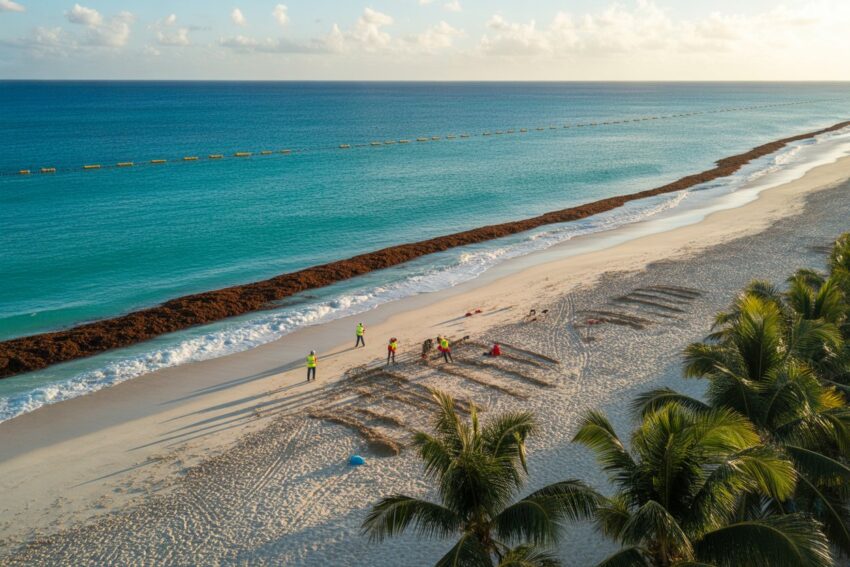
Early Landfall: Locations like Isla Mujeres and Cancun have already reported clearing hundreds of tons of seaweed—a task usually reserved for the peak summer months.
The “Great Atlantic Belt”: This floating forest, fueled by warmer ocean temperatures and nutrient runoff, is currently estimated to hold over 280,000 tons of algae headed directly for the Yucatan Peninsula.
A Military-Grade Defense Operation
Mexico isn’t waiting for the seaweed to hit the sand. The Mexican Navy (Semar) has treated the 2026 season as a full-scale coastal defense operation. With the eyes of the world on Mexico ahead of the 2026 World Cup, authorities are sparing no expense to keep the beaches pristine for the global crowds expected this summer.+1
The current “armada” deployed to intercept the sargassum includes:
The Fleet: 16 surface vessels, including specialized amphibious collection boats and one massive ocean-going ship.
The Shield: 9,500 meters of containment barriers are already installed, with an additional 6,000 meters being rushed to high-traffic zones like Playa del Carmen and Tulum.
The Manpower: Hundreds of naval personnel and local workers are operating 24/7 to scoop up the heavy mats before they reach the shallow water where they begin to decompose.
Impact on the Traveler: The Human Side of the “Brown Tide”
For the family that has saved all year for a Caribbean escape, the arrival of sargassum can be heartbreaking. Beyond the visual clutter, the seaweed releases hydrogen sulfide as it rots on shore, creating a “rotten egg” smell that can drive guests away from beachfront restaurants.
However, the 2026 season is also a story of resilience and adaptation. “We ask tourists not to panic,” says local municipal environmental secretary Samantha Álvarez. “Sargassum is a natural phenomenon. One day it’s here, the next it’s gone, depending on the wind.”
Navigating the 2026 Season: Tips for Visitors
If you are planning a trip to Cancun, Playa del Carmen, or Tulum this year, you don’t need to cancel—you just need to be savvy.
Use Real-Time Maps: Follow the Sargassum Monitoring Network on social media. They provide “traffic light” updates (Green/Yellow/Red) for specific beaches daily.
Island Hop: West-facing beaches and islands like Cozumel and Isla Mujeres (Playa Norte) are often naturally shielded from the seaweed due to ocean currents.
Explore the Inland Gems: When the beach is “red,” it’s the perfect day to visit a cenote (natural sinkhole) or a Mayan ruin like Chichén Itzá, which are entirely unaffected by the algae.
Stay Flexible: Choose resorts that have active, 24/7 beach cleaning crews or offshore barriers.
Looking Ahead: The Sustainability Factor
The 2026 crisis is also driving innovation. In Playa del Carmen, collected sargassum is being optioned as a potential biofuel resource, and several entrepreneurs are continuing to turn the “nuisance” into construction materials like bricks.
While the “brown tide” is a reminder of our changing climate and warming seas, the coordinated effort between the Navy, the tourism sector, and local communities shows that Mexico is ready to protect its crown jewel. The sea may be changing, but the spirit of “Pura Vida” and Mexican hospitality remains as clear as the water we all hope to see.
The post Mexico Tourism Braces for Record 2026 Sargassum Season: Early Arrival and Defense Plans appeared first on Travel And Tour World.
Source: travelandtourworld.com



Sorry, the comment form is closed at this time.