

More Than a Game: How the 2026 World Cup is Set to Transform Mexico’s Economy and Tourism Legacy
More Than a Game: How the 2026 World Cup is Set to Transform Mexico’s Economy and Tourism Legacy
As the countdown to the 2026 FIFA World Cup intensifies, the conversation in Mexico has shifted from the pitch to the streets. While the world prepares to see the greatest athletes compete, Mexico is preparing for something much larger: a profound economic and social transformation. According to recent insights from Tourism Review, the 2026 tournament isn’t just a sporting event—it’s a catalyst that will redefine public spaces, airports, and local businesses across the nation.
A New Model for a Global Stage
Unlike previous iterations of the tournament in Brazil or Russia, which relied on massive influxes of millions of international visitors, the 2026 World Cup—co-hosted by Mexico, the United States, and Canada—adopts a “spread-out” model. Mexico is expecting approximately 836,000 tourists specifically for the event. While this number might seem modest compared to the 1.5 million seen in 2014, the strategy is surgical.
The focus has shifted from sheer volume to high-value engagement and local distribution. With 13 matches split between Mexico City, Monterrey, and Guadalajara, the goal is to ensure that the wealth generated by the tournament doesn’t just stay in stadium luxury boxes but flows into the pockets of local street vendors, independent restaurateurs, and regional artisans.
The Zócalo and the Magic of Fan Fests
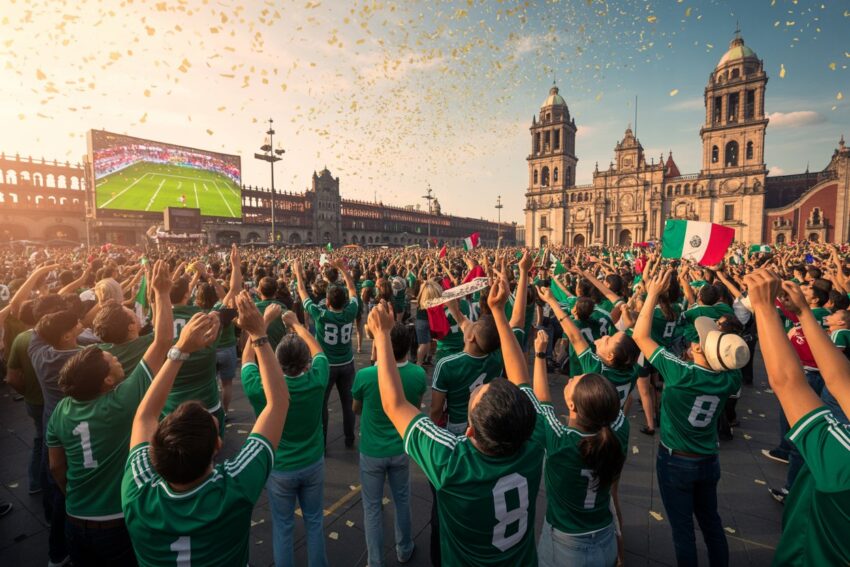
Perhaps the most humanizing element of the 2026 plan is the emphasis on FIFA Fan Fests. You don’t need a ticket to the Estadio Azteca to be part of the World Cup. These public viewing parties are designed to be “soccer for everyone.”
In Mexico alone, these festivals are expected to draw 4.2 million people. Imagine the historic Zócalo in Mexico City—a square that has seen centuries of history—vibrating with the cheers of 2.2 million fans. In Monterrey, the lush Fundidora Park will host 1.1 million, while Guadalajara’s Plaza Liberación prepares for nearly a million visitors. These are not just crowds; they are communities. They represent an open-door policy that encourages longer stays and daily local spending, turning every match day into a nationwide holiday.
The Billion-Dollar Playbook
Deloitte estimates that the direct economic impact on Mexico will sit at roughly $1.243 billion. While this represents a small fraction of the national GDP, its significance lies in its “multiplier effect.”
The spending isn’t concentrated in one week. Instead, it arrives in waves. The group stage’s conclusion (late June) is expected to see a peak of $346.8 million in spending. Visitors from nations like Japan and South Korea are expected to stay longer, often pairing their soccer passion with leisure trips to Mexico’s beaches or “Pueblos Mágicos.” On average, a fan will spend between $900 and $2,000 over a stay of two to five days. This is a massive injection of liquidity into the service sector.
The “World Cup Basket”: A Win for Local Commerce
The true winners of 2026 won’t just be the teams on the field, but the over 206,000 food and beverage outlets scattered across the country. Interestingly, 95% of these businesses are independently owned.
The tournament creates a “World Cup basket” of consumption. Food leads the charge with an estimated $562.5 million in extra activity, followed by retail and electronics. Before the first whistle even blows, Mexican households will be upgrading sound systems and televisions, and stocking up on party supplies. Once the games begin, the street-level economy takes over. Every taco stand near a Fan Fest and every neighborhood bar becomes a “venue,” sharing in the $563 million generated by fans watching matches outside of the stadiums.
A Legacy That Lasts Until 2030
One of the most encouraging projections from the Tourism Review analysis is the “long tail” of the World Cup. The event is expected to trigger a 26.5% growth spike in tourism for 2026, but the benefits don’t vanish when the trophy is hoisted.
Thanks to global exposure and improved infrastructure, Mexico is projected to see sustained tourism growth of 23.3% over the three years following the tournament. By upgrading airports and public transit today, Mexico is ensuring that the 2026 World Cup leaves behind a legacy of accessibility and a bolstered international reputation.
The Heart of the Matter
At its core, the 2026 World Cup in Mexico is about more than revenue—it’s about the shared joy of a nation where soccer is a cultural heartbeat. It is an economy in motion, powered by the collective energy of millions. Success in 2026 will be measured not just by the final score of the championship game, but by the busy tables in local squares and the lasting prosperity of the neighborhoods that hosted the world.
Mexico isn’t just playing the game; it’s inviting the world to the table. And in 2026, there will be a seat for everyone.
The post More Than a Game: How the 2026 World Cup is Set to Transform Mexico’s Economy and Tourism Legacy appeared first on Travel And Tour World.
Source: travelandtourworld.com



Sorry, the comment form is closed at this time.