


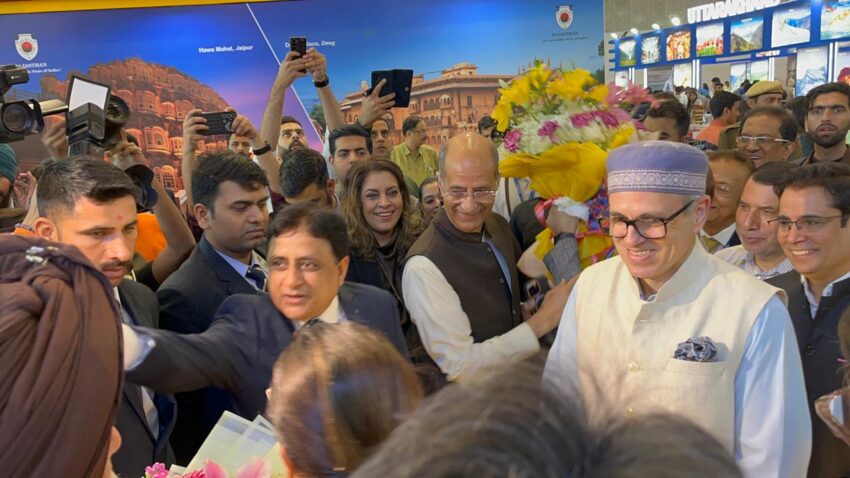
Omar Abdullah Pivots J&K Toward ‘Value-Based’ Tourism at SATTE (South Asian Travel and Tourism Exchange) 2026
Omar Abdullah Pivots J&K Toward ‘Value-Based’ Tourism at SATTE (South Asian Travel and Tourism Exchange) 2026
The sprawling halls of Yashobhoomi in New Delhi buzzed with a distinct energy this week as the 33rd edition of SATTE (South Asian Travel and Tourism Exchange) 2026 took centre stage. Amidst the neon displays of 60 nations and the frantic networking of 2,000 exhibitors, one message rang louder than the rest: India’s tourism landscape is no longer just about how many people arrive, but the quality of the legacy they leave behind.
Leading this narrative shift was Omar Abdullah, Chief Minister of Jammu and Kashmir, who used the platform to pivot away from traditional metrics. In a refreshing display of candour, Abdullah outlined a vision that prioritises the “Indian traveller” and “sustainable value” over the vanity of international arrival statistics.
A Strategic Pivot: Why Domestic Value Trumps Global Volume
For decades, the success of Jammu and Kashmir’s tourism sector was often measured by the influx of foreign backpackers or international luxury travellers. However, speaking on the third day of the exhibition, Abdullah turned this logic on its head.
“I’m not particularly interested in foreign tourists if I can secure a strong share of Indian travellers,” Abdullah stated, pointing to a seismic shift in the domestic market. His logic is grounded in modern economic realities: the contemporary Indian traveller is aspirational, high-spending, and increasingly seeks experiences that rival global destinations.
By focusing on the domestic market, the Union Territory aims to build a more resilient ecosystem. Domestic tourism isn’t just a safety net; it is the engine of the Indian economy. Abdullah’s strategy is clear: if J&K can ensure every domestic visitor returns home feeling “satisfied, valued, and eager to come back,” the sustainability of the industry is guaranteed.
Nine New Frontiers: The Infrastructure Push
While the sentiment is focused on the “human” element of travel, the execution relies on cold, hard infrastructure. The Chief Minister highlighted a landmark partnership with the Government of India to develop nine new world-class, sustainable destinations across the region.
This isn’t merely about building more hotels. The vision for these nine sites includes:
Eco-conscious development: Ensuring the fragile Himalayan ecology isn’t compromised by the “volume-driven” mistakes of the past.
Year-round accessibility: Breaking the “seasonal” curse of J&K tourism through enhanced rail connectivity to Srinagar and a significant expansion of airport infrastructure.
Value-Based Tourism: Shifting the focus to high-quality amenities that justify premium positioning, ensuring that the local economy benefits from higher per-capita spending.
SATTE 2026: The Pulse of South Asian Travel
The event itself, organised by Informa Markets in India, has become more than just a trade show; it is a policy-shaping powerhouse. Yogesh Mudras, Managing Director of Informa Markets in India, noted that with cultural heritage now accounting for over half of India’s tourism revenue, the industry requires “structured opportunity” rather than just casual conversation.
With over 3,200 brands under one roof, SATTE 2026 served as the bridge between government stakeholders and the private sector. Mudras emphasised that while the business conducted on the show floor is vital, the “leadership conversations” are what truly mature the market.
Gemini said
The Strategic Engine: SATTE 2026 as a Policy Powerhouse
Organised by Informa Markets in India, the 33rd edition of SATTE 2026 has transcended its origins as a traditional trade show. In today’s economic climate, it functions as a critical “policy-shaping powerhouse,” where the blueprint for South Asia’s travel future is drafted in real-time. This year, the event’s scale—hosting over 3,200 brands and 2,000 exhibitors—serves a purpose far greater than simple networking; it acts as the primary bridge between high-level government stakeholders and the agility of the private sector.
Yogesh Mudras, Managing Director of Informa Markets in India, highlighted a pivotal shift in the nation’s economic landscape: cultural heritage now accounts for more than 50% of India’s total tourism revenue. This statistic underscores why the industry can no longer rely on “casual conversation” or fragmented efforts. Instead, Mudras argues that the sector requires “structured opportunity”—a deliberate alignment of marketing, infrastructure, and preservation that only a platform of SATTE’s magnitude can provide.
While the vibrant energy and transactional success on the show floor are essential for immediate growth, the true value of the 2026 exchange lies in its “leadership conversations.” These high-level dialogues are where market maturity is forged. By bringing together decision-makers from over 60 countries, the event facilitates an outcome-driven environment where long-term policy thinking is harmonised with commercial reality.
In essence, SATTE 2026 is where the “why” of travel meets the “how” of governance. It provides the intellectual and commercial scaffolding necessary to support India’s transition from a volume-driven market to a value-based global leader. As the industry matures, the platform remains the essential site where the tourism ecosystem comes together with a singular, unified purpose: to define how India travels and how the world, in turn, discovers India.
The post Omar Abdullah Pivots J&K Toward ‘Value-Based’ Tourism at SATTE (South Asian Travel and Tourism Exchange) 2026 appeared first on Travel And Tour World.
Source: travelandtourworld.com


Sorry, the comment form is closed at this time.