


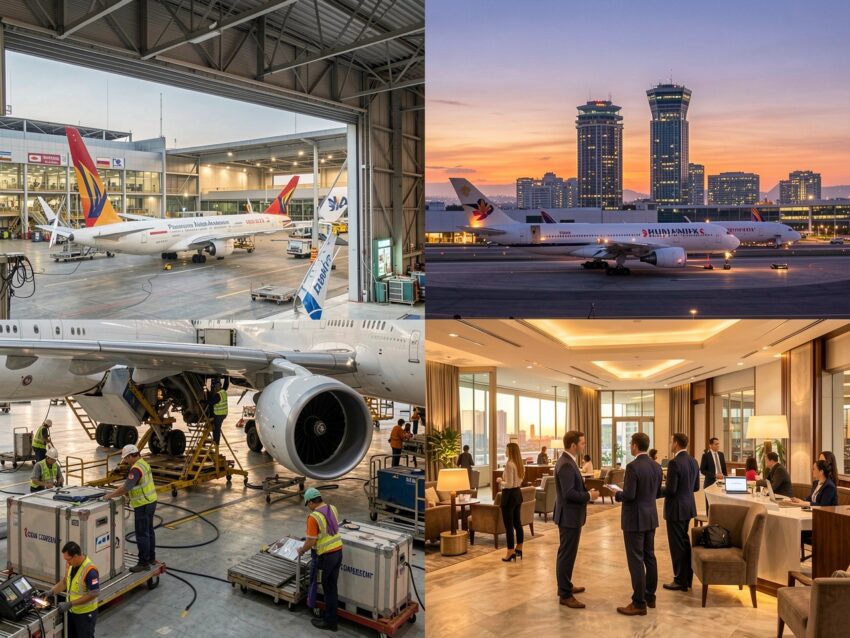
Philippine Airlines, Singapore Airlines, Delta Air Lines, Lufthansa Technik, United Airlines, Korean Air, Japan Airlines, ANA, Qantas, Emirates, Qatar Airways & Cathay Pacific Watch as US, South Korea, Japan and Australia Eye Manila’s MRO Boom
Philippine Airlines, Singapore Airlines, Delta Air Lines, Lufthansa Technik, United Airlines, Korean Air, Japan Airlines, ANA, Qantas, Emirates, Qatar Airways & Cathay Pacific Watch as US, South Korea, Japan and Australia Eye Manila’s MRO Boom
Philippine Airlines, Singapore Airlines, and Delta Air Lines are closely watching the Philippines as it accelerates its rise as a regional aviation powerhouse, with the Department of Trade and Industry using the global stage of Singapore Airshow 2026 to promote the country as a competitive hub for aerospace manufacturing and maintenance, repair, and overhaul services backed by export figures that exceeded US$590 million in 2024 and climbed past US$603 million in the first nine months of 2025. This strategic push comes at a time when aviation is a major economic engine for the country, supporting tens of thousands of direct jobs and contributing billions of dollars in economic output, while tourism receipts reached nearly PHP 694 billion in 2025 with more than 6.4 million visitor arrivals recorded. For travelers from the United States, South Korea, Japan, and Australia—among the Philippines’ top source markets—the expansion of MRO capability and airport infrastructure at hubs like Manila and Clark signals stronger operational reliability, potential route growth, and improved connectivity across Asia-Pacific and long-haul corridors. As global carriers assess Southeast Asia’s expanding aviation ecosystem, the Philippines’ export-driven aerospace momentum is positioning the country not just as a leisure destination known for its islands, but as a serious aviation and travel gateway where airlines, airports, and hospitality brands are aligning for the next phase of regional growth.
Philippine Airlines, Singapore Airlines, Delta Air Lines and Lufthansa Technik Monitor Philippines’ Aerospace Rise as DTI Showcases Export Growth at Singapore Airshow 2026
The Philippines is no longer just a tropical leisure destination. It is positioning itself as a serious aviation and aerospace player in Asia. At Singapore Airshow 2026, the Department of Trade and Industry (DTI), together with key economic agencies, promoted the country as a competitive hub for aerospace manufacturing and maintenance, repair and overhaul (MRO) services. The push is backed by solid export growth. Philippine aerospace exports reached over US$590 million in 2024 and climbed further to more than US$603 million in the first nine months of 2025, according to official investment data. That export momentum is now translating into global airline interest, stronger aviation partnerships, and new implications for tourism and hospitality.
The presence of major carriers and aerospace companies at the Airshow signals confidence in Southeast Asia’s expanding aviation market. Singapore Airshow is one of Asia’s largest aerospace and defense exhibitions. It draws airlines, aircraft manufacturers, MRO firms, airport operators and government delegations from around the world. The Philippines used this global platform to highlight its skilled workforce, competitive costs, established MRO ecosystem and growing infrastructure hubs such as Clark and Manila.
United Airlines, Korean Air, Japan Airlines and ANA Track Clark’s Expanding Role as an Aviation Gateway
Clark International Airport is emerging as a strategic alternative to Manila’s Ninoy Aquino International Airport. Passenger traffic at Clark surpassed 2.75 million in 2025, marking double-digit year-on-year growth. The airport’s new terminal has increased capacity to 8 million passengers annually. For airlines, this expansion means more room for route development, fewer congestion challenges and stronger regional connectivity.
Clark is also central to aerospace development. Major MRO operators are expanding capacity in the area. Lufthansa Technik Philippines, a joint venture between Lufthansa Technik and MacroAsia, operates one of the largest aircraft maintenance facilities in the region. Reports indicate that discussions are ongoing for a potential large-scale expansion project at Clark that could significantly increase maintenance capability, including widebody aircraft servicing. Such developments reduce aircraft downtime and strengthen airline scheduling reliability.
For travelers, this matters. Reliable aircraft maintenance translates into operational stability. Fewer technical disruptions. Better on-time performance. More consistent long-haul schedules connecting Manila and Clark with North America, East Asia, Australia and the Middle East.
Qantas, Emirates, Qatar Airways and Cathay Pacific Assess Southeast Asia’s MRO Shift as Manila Gains Strategic Value
Asia Pacific is projected to account for a substantial share of global aircraft demand over the next two decades. As fleets expand, so does the need for maintenance and engineering capacity. Airlines operating long-haul routes between Australia, the Middle East, East Asia and North America increasingly look for regional MRO hubs to minimize ferry time and operational costs.
The Philippines offers competitive labor costs, English proficiency, and established aerospace manufacturing capability. Local firms already produce precision components, sub-assemblies and wiring systems that integrate into global aircraft supply chains. The government has designated aerospace as a priority sector under its industrial development strategy, encouraging foreign direct investment and technical partnerships.
For global carriers like Emirates and Qatar Airways, Southeast Asia remains a critical transit and origin market. For Qantas and Korean Air, Manila and Clark serve both point-to-point leisure markets and connecting flows. For Cathay Pacific and Japan Airlines, proximity to the Philippines enhances regional network flexibility.
Aviation Growth Powers Tourism Momentum as US, South Korea, Japan and Australia Lead Visitor Numbers
Tourism data underscores why aviation development is so critical. The Philippines recorded approximately 6.48 million total visitor arrivals in 2025, including foreign tourists and returning overseas Filipinos. Inbound tourism receipts reached nearly PHP 694 billion in 2025, reflecting strong travel demand. The United States and South Korea remain among the top source markets, followed by Japan, China and Australia.
Improved air connectivity and maintenance capability can strengthen capacity deployment on key routes. Philippine Airlines operates nonstop services from Manila to Los Angeles, San Francisco, Seattle and New York. Delta Air Lines maintains code-share partnerships on certain routes connecting US passengers to Manila via Asian hubs. Singapore Airlines connects Manila to its global network via Singapore. Korean Air, Japan Airlines and ANA link Manila to Seoul, Tokyo and onward destinations.
For US travelers, nonstop services from Manila to major West Coast gateways reduce transit time. For South Korean and Japanese visitors, frequent regional flights support short-break leisure travel. For Australian tourists, direct connections between Manila and Sydney, Melbourne and Brisbane make tropical island getaways accessible within eight hours.
Hospitality Industry Benefits as Marriott, Hilton, Okura and Global Hotel Brands Anticipate Business and Leisure Demand
Aerospace investment does not just impact airlines. It stimulates business travel, technical delegations and supply chain meetings. Engineers, inspectors, aviation executives and suppliers require accommodation, meeting facilities and long-stay options near airport hubs. Clark and Metro Manila have seen new hotel inventory in recent years, including international brands such as Marriott, Hilton, Novotel and Hotel Okura.
Business travel often yields higher average daily room rates than leisure segments. Aviation-linked events, airshows, technical training sessions and MRO contracts generate recurring occupancy demand. This supports food and beverage outlets, transport services and event venues. For leisure travelers, improved connectivity enhances destination confidence. Stable flight operations encourage bookings, especially for high-value long-haul markets.
Tourists benefit from expanded accommodation options across different price tiers. Luxury resorts in Boracay, Cebu and Palawan gain from stronger international arrivals. City hotels in Manila and Clark capture transit passengers and corporate clients linked to aerospace development.
Travel Tips for Visitors Planning Trips to Manila and Clark
Choose arrival airport strategically. Ninoy Aquino International Airport offers the widest network coverage. Clark International Airport may provide faster immigration processing and less congestion. Check airline schedules carefully, as some carriers operate seasonal frequency adjustments based on demand.
Book long-haul flights early during peak travel months. December to May remains high season for inbound tourism due to favorable weather. US and South Korean arrivals typically spike during holiday periods. Consider mid-week departures for better fares.
For travelers connecting onward to island destinations, allow sufficient transfer time. Domestic carriers operate frequent flights to Cebu, Davao, Puerto Princesa and Caticlan. Maintenance expansion and aviation upgrades aim to improve schedule reliability, but buffer time remains advisable.
Stay near airport districts if traveling for business. Clark’s surrounding Freeport Zone offers integrated business parks, hotels and retail complexes. Manila’s Newport World Resorts area near NAIA Terminal 3 provides convenient access for early morning departures.
Why Singapore Airshow 2026 Matters for Future Travelers
Singapore Airshow gathers industry decision-makers shaping future route networks, fleet purchases and maintenance contracts. When the Philippines promotes aerospace manufacturing and MRO services at this forum, it signals long-term aviation ambition. Export growth above US$600 million demonstrates tangible industry performance rather than speculative planning.
Airlines evaluate such developments carefully. A strong local aerospace base reduces dependence on distant maintenance facilities. It encourages aircraft basing decisions. It influences route expansion feasibility. Over time, that can translate into more frequencies, improved aircraft utilization and competitive fares.
For travelers, stronger aviation ecosystems mean better service reliability. For tourism boards, it means stronger negotiating power when courting new airlines. For hotel operators, it signals stable business demand beyond seasonal leisure fluctuations.
Philippine Airlines, Singapore Airlines and Regional Carriers Position for Network Optimization
Philippine Airlines continues to modernize its fleet with Airbus A350s and A321neos on select routes. Singapore Airlines operates widebody aircraft on Manila routes, connecting passengers to Europe, North America and Australia via Changi Airport. Korean Air, Japan Airlines and ANA provide efficient one-stop options to North America and Europe through Seoul and Tokyo.
If MRO capacity expands locally, turnaround efficiency for regionally based aircraft could improve. Airlines may deploy aircraft more strategically in Southeast Asia. That strengthens Manila’s competitiveness as a gateway.
Aviation Strategy Fuels a Broader Travel Renaissance
The Philippines’ aerospace export growth and MRO investment push are more than industrial policy headlines. They are foundational steps that shape the travel experience. Reliable aircraft maintenance supports punctual departures. Expanded airport capacity encourages route development. Business aviation activity fuels hotel demand. Tourism receipts reinforce economic confidence.
Philippine Airlines, Singapore Airlines, and Delta Air Lines are watching closely as the Philippines positions itself as a rising aerospace and MRO hub at Singapore Airshow 2026, backed by exports surpassing US$600 million and strong aviation growth.
With tourism arrivals exceeding 6.4 million in 2025 and major markets like the US, South Korea, Japan, and Australia driving demand, the country’s aviation expansion could reshape connectivity, airline operations, and hotel growth across Manila and Clark.
As Philippine Airlines, Singapore Airlines, Delta Air Lines, Lufthansa Technik and other global players watch Manila’s rise, travelers stand to benefit. More connectivity. More hotel options. More seamless journeys. The Singapore Airshow 2026 showcase signals that the Philippines intends to compete not only as a beach paradise but as a serious aviation hub in Asia. For tourists planning their next trip to Southeast Asia, that transformation could mean smoother flights, stronger schedules and an expanding network of world-class hospitality waiting on arrival.
The post Philippine Airlines, Singapore Airlines, Delta Air Lines, Lufthansa Technik, United Airlines, Korean Air, Japan Airlines, ANA, Qantas, Emirates, Qatar Airways & Cathay Pacific Watch as US, South Korea, Japan and Australia Eye Manila’s MRO Boom appeared first on Travel And Tour World.
Source: travelandtourworld.com



Sorry, the comment form is closed at this time.