


RIMOWA vs. Tumi: Which Luggage Brand Is Better?
Whether you’re a frequent flyer, an aspiring traveler, or just someone who wants to ensure you buy a suitcase that will likely never need replacing, Tumi and RIMOWA luggage sets are some of the best to consider.
These companies are known for their innovative luggage designs and high-quality goods, including hard aluminum suitcases, polycarbonate shell suitcases, and more.
What you’ll notice is that these luggage brands tend to cost way more than other brands mid-tier brands (Away, July or Monos Travel, for example), where suitcase costs start at $250 USD.
Why is that exactly? Is it just a name-brand thing, or is their luggage actually superior? This post will be dedicated to helping you understand and compare RIMOWA vs. Tumi luggage.
The end goal? To help you figure out which one to stick with.
You may already know what you’re looking for and may be leaning towards one brand over the other, but it’s best to have all the information in front of you if you are trying to decide on just one luggage brand to buy from.
Though these two brands have similar products, you may find that one brand does not sell something while the other does. We discuss everything below to help you determine which brand and luggage set will work best for your needs!
This post may contain affiliate links. You won’t be paying a cent more, but in the event of a sale, the small affiliate commission I receive will help keep this blog running/pumping out useful and free content. Thanks a lot!
Main Takeaways
RIMOWA tends to target a slightly younger, trendier, and more design-conscious demographic. Their luggage often appeals to fashion-forward travelers who prioritize both style and functionality, as well as modern and minimalist aesthetics.
Tumi caters more to a slightly older, professional, and business-oriented demographic. Like pilots and airline workers! Their luggage is known for its functional/organizational pockets, making it a preferred choice for travelers who value practicality.
Tumi offers a broader range of materials and includes soft cases made from their ballistic nylon.
Tumi is going to be your more affordable option. Plus, Tumi bags go on sale much more frequently, helping to further lower prices if budget is a factor for you.
RIMOWA offers an unbeatable lifetime guarantee on all suitcases though, whereas Tumi offers a 5-year warranty on suitcases.
RIMOWA vs. Tumi: Overview Of The Brands
Before we dive into the nitty-gritty details of these two luggage brands, let’s start by getting to know the brands a bit better and learning about their history.
RIMOWA
RIMOWA, the older of the two brands, first started in 1898 by manufacturing wooden luggage cases as a small family-run business. In 1937, the first aluminum trunk was made by the son of the founder and the business’s namesake, Richard Morszeck; this is the type of luggage that launched RIMOWA into fame.
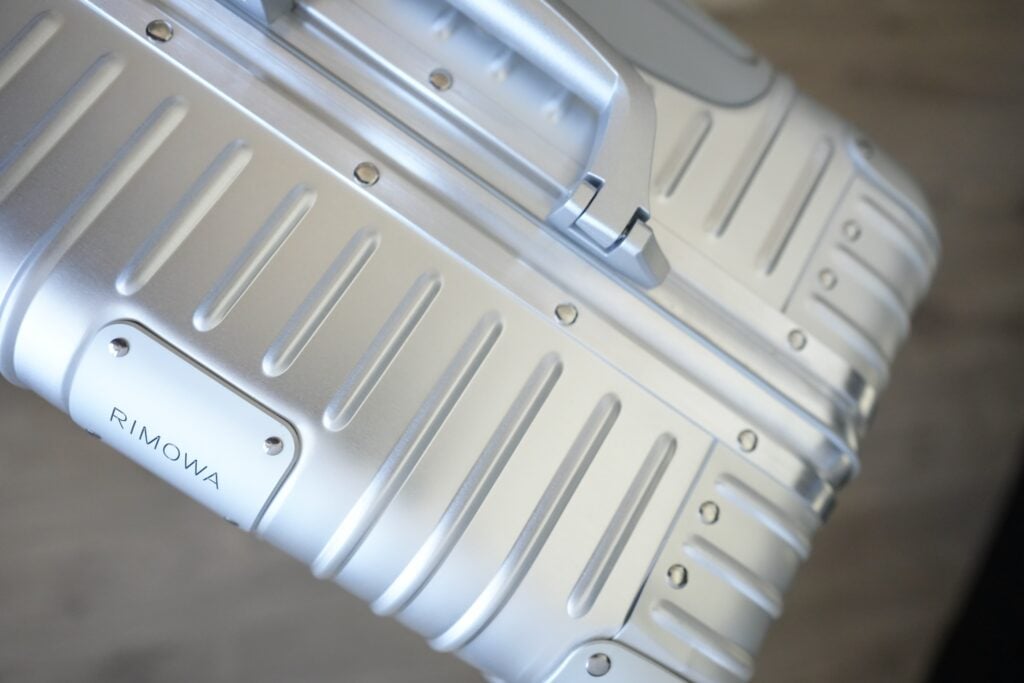
Inspired by the world’s first all-metal aircraft made in Germany in 1950, RIMOWA adopted their signature groove design, another well-known aspect of RIMOWA luggage.
RIMOWA has also been a pioneer in the use of polycarbonate in the manufacturing of their suitcase, a game-changing material that makes suitcases more lightweight, durable, and flexible than traditional suitcases.
The brand also offers a wide range of products, including carry-on and check-in-size suitcases, as well as backpacks, duffel bags, and other useful travel accessories including iPhone accessories, watch cases, wine cases, eyewear, and even suit holders.
RIMOWA’s commitment to quality and craftsmanship extends beyond its products. The brand also offers a comprehensive in-store repair and restoration service, which allows customers to have their RIMOWA suitcases repaired or restored, even years after they were first purchased. Participating luxury hotels even offer RIMOWA repair services too!
And best of all, they have one of the best warranties out there – a lifetime warranty on all suitcases.
CHECK OUT RIMOWA’S SUITCASE COLLECTION
Tumi
Though not as longstanding as RIMOWA, Tumi is another world-renowned luggage brand with humble beginnings, starting as an American leather bag importer selling South American bags. They are probably best known for their innovative introduction of soft, ultra-functional, black-on-black ballistic nylon travel bags.
Founded in 1975, TUMI takes its name from a Peruvian icon known to its founder from his Peace Corps days in South America. Not too long after its founding, Tumi became a leading name in luggage design by introducing one of its signature bags made with patented ballistic nylon material.
In the 1980s, Tumi introduced its take on a “soft briefcase”, which drastically changed the future of the suitcase industry. In 1992, the brand also expanded its fame by adding new products like leather wallets and other goods, followed by carry-ons and checked luggage suitcases.
Since 1993, Tumi has been releasing one hit product after another and has expanded to become a global influence on the luggage market! You can expect to find a wide range of luggage materials, including aluminum, Tegris (looks like carbon fiber), and ballistic nylon options.
Though their main focus is still luggage, Tumi also sells a variety of other products ranging from backpacks to electronics.
CHECK OUT TUMI’S SUITCASE COLLECTION
RIMOWA vs. Tumi: Design And Style
Despite both of them being luggage brands, the two brands offer vastly different designs and styles.
Key Takeaways
RIMOWA’s luggage features vertical grooves and more colorful choices.
Tumi suitcases have a more fluid, wavy pattern and skew toward darker color schemes.
Tumi offers more variety when it comes to hard and soft suitcase materials (aluminum, titanium, ballistic nylon, polycarbonate, etc.)
RIMOWA
RIWOWA is well-known for its hard-shell luggage that’s meant to keep your belongings safe even when flying and when your luggage gets mishandled.
The company uses two primary materials for its designs — aluminum and polycarbonate — allowing most luggage pieces to carry the same signature groove designs they’re known and loved for. You’ll find more color choices for their polycarbonate choices over aluminum ones.
Some other design elements that RIMOWA suitcases are known for are their rounded corners with corner caps, strictly vertical grooves inspired by aircraft design, and a more sleek and minimalist style.
Though RIMOWA does more than just luggage, their luggage sets also have three main size categories:
Cabin – 21.7 x 15.8 x 9.1 Inches
Check-in – 30.8 x 20.5 x 10.7 Inches
Trunk – 31.5 x 14.8 x 17 Inches
Tumi
Like RIMOWA, Tumi offers hard-shell options for luggage, though they also have soft-shell suitcases that feature their patented ballistic nylon.
In terms of design and styling, Tumi leans towards a darker color scheme, though there is often the choice of opting for different color accents.
Tumi’s hard-shell luggage also features a completely different design for their bags, choosing to use a more organic, flowy, and wavy pattern for some of their aluminum and polycarbonate options. At the same time, other pieces make use of recycled materials that give off a carbon fiber-like design details.
When looking at hardshell suitcases, you’ll find that Tumi suitcases tend to have a glossy resin finish and often use two-toned elements for their luggage pieces.
Again, Tumi sells more than just luggage, but in terms of luggage alone, they have two different categories with ranging sizes:
Carry-On – Ranges from 15 to 22 x 14 x 9 inches
Carry-on variations: Compact, International, Continental
Checked – Ranges from 26 to 31+ x 22 x 12.5 inches
Checked bag variations: Short, Extended, Worldwide
RIMOWA vs. Tumi: Durability And Quality
When you’re looking to buy a new luggage piece, one of the first things you’ll likely consider is the quality and durability of the case you buy.
Key Takeaways
Luckily, both Tumi and RIMOWA excel in this category! Both brands are well-known for having high-quality luggage that should last you for years (if not decades) to come, and both use excellent materials to make their cases go the extra mile.
RIMOWA
As mentioned before, the two primary materials used by RIMOWA are aluminum and polycarbonate for the exteriors — and both are great for longevity and protecting the belongings of your suitcase. Their suitcases also have an interior that mainly uses polyester, which is also very durable.
Tumi
With a broader range of bags, including soft-shell suitcases and soft briefcases, Tumi has made even their “delicate” bags extra durable.
They also use high-quality aluminum for some of their hard suitcases, while others are made from polycarbonate or carbon fiber. All three of these materials are meant to be ultra-durable over the years.
Let’s touch on Tumi’s soft cases. “Soft” doesn’t mean compromising! These softshell products are made with their patented ballistic nylon, making them water-resistant and durable. It’s quite easily one of the best materials to use for soft suitcases.
In addition, Tumi also uses an anti-microbial lining on some components to prevent the growth of any bacteria.
RIMOWA vs. Tumi: Cost
Key Takeaways
After doing an apples-to-apples comparison (looking at the same size/style/type of suitcases between the same brands), we found that Tumi is actually more affordable than RIMOWA.
For a polycarbonate carry-on, Tumi charges $150 less than what RIMOWA charges.
For an aluminum check-in suitcase, Tumi charges $305 less than what RIMOWA charges.
On top of that, you’ll be able to find even more discounts at Tumi outlet stores. RIMOWA does not have an outlet store and suitcases rarely go on sale.
In a nutshell, what you’ll find is that the higher the quality of the material, the more expensive the luggage is. For example, a large check-in suitcase made with aluminum is going to cost way more than a carry-on made with polycarbonate.
RIMOWA
To simplify matters, let’s first look at the sizes of the luggage options and the price range each one is set at.
RIMOWA’s carry-on suitcases start at $700 for the Essential Light – Cabin U (RIMOWA’s lightest suitcase yet). The price is kept on the ‘lower end’ using polyester for the interior and polycarbonate for the exterior, with other components made of mostly plastic.
RIMOWA offers a few other carry-on models, all of which increase in price as the materials used improve. At the higher end, carry-on luggage pieces can cost as much as $1500 for the Original Cabin (their bestseller) or $3000+ for their Distinct Collection (the newest, most luxurious of the lines where suitcases are made with leather and aluminum).
RIMOWA’s check-in suitcases see a similar price increase, the larger and fancier the features = the more expensive.
Again, this fluctuation is basically due to better materials used, such as aluminum (compared to polycarbonate) and leather instead of plastic.
Are there ways to get discounts on RIMOWA suitcases?
At the moment, it’s pretty rare to find discounts or sales on RIMOWA suitcases. You should be prepared to pay the retail price at full cost for their products!
Alternatively, you can consider the secondhand market (one of my favorite ways to shop). Consider buying pre-owned RIMOWA luggage from reputable sources like Poshmark or TheRealReal where you’re relatively sheltered from scammers.
Pro Tip: Sign up for Poshmark with my referral code ELBUNZ for $10 off your first purchase!
Tumi
TUMI offers three carry-on sizes, and each size is available in multiple materials — this is where prices start to swing.
Carry-On Sizes
Compact (smallest)
International (standard overhead-friendly size)
Continental (largest carry-on)
Materials You’ll See Across Carry-Ons
Ballistic nylon (soft-sided, most affordable)
Polycarbonate (hard-sided, lightweight)
Aluminum (durable, premium)
Carbon fiber (light + high-end)
Titanium (top-tier, ultra-premium)
Price Ranges (Carry-On)
Compact Carry-On: starts around $750
International Carry-On: starts around $795, up to $3,500 (titanium)
Continental Carry-On: starts around $750, up to $1,795
Add-ons like laptop sleeves or upgraded interiors can bump the price even more. As you can see, Tumi has a similar trend — prices increase with quality and size.
Are there ways to get discounts on Tumi suitcases?
Yes, there are actually quite a few ways to find discounted Tumi bags and suitcases! Here’s a list of ways to get a good deal:
Tumi Outlet Stores: Tumi has outlet stores in various locations where you can find discounted products, including suitcases.
Seasonal Sales: Tumi often offers sales during holidays, like Black Friday and Cyber Monday, as well as clearance sales at the end of each season.
Department Store Sales: Some department stores may include Tumi luggage in their sales events, offering discounts or promotions.
Online Retailers: Online retailers like Amazon, eBay, and Zappos may have discounted Tumi suitcases, especially during sales events like Prime Day or holiday promotions.
Tumi’s Official Website: Occasionally, Tumi’s official website may offer promotions or discounts on their products.
Membership Programs: Some credit card companies and travel reward programs offer discounts or cashback rewards when you purchase Tumi luggage.
Subscribe to Tumi’s Newsletter: Signing up for Tumi’s newsletter can sometimes give you access to exclusive deals and promotions.
Examples of what you can find at a Tumi Outlet Store!
Apples-to apples price comparison
Let’s compare the price between the two brands by doing an apples-to-apples comparison of a few popular suitcase sizes in both aluminum and polycarbonate. We’re just consider full-price items here:
Product TypeRIMOWA CostTUMI CostPolycarbonate Carry-On$950 (this one)$795 (this one)Aluminum Carry-On$1500 (this one)$1295 (this one)Aluminum Check-In L$1875 (this one)$1595 (this one)
RIMOWA vs. Tumi: Weight And Size
Key Takeaways
RIMOWA and Tumi have comparable luggage pieces in size and weight.
While they both strive to keep their products as light as possible, when you upgrade the quality of the materials (aka metal vs polycarbonate shells), there will most definitely be an increase in the weight.
Want something lighter? Opt for their nylon or polycarbonate products. If you don’t mind the weight, then you the aluminum (or titanium) case can be the way to go.
RIMOWA
Polycarbonate: suitcases range in weight from 4.41 lbs to 11.9 lbs depending on size.
Aluminum: ranges from 9.5 lbs for the most compact case to 13.2 lbs for the largest (Classic Trunk).
SizeWeight (in lbs)MaterialEssential Lite Cabin U (20 x 14 x 7.9 inches)4.41PolycarbonateEssential Trunk Plus (31.5 x 14.6 x 16.1 inches)11.9PolycarbonateOriginal Compact (16 x 16.34 x 9.06 inches)9.48AluminumClassic Trunk (29.5 x 14.2 x 18.5 inches)13.2Aluminum
Tumi
Tumi Compact suitcases can range in weight from 6.6 lbs for a nylon case and up to 8.5 lbs for a ballistic nylon case. The Carry-On International line weighs anywhere from 7.9 lbs for the polycarbonate version to 13 lbs for the aluminum version.
The table below shows more detail, including the size, weight, and material used in the suitcase:
Average Carry-On SizeWeight (in lbs)MaterialCompact (15/16 x 14 x 8 inches)6.6Nylon 7Polycarbonate 8.5Ballistic NylonInternational (21/22 x 14 x 9 inches)7.9Polycarbonate / Tegris 8.8 – 10.7Ballistic Nylon 11.5Titanium 12.1Fabric 13AluminumContinental (21/22 x 16 x 9 inches)8.2Polycarbonate 8.4Tegris 11.1-11.4Ballistic Nylon 11.8Aluminum
The Check-in luggage options also have vastly different weights, between 9.9 lbs for polycarbonate to 18.3 lbs for ballistic nylon.
Average SizeWeight (in lbs)MaterialShort (26-27 x 17.5 x 10 inches)9.9Polycarbonate 11.9Tegris 14.1Aluminum 15.4Ballistic NylonExtended (29-31 x 21 x 12 inches)12.1Polycarbonate 13.2Tegris 13.4Ballistic Nylon 16.1AluminumWorldwide (31+ x 22 x 12.5 inches)13.4Polycarbonate 18.3Ballistic Nylon
RIMOWA vs. Tumi: Warranty And Customer Service
With luggage in this higher end price range, you better hope they offer good warranty plans and unparalleled customer service! Luckily, both Tumi and RIMOWA have great customer service when you actually need help.
That said, one brand does offer a much better warranty on their suitcases…
Key Takeaways
RIMOWA comes out on top here with a lifetime warranty, whereas Tumi offers a warranty for up to 5 years.
RIMOWA
RIMOWA has a lifetime warranty on all its suitcases, giving you peace of mind when buying one. In addition, there is also a comprehensive in-store repair and restoration service if you need it and a dedicated team of people to help you resolve any issues you may have.
This allows you to have your RIMOWA suitcases repaired or restored, even years after they were first purchased. Participating luxury hotels even offer RIMOWA repair services too!
Tumi
Tumi also offers a warranty on their suitcases, and while it’s NOT a lifetime warranty, it still covers your purchase for up to 5 years (or two years for any wallet or accessory).
For the first year: if your TUMI product is damaged – including damage caused by normal wear and tear, airline handling, or other transit damage – TUMI will cover all repair expenses, including shipping costs to and from the repair facility. If they determine that the product is damaged beyond repair, they will replace it.
Then from years 2 to 5, travel bags, business cases, cross-body bags, totes, backpacks, and handbags are covered for manufacturing defects and normal wear and tear.
Tumi also has a repair service that you can use via their website, too.
RIMOWA vs. Tumi: Popularity And Brand Recognition
Both RIMOWA and Tumi are well-known brands and industry leaders when it comes to luggage. I’d be shocked if you said you hadn’t ever seen RIMOWA suitcases rolling by or Tumi bags being carried by pilots, flight attendants, and business people!
Let’s touch on a few reasons why people like these brands.
Key Takeaways
RIMOWA tends to target a slightly younger, trendier, and more minimalist or design-conscious demographic. The suitcases, while spacious, don’t have too many built-in organizational features.
Tumi caters to a slightly older, professional, and business-oriented demographic. Like pilots! Their products put functionality and organization at the forefront (functional compartments and pockets), making it ideal for carrying work-related items alongside personal belongings.
RIMOWA
RIMOWA is arguably the more ‘famous’ of the two, especially in recent years thanks to previous collaborations with Abloh, Tiffany & Co. and Off-White.
These collaborations have helped them with their brand awareness and has really captured the attention of a younger and trendier audience. RIMOWA tends to target a slightly younger, trendier, and more design-conscious demographic. Their luggage often appeals to fashion-forward travelers who prioritize both style and functionality — and those who appreciate modern and minimalist aesthetics.
RIMOWA’s luggage is suitable for both leisure and business travel, but its image leans more toward the leisure side. Having a RIMOWA suitcase is almost like making a fashion statement while exploring the world!
RIMOWA has cute limited-edition colors and collaborations from time to time.
Tumi
Tumi is also a well-known and highly trusted brand.
Tumi caters to a slightly older, professional, and business-oriented demographic. Their suitcases, briefcases, and backpacks are all known for their durability, organization, and functionality, making them a preferred choice for business travelers (like CEOs, executives, pilots, and flight attendants) who value practicality and reliability.
Many professionals appreciate the brand’s organizational features, like multiple compartments and pockets, making it ideal for carrying work-related items alongside personal belongings.
One reason for Tumi’s world-renowned status is the use of their patented ballistic nylon to make soft-shell suitcases that are still very durable, which is one thing RIMOWA does not offer.
RIMOWA vs. Tumi: Which Brand Is Better?
Tumi and RIMOWA are two exceptional luggage brands that put the safety and longevity of your chosen products first. But ultimately, which is better?
That’s a totally subjective question — and the answer will differ depending on who you ask. We think both brands produce top-notch products that anyone would be happy owning.
But if we had to pick just one, we’d choose RIMOWA for our own personal reasons below. (We can only give you our thoughts, but it’ll be up to you in the end!)
Personally, we are team RIMOWA because:
They offer an unbeatable lifetime warranty on suitcases (Tumi only offers a 5-year warranty at the moment)
There are just more cute color choices when it comes to certain suitcases (as seen in their polycarbonate suitcases)
The suitcases are more simple and sleek, perfect for leisure travelers, minimalists, and/or people who have an eye for design
We don’t mind travel gear with fewer pockets/compartments because we use compressible packing cubes when we travel and organize that way!
With this in mind, there are a few things Tumi does well that RIMOWA doesn’t:
They offer more overall choices when it comes to luggage materials and luggage functions, which may have a significant impact on your decision. Tumi carries expandable suitcases, cases made with FXT Ballistic Nylon, Tegris, and even titanium suitcases — RIMOWA doesn’t have any of that.
Tumi’s suitcases feature way more built-in pockets and compartments, making organizing your stuff a breeze — great for business travelers.
They offer soft-sided suitcases, whereas RIMOWA just has hard-sided suitcases.
Their bags generally cost less than what RIMOWA sells them for (by at least $150 for the carry-on size). Plus, these bags go on sale a lot more frequently, which means you’ll be able to find them at a better price!
Final thoughts: Both brands have top-notch products that can withstand the test of time. To this day, they produce some of the best suitcases in the world! With either brand, you can honestly rest easy knowing you have a trusty suitcase that’ll do its job in protecting your gear.
For something that’s timeless, durable, and can serve as a little bit of a fashion statement too, RIMOWA may be your best option.
However, if you’re in the market for a suitcase you can take on your next business trip OR you might not want to commit to a hard-sided suitcase, Tumi may be an ever-so-slightly more affordable (yet equally as durable) option.
CHECK OUT RIMOWA’S SUITCASE COLLECTION
CHECK OUT TUMI’S SUITCASE COLLECTION
Looking for more travel gear tips? You may also like:
RIMOWA Essential Cabin Review: Is It Worth The Money?
RIMOWA Original vs. Essential: Which Is Right For You?
LEVEL8 Gibraltar Aluminum Carry-On Review: Is This A Good RIMOWA Dupe?
20 Of My Favorite Things From Around The World
10 Best Women’s Shoes For Walking Around Europe (That Are Actually Cute)
25 Top Travel Gadgets That Will Make Your Next Trip So Much Better
Source: travelswithelle.com


Sorry, the comment form is closed at this time.