


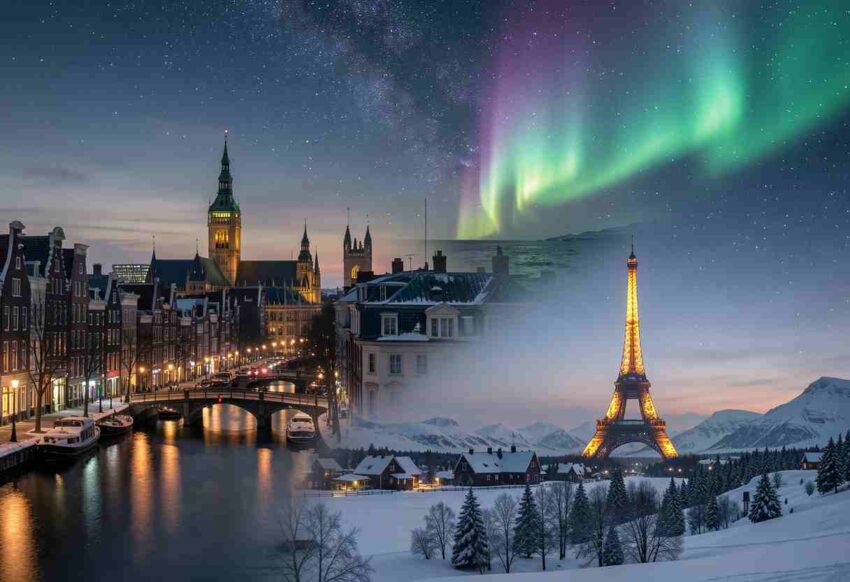
Rome Unites Amsterdam, London, Madrid, Paris, Tromsø and Rovaniemi at the Heart of Europe’s 2026 Noctourism Surge in Spectacular Night-Time Travel
Rome Unites Amsterdam, London, Madrid, Paris, Tromsø and Rovaniemi at the Heart of Europe’s 2026 Noctourism Surge in Spectacular Night-Time Travel
Noctourism has emerged as one of the most powerful travel shifts in twenty twenty six, transforming how destinations in Italy, the Netherlands, the United Kingdom, Spain, France, Norway, Finland, Ireland, Serbia, Germany, the Czech Republic, and other parts of Europe are being experienced after dark. This movement has been popularised by Booking.com through its twenty twenty five travel predictions, which highlighted noctourism as a core global trend built around stargazing, illuminated heritage walks, late-night museums, twilight safaris, night markets, and curated cultural tours under the night sky. A large-scale survey of more than twenty seven thousand travellers across thirty three countries showed that sixty two per cent are considering trips centred on night-time activities, with seventy two per cent expressing interest in dark-sky experiences and fifty four per cent planning more evening-based itineraries to escape rising daytime heat.
At the same time, a detailed Noctourism Hotspots Index from Radical Storage has ranked fifty cities worldwide across experiences, natural factors, safety, and night-time transport, placing several European destinations in leading positions and confirming Europe’s central role in this new travel era. Parallel to this, the European Union has supported the URBACT Cities After Dark network, encouraging cities to treat the period between six in the evening and six in the morning as a critical layer of their urban and tourism strategies.
Understanding noctourism as a European trend
The concept of noctourism has been framed as a reimagining of travel around what happens after sunset, rather than a narrow focus on bars and clubs. Under this broader lens, night-time tourism has been seen to include astro-tourism, night safaris, late-opening museums, evening food markets, illuminated walking tours, and cultural performances that are scheduled to take place under cooler temperatures and softer light.
Several structural drivers are shaping this trend across the continent. Climate change is encouraging travellers to avoid peak daytime heat, with more than half of surveyed travellers intending to shift certain activities into the evening hours to reduce sun exposure. Overtourism in popular European capitals has also been prompting authorities to push visitors into off-peak time slots, especially in the evenings, to spread crowds more evenly across the day. In addition, a strong appetite for more atmospheric, crowd-free encounters with icons such as the Colosseum in Rome, the canals of Amsterdam, or the Northern Lights above Tromsø and Rovaniemi is being recorded.
The policy landscape has been adapting in tandem. The URBACT Cities After Dark network, supported by the European Union, has been positioned as the first co-funded initiative devoted to night-time economy planning, bringing together ten European cities to share methodologies and create integrated action plans for life between six in the evening and six in the morning. This framework has been giving noctourism not only a commercial but also an institutional and governance dimension.
How Italy is leading: Rome as the world’s noctourism capital
In Italy, Rome has been placed at the top of the Radical Storage Noctourism Hotspots Index for twenty twenty six, with an overall score of six point zero seven out of ten. The Italian capital has been recognised for the breadth and quality of its night-time experiences, recording three hundred and five distinct night tours with an average rating of four point seven and an average price of fifty one euros per person.
One of the most emblematic offerings in Italy has been A Night at the Colosseum. This official programme has been operated through the Parco Archeologico del Colosseo and has been scheduled on Tuesdays and Thursdays from eight in the evening to midnight during the warmer months, generally from mid May to late October. Visitors have been guided for about sixty minutes across the arena floor and through the underground tunnels in groups of up to twenty five, with a full-price ticket set at fifty euros. During winter and early spring, these night tours have been placed on seasonal pause, with resumption anticipated around May twenty twenty six.
Another major nocturnal fixture in Italy has been La Notte dei Musei in Rome. For twenty twenty six, this event has been expected on the sixteenth of May, aligning with the wider European Night of Museums initiative supported by UNESCO, the Council of Europe, and ICOM. More than sixty civic and state museums in the Italian capital have been scheduled to open at night with symbolic one euro entry, complemented by concerts, theatrical performances, temporary installations, and guided visits.
The Jubilee twenty twenty five Holy Year, running from December twenty fourth twenty twenty four to January sixth twenty twenty six, has drawn an estimated thirty five million pilgrims and visitors to Rome. In response, Italy has directed large-scale investment into metro upgrades, monument restoration, and public realm improvements, many of which have had a direct impact on the comfort and capacity of night-time tourism. Rome has been assessed with a transport index of five point eight, supported by metro and night bus services running until approximately eleven thirty at night, for an average one-way fare of one euro and fifty one cents. At the same time, Italy has begun to experiment with overtourism management through measures such as an access fee around the Trevi Fountain, a policy that has been expected to encourage more evening and shoulder-hour visits rather than midday clustering.
Together, these developments have placed Italy at the forefront of global noctourism, with Rome acting as a symbolic and practical leader in structured night-time tourism experiences.
The Netherlands and its night-time canals: Amsterdam after dark
In the Netherlands, Amsterdam has been ranked joint second in the Noctourism Hotspots Index, with a total score of six point zero three. The Dutch capital has achieved the highest safety rating among the top European cities in the index at eight point three, combined with a strong experiences score of seven point five. Amsterdam has been hosting one hundred and sixty four night tours at an average cost of thirty euros, with an average rating of four point six.
A focal point for noctourism in the Netherlands has been the Amsterdam Light Festival. The fourteenth edition, held between November twenty seventh twenty twenty five and January eighteenth twenty twenty six under the theme Legacy, has brought twenty light artworks by international artists onto and around the UNESCO-listed canal belt. These works have been experienced via dedicated canal cruises and free walking routes each evening, generally from five in the afternoon to eleven at night, creating a structured and visually compelling night-time route through the historic city. The fifteenth edition has already been confirmed for November twenty twenty six, signalling a continuous investment in after-dark cultural programming.
Beyond the festival, the Netherlands has cultivated a governance model for night-time life in Amsterdam that has drawn global attention. The city has been among the first in the world to establish the role of a nachtburgemeester, or night mayor, tasked with mediating between residents, businesses, visitors, and authorities on issues such as noise, safety, and late-night mobility. Through its Tourism in Balance regulation, Amsterdam has been imposing caps on overnight stays and shaping rules for visitor management in order to preserve quality of life while maintaining its appeal as a vibrant destination.
While Amsterdam’s transport index at four point seven is lower than certain peers, partly because regular public transport generally stops around twelve thirty in the morning and tickets average three euros and forty one cents, the compact size of the city and its dense cycling network have been facilitating straightforward night-time navigation. In this way, the Netherlands has balanced its nocturnal appeal with an emphasis on safety and community impact.
The United Kingdom’s twenty four hour ambitions: London’s night-time reforms
In the United Kingdom, London has been placed seventh in the global Noctourism Index with an overall score of five point seven, but it has ranked second in experiences with an index of eight point eight, behind only Rome. The British capital has offered two hundred and seventy six night tours with an average cost of thirty two euros and an average rating of four point four. These tours have included West End theatre productions, comedy nights, Thames river dinner cruises, evening cable car rides over the Docklands, and open-top sightseeing routes past Buckingham Palace, the Tower of London, and other illuminated landmarks.
The night-time economy in the United Kingdom’s capital has been valued at approximately twenty one point zero five billion pounds for twenty twenty four, underlining its macroeconomic significance. In February twenty twenty six, a London Nightlife Taskforce report, commissioned by the Mayor of London, has released twenty three recommendations aimed at safeguarding and expanding this sector.
Key proposals in the United Kingdom context have included official recognition of nightlife, defined as social and cultural participation between six in the evening and six in the morning, as a sector to be specifically championed by the Department for Culture, Media and Sport. A Nightlife Commission has been proposed to offer strategic oversight, alongside a Nightlife Future Fund designed to provide seed finance for innovative night-time ventures. A Night-Time Business Cost Relief Scheme has been suggested to address financial pressures through targeted VAT relief and a reframing of business rates to better reflect cultural and economic contributions.
In regulatory terms, work has been progressing on a Draft London Strategic Licensing Policy twenty twenty six to twenty thirty one, which has been intended to align licensing decisions with the broader vision of a thriving night-time economy. The Heart of London Business Alliance has also implemented an Evening and Night-Time Economy Strategy for the West End, covering the core six in the evening to six in the morning period, and has noted that the area generates approximately four point nine billion pounds for the United Kingdom economy, twenty per cent of which is attributed to activities taking place during evening and night-time hours.
The Good Travel Management study has ranked London fourth globally for noctourism, identifying that fourteen point one per cent of its five thousand three hundred and seventeen top-rated attractions, or seven hundred and fifty one venues, remain accessible at night, the highest absolute number for any city included in the analysis. Through this combination of policy reform, economic scale, and sheer volume of experiences, the United Kingdom is positioning its capital as a model for the twenty four hour city.
Spain’s rising star: Madrid and Barcelona after dark
Within Spain, two cities have come into particular focus: Madrid and Barcelona. Madrid has not been listed in the top ten of the Radical Storage overall rankings but has led critical noctourism sub-indices and has been named Europe’s Best Destination twenty twenty six by European Best Destinations.
Madrid and Belgrade have shared the highest transport score at eight point zero out of ten, with Madrid’s integrated public transport network offering one-way fares at one euro and fifty one cents and operations extending until two in the morning. These services have been complemented by the búhos network of night buses that continue running through the late hours, making the Spanish capital one of the most accessible cities in Europe for after-dark travel.
A Good Travel Management analysis has ranked Madrid second worldwide, noting that fourteen point nine per cent of its two thousand one hundred and sixty two best-rated attractions, or three hundred and twenty three venues, are open at night, the highest proportion in Europe. The Spanish capital has been offering illuminated walking routes around the Royal Palace, Puerta del Sol, and Gran Vía, as well as flamenco dinner shows, late-night tapas crawls in districts such as La Latina and Malasaña, and rooftop terraces overlooking Cibeles and surrounding boulevards.
Madrid has also been strongly recognised at the branding level. Time Out has named it Europe’s top nightlife city based on survey responses from more than twenty thousand participants across over one hundred countries. European Best Destinations has declared Madrid the Number One European Best Destination for twenty twenty six, with Tourism Councillor Almudena Maillo attributing this positioning to the city’s distinctive atmosphere. At FITUR twenty twenty six, held in Madrid, Mayor José Luis Martínez-Almeida has announced that international visitor spending in the city has surpassed seventeen point eight billion euros in twenty twenty five, which represents a rise of approximately one point five billion euros compared with twenty twenty four. A Tourism Decentralisation Plan and a Tourist Mobility Strategy have been unveiled to distribute visitor benefits more evenly across districts and to further strengthen Madrid’s mobility offer.
Barcelona, meanwhile, has been identified as another key Spanish player in noctourism. According to the Good Travel Management study, three hundred and sixty of Barcelona’s two thousand nine hundred and forty seven top-rated attractions, representing twelve point two per cent, are available at night, placing the city sixth globally in this metric. The twenty twenty six events calendar in Barcelona has been dominated by night-oriented festivals such as Primavera Sound in early June, the Sónar electronic music festival from the eighteenth to the twentieth of June, and the Tour de France Grand Départ on the fourth of July, all of which have significant evening components. Spain has also been utilising tourism taxes, including an increased nightly tourist levy in Barcelona, to manage overtourism and support infrastructure that indirectly benefits nocturnal visitors.
Together, these developments in Madrid and Barcelona have illustrated how Spain is using noctourism both as an economic engine and as a tool for more balanced visitor management.
France and EU governance: Paris and the Cities After Dark network
France has been represented strongly by Paris in the noctourism landscape. Paris has tied for eighth place in the Radical Storage ranking with an overall score of five point six seven, including an experiences index of eight point two and a transport index of six point six, one of the highest among the top ten destinations. The French capital has hosted two hundred and sixty five night tours, typically priced around fifty nine euros and rated at four point five on average.
On the experiential side, France has promoted open-top bus tours that pass through illuminated Parisian corridors, such as the Eiffel Tower, the Champs-Élysées, the Notre-Dame area, and the Arc de Triomphe, which are among the most frequently booked night excursions in Europe. Nuit Blanche, Paris’s well-known all-night contemporary art festival, and regular late-night museum programmes and Seine dinner cruises have broadened the city’s nocturnal cultural offer.
At the governance level, France has played a pivotal role in the URBACT Cities After Dark network. Paris has been one of ten partner cities participating in this European Union co-funded project, which has aimed to generate Integrated Action Plans for the night-time economy between twenty twenty three and twenty twenty five. Paris has built on an existing Council for Night Life, created in twenty fourteen, which implemented thirty seven initiatives between twenty fourteen and twenty twenty, and has used URBACT to renew and systematise its approach.
Through this process, France has supported the development of eight thematic working groups in Paris, covering new night-time spaces, risk prevention, discrimination, mobility, safety, retail and work, nightlife promotion, and ecological transition. The resulting Integrated Action Plan has aimed to deliver a global, coordinated, and participatory strategy that positively shapes night-time behaviours in the French capital.
The broader URBACT Cities After Dark handbook, Cities After Dark in ten steps, published in late twenty twenty five, has synthesised lessons from ten cities including Braga, Budva, Genoa, Málaga, Nicosia, Paris, Piraeus, Tallinn, Varna, and Zadar. This guide has provided European municipalities with stepwise recommendations such as understanding their night-time economy, involving stakeholders, rethinking public spaces after dark, ensuring services run beyond six in the evening, enabling sustainable night mobility, and carefully measuring impacts. Across these steps, French participation has contributed to European-level thinking on safe, inclusive, and creative night-time environments.
Nordic and Celtic contributions: Norway, Finland, Ireland, and others
In Norway, Tromsø has shared second place in the Radical Storage global ranking with an overall score of six point zero three and the highest natural factor index of seven point three eight among the top ten cities. With only around three hours and forty five minutes of daylight in winter and relatively low light pollution, Tromsø has been recognised as one of the world’s premier locations for observing the Northern Lights. From late August to early April, aurora viewing opportunities have been present, particularly between six in the evening and two in the morning on clear nights, supported by specialised night tours that can cross into Finland or Sweden to chase clearer skies, as well as reindeer sledding and snowmobile excursions under the aurora. Norway’s strong safety score of eight point one has further bolstered its noctourism appeal.
In Finland, Rovaniemi has been ranked fourth in the overall index with a composite score of five point nine one, achieving a safety rating of nine point four, the highest in the top ten, and a natural factor index of six point one five. Rovaniemi, known for its Santa Claus branding, has offered one hundred and fifty three night tours ranging from Northern Lights safaris to late-night barbecues and forest visits, at an average price around one hundred and twenty six euros. The Northern Lights have been visible in this region from late August through mid April, with limited winter daylight of approximately five hours and twenty four minutes further enhancing the length of night suitable for aurora tourism.
In Ireland, Dublin has been highlighted in the Good Travel Management study as a leading noctourism destination, ranking third globally with fourteen point five per cent of its one thousand two hundred and eighty six top-rated attractions, representing one hundred and eighty six venues, open at night. Tourism Ireland has announced ambitious twenty twenty six marketing plans to increase overseas visitor arrivals, some of which are expected to support growth in evening and night-time experiences.
Other European locations have made notable contributions. In Serbia, Belgrade has shared the top night-time transport score with Madrid, with a zero-fare public transport model in place since January twenty twenty five, allowing residents and visitors to use buses, trams, trolleybuses, and BG trains free of charge until approximately twelve thirty at night. In Germany, Munich has recorded a safety index of eight point nine, enhancing its status as a secure city for after-dark experiences linked to its beer halls, historic centre, and nearby dark-sky landscapes. In the Czech Republic, Prague has reported a safety index of eight point five and has been celebrated for its illuminated Gothic architecture and atmospheric Old Town at night.
In the United Kingdom’s Orkney Islands, the highest natural factor index in the Radical Storage analysis has been recorded at eight point eight four, thanks to extremely low light pollution and almost eight hours of winter daylight, creating strong conditions for celestial and aurora viewing. In Iceland, Reykjavik has combined a safety score of eight point five with a natural factors index of five point two, positioning it as another important node in the northern noctourism corridor.
European Union institutions and the strategic framing of noctourism
At the European Union level, noctourism has been gradually integrated into broader tourism and urban policy discussions. On the twenty sixth of January twenty twenty six, the European Commission convened European Tourism Day in Brussels, under the leadership of Commissioner for Sustainable Transport and Tourism Apostolos Tzitzikostas. This event examined recent policy developments and considered priorities for a forthcoming EU Strategy for Sustainable Tourism, while hearing from senior executives of TUI, Radisson Hotel Group, TripAdvisor, and the European Tourism Association on emerging trends, including the growing importance of night-time travel and experiences.
Concurrently, the World Tourism Organization has projected that twenty twenty six is on course to set new records for international tourism, with anticipated growth of three to four per cent over the previous year. Within this environment, noctourism has been viewed as both an economic driver and a management instrument, allowing European cities and regions to extend tourism activity beyond daylight hours, ease daytime crowding, diversify revenue streams, and offer richer, more memorable experiences for visitors.
The URBACT Cities After Dark handbook has been described as a legacy tool for European local governments, offering a ten-step template that can be adapted to different national contexts. Its emphasis on equality, green transition, and digital transformation has aligned noctourism policy with wider EU priorities, ensuring that the night-time economy is treated not only as a source of entertainment but also as a laboratory for inclusive, sustainable, and technologically informed urban innovation.
The post Rome Unites Amsterdam, London, Madrid, Paris, Tromsø and Rovaniemi at the Heart of Europe’s 2026 Noctourism Surge in Spectacular Night-Time Travel appeared first on Travel And Tour World.
Source: travelandtourworld.com



Sorry, the comment form is closed at this time.