


Saudia Flight Safety Under Middle East Airspace Curbs, Verified Facts, Disruptions and Key Insights: New Updates
Saudia Flight Safety Under Middle East Airspace Curbs, Verified Facts, Disruptions and Key Insights: New Updates
Saudia’s current operating environment has become even more complex today as the latest joint military actions by the United States and Israel against Iranian targets intensify regional aviation risk and trigger new airspace restrictions across the Middle East. Authorities are again using emergency notices and route bans to keep civil aircraft away from areas where missiles and drones may be active, and Saudia’s network is directly affected.
Headline context and key points for today
Saudia flights are being reshaped in real time by fresh airspace closures and security advisories issued after US–Israel strikes on Iranian territory.
The confirmed technical event on Saudia flight SV3112 (Jeddah–Lucknow), with about 250 Hajj pilgrims safely evacuated and no injuries, remains a recent reminder of how onboard incidents are handled under pressure.
Earlier serious Saudia emergencies still centre on landing‑gear faults and precautionary emergency landings, not loss of aircraft control.
Governments and aviation regulators are tightening routing rules and issuing NOTAMs to keep passenger flights clear of active military operations and high‑risk zones.
How today’s regional escalation is reshaping Saudia routes
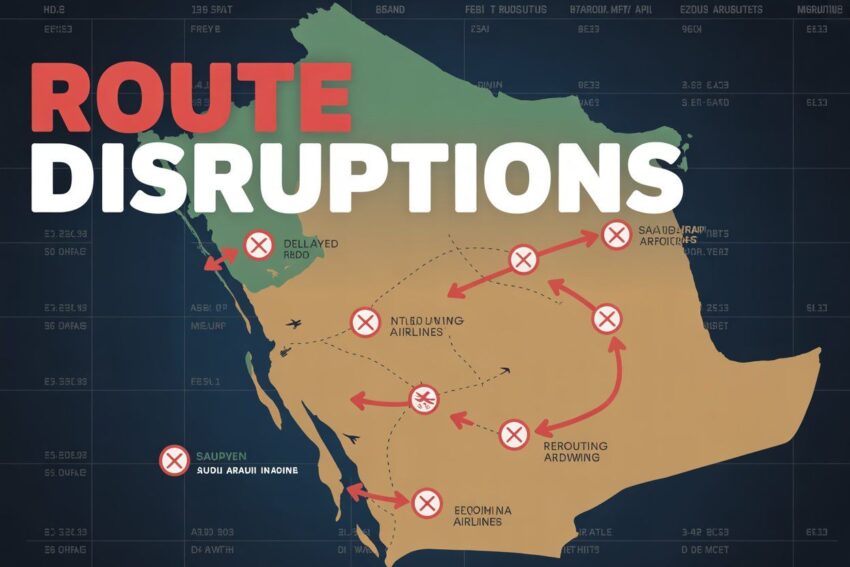
With new US–Israel strikes on Iran, Middle East airspace management has shifted from “heightened tension” to an acutely sensitive phase. Several states in the region are expected to either fully close or heavily restrict parts of their skies to civil overflights that might intersect with military activity or missile trajectories. For Saudia, this means:
Long‑haul corridors that overfly or pass near Iran, Iraq, Syria or adjacent high‑risk sectors may be shut off or limited at certain levels.
Flights between Saudi Arabia and Europe, parts of Asia and North Africa may need to detour significantly, adding time, fuel burn and possible technical stops.
Some routes could be suspended at short notice if there is no safe, regulator‑approved alternative track available.
Operators like Saudia will be forced into rapid, rolling replans of flight paths, often hours or even minutes before departure. Dispatch teams will avoid specific waypoints and altitudes mentioned in the latest NOTAMs and conflict‑zone bulletins, while air‑traffic control units in Saudi Arabia and neighbouring states manage heavier‑than‑usual flows in corridors still deemed safe.
What this means for passengers flying Saudia today
For travellers, the immediate impact of today’s developments is disruption and uncertainty, even on flights that remain technically “operational”:
Longer flight times: Detours around newly restricted areas will add distance and sometimes require lower cruise levels, stretching block times.
Schedule changes on short notice: Departure and arrival times may be retimed, swapped, or delayed as Saudia adapts to evolving restrictions and military activities.
Higher risk of missed connections: Passengers connecting through Jeddah, Riyadh or other Saudi hubs will face a greater chance of misconnecting, with rebooking handled case by case.
Route changes without cancellation: Even when flights operate, their tracks on the map may look very different from usual, taking wider arcs around Iranian and neighbouring airspace.
In this environment, “on time” no longer guarantees “as planned”: the path used to reach a destination is being driven primarily by safety and regulatory constraints, not by the shortest great‑circle route.
Saudia flight SV3112 and why it matters in today’s context
The previously confirmed incident involving Saudia flight SV3112 from Jeddah to Lucknow remains a relevant reference point for how the airline and authorities respond when something goes wrong on a flight, regardless of the regional security backdrop.
The Airbus A330‑343 landed in Lucknow with around 250 Hajj pilgrims on board.
Smoke and sparks observed from the left main landing‑gear wheels triggered a full airport emergency response.
Ground checks found a hydraulic oil leak in the landing‑gear system that overheated part of the wheel assembly.
The aircraft was stabilised on the runway, then moved to a safe taxiway position; the crew, tower and emergency services remained in constant communication.
All passengers and crew were safely evacuated with no reported injuries, and the aircraft was later ferried empty after engineering checks.
In today’s more volatile regional setting, this case underlines that Saudia’s onboard safety management and ground response are designed to cope with technical issues at the same time as the airline navigates external security pressures.
Earlier emergencies still shaped mainly by landing‑gear faults
The most serious Saudia‑linked emergencies in recent years continue to be concentrated around landing‑gear malfunctions:
A leased Boeing 767‑300ER operating under the Saudia brand experienced a right main‑gear failure on approach to Medina, resulting in an emergency landing and slide evacuation. Fourteen passengers sustained minor injuries and three had serious injuries, mostly linked to the evacuation process.
An Airbus A330‑200, operated for Saudia on flight 3818, diverted to Jeddah from its planned Medina–Dhaka route due to a nose‑gear problem and landed with the nose gear retracted; no injuries were reported.
This pattern is important to keep in view today: even as regional risks rise due to military operations, Saudia’s documented emergencies are predominantly technical and localised, not the result of direct interaction with regional hostilities. Emergency procedures and crew training remain the main tools for containing those risks.
Regulatory response today: NOTAMs, closures and conflict‑zone guidance
In light of current US–Israel actions against Iran, regulators and information providers are expected to:
Issue new or updated NOTAMs closing or severely restricting parts of Iranian and neighbouring airspace to civil traffic.
Re‑classify certain flight information regions as high‑risk, advising operators to avoid them altogether or use them only under strict conditions.
Publish conflict‑zone bulletins outlining missile and drone activity zones, expected trajectories, and altitude bands to avoid.
For Saudia, each new notice can trigger one of three outcomes on affected flights:
Reroute: The flight operates but takes a longer, safer path.
Delay: Departure is pushed back while planners reassess conditions or wait for off‑peak windows.
Cancel: The flight is scrubbed when no route meets the airline’s and regulators’ safety thresholds.
This constant recalibration is likely to continue as long as US, Israeli and Iranian forces remain engaged in active operations and as long as there is a risk of spillover toward major civil airways.
Safety procedures and passenger guidance in today’s situation
In the current environment, one principle doesn’t change: diversions, emergency landings and on‑ground evacuations are built into the system to protect people, not to signal an erosion of safety standards.
For passengers flying Saudia today or in the coming days:
Monitor official channels only: Rely on the airline’s website/app, airport websites, and official aviation or government alerts. Avoid decisions based on unverified social media rumours.
Expect last‑minute changes: Have backup plans for onward travel and build in extra time for connections, especially at Jeddah and Riyadh.
Stay reachable: Ensure your booking has a working phone number and email so the airline can notify you of rebookings or gate changes.
Follow crew instructions closely: In the unlikely event of an in‑flight or landing‑phase incident, prompt and calm compliance with crew directions is crucial.
Saudia, like other carriers in the region, is now balancing two layers of safety at once: internal aircraft reliability and operating procedures, and external constraints driven by today’s large‑scale military operations. The result, from a passenger’s perspective, is more disruption—but also a system that is deliberately biased toward caution and risk avoidance rather than operational convenience.
Section / ThemeKey ElementSpecific DetailsHeadline focusCore operational impactSaudia’s network is being reshaped by regional airspace closures, security notices, and conflict‑driven risk assessments.Headline focusConfirmed technical incidentFlight SV3112 (Jeddah–Lucknow) experienced a landing‑gear related hydraulic issue; around 250 Hajj pilgrims were safely evacuated with no injuries.Headline focusNature of past emergenciesPrevious serious Saudia emergencies are mainly tied to landing‑gear malfunctions and precautionary, safety‑driven diversions.Headline focusRole of authoritiesRegulators use NOTAMs, route restrictions, and partial airspace closures to keep civil traffic away from conflict zones.Airspace restrictionsRegions affectedClosures/limits over parts of Iran, Iraq, Syria, Jordan and nearby conflict‑exposed areas have disrupted standard long‑haul corridors.Airspace restrictionsOperational effect on SaudiaSaudia and other airlines must redesign flight plans, add extra distance, and sometimes suspend certain routings when no safe alternative exists.Airspace restrictionsIranian measuresIran’s Ministry of Roads and Urban Development and ANSPs have temporarily closed or narrowed airspace segments after attacks or spikes in military activity.Airspace restrictionsUse of NOTAMsFormal NOTAMs and public statements instruct airlines to avoid specific FIRs and altitude bands during sensitive periods.Airspace restrictionsTraffic patternsTraffic has shifted to southern and northern corridors, increasing congestion over parts of Saudi airspace despite strict safety compliance.Passenger impactSchedule disruptionLonger flight times, re‑timed schedules and same‑day changes have become more frequent on routes via Jeddah, Riyadh and other Saudi hubs.Passenger impactConnection riskTravellers risk missed connections and longer layovers as timetables are adjusted to follow evolving regulatory guidance.Passenger impactHidden route changesEven when flights operate on time, routings may be significantly altered to remain clear of conflict‑affected skies.SV3112 incidentFlight detailsSaudia A330‑343, flight SV3112 from Jeddah to Lucknow, carrying a large group of Hajj pilgrims.SV3112 incidentWhat happened on landingSmoke and sparks were seen from the left‑hand main‑gear wheels at Lucknow, triggering an airport‑level emergency response.SV3112 incidentCause identifiedGround investigation found a hydraulic oil leak in the landing‑gear system, causing overheating in the wheel assembly.SV3112 incidentResponse stepsAircraft stabilised on the runway, then moved to a safe taxiway position for inspection and cooling; continuous coordination between cockpit, ATC and emergency services.SV3112 incidentPassenger outcomeAround 250 pilgrims plus crew safely deplaned, no injuries reported, full emergency protocol activated at Chaudhary Charan Singh International Airport.SV3112 incidentOperational aftermathNo additional damage reported; runway cleared, airport operations minimally affected; aircraft later repositioned empty after checks and clearance.Historical incidents2014 Medina emergencyLeased Boeing 767‑300ER under Saudia banner suffered right main‑gear failure at Prince Mohammad bin Abdulaziz International Airport, leading to an emergency landing and slide evacuation.Historical incidentsMedina injuries and damage14 passengers with minor injuries and 3 with serious injuries, mainly from evacuation; aircraft had substantial but contained structural damage.Historical incidents2018 Jeddah diversionAirbus A330‑200 operated by Onur Air for Saudia as flight 3818 diverted from Medina–Dhaka to Jeddah due to a nose‑gear malfunction.Historical incidents2018 landing outcomeAircraft landed with nose gear retracted, showed sparks and nose‑down attitude, but no passenger or crew injuries were reported.Historical incidentsTechnical patternMajor emergency landings in Saudia’s record are predominantly associated with landing‑gear system faults, not in‑flight structural failures.Regional risk contextDrivers of riskConflicts involving Israel, Iran and non‑state actors have increased missile and drone activity near civilian routes.Regional risk contextRegulator warningsEASA and FAA advisories warn of potential spillover into the airspace of Egypt, Saudi Arabia and neighbouring states, recommending avoidance of certain airways and altitudes.Regional risk contextIranian policy stanceIran presents closures and partial reopenings as safety‑driven, using time‑bound NOTAMs to govern when routes can be used.Regional risk contextEmbassy guidanceEmbassies, including the US mission in Iran, warn travellers that schedules may remain unstable, with last‑minute cancellations and diversions likely even after partial reopening.Operational planningImpact on Saudia planningSaudia must continuously replan its network: some flights are rerouted, some delayed for safer windows, others cancelled when risks exceed thresholds.Safety protocolsPurpose of emergenciesEmergency landings, diversions and evacuations are treated as core safety mechanisms, not evidence of lax safety culture.Safety protocolsCrew actionsIn SV3112, Medina and Jeddah events, crews followed checklists, declared appropriate emergencies and coordinated with ARFF and ATC to stabilise aircraft and evacuate passengers.Safety protocolsRisk reductionProcedures for emergency landings and rapid evacuation substantially reduce passenger risk even when aircraft incur damage.Traveller adviceRecommended information sourcesPassengers are urged to rely on ministries of transport, civil‑aviation authorities, airports and airline channels for accurate, real‑time flight information.Traveller adviceNature of disruptionsShort‑notice cancellations, re‑timings and reroutes are framed as essential risk‑management tools in conflict‑adjacent airspace.Traveller advicePlanning tipsTravellers connecting via Jeddah or Riyadh should allow for schedule variability, build in longer connection times and monitor live updates from their airline and departure airport.
The confirmed Saudia incident: SV3112 from Jeddah to Lucknow
One of the most recent Saudia operational events to be formally acknowledged by Indian authorities involves flight SV3112 from Jeddah to Lucknow, which was carrying a large group of Hajj pilgrims. The wide‑body Airbus A330‑343 operated by Saudia landed at Chaudhary Charan Singh International Airport in Lucknow, where airport staff and observers noticed smoke and sparks coming from the left‑hand main‑gear wheels shortly after landing. This immediately triggered an airport‑level emergency response, with the Airport Rescue and Fire Fighting (ARFF) team deployed in coordination with the cockpit crew.
Investigations conducted on the ground indicated that the source of the smoke was a hydraulic oil leak in the landing‑gear system, which led to overheating in the affected wheel assembly. In line with standard operating procedures, the aircraft was first stabilised on the runway, then carefully moved to a safer position on the taxiway for technical inspections and cooling. Throughout the process, communication was maintained between the cockpit, the control tower and emergency services to ensure that the situation remained under control.
Airline and passengers involved in the confirmed event
Airline: Saudia (Saudi Arabian Airlines)
Flight: SV3112
Route: Jeddah – Lucknow
Aircraft type: Airbus A330‑343
Passengers: Around 250 Hajj pilgrims, plus crew
Outcome: All passengers safely deplaned, no injuries reported, smoke traced to a minor hydraulic leak in the landing‑gear area, full emergency response activated at Lucknow Airport
Authorities and local reports have not indicated any additional injuries or structural damage arising from this specific incident. Once the aircraft had been secured and the risk of further overheating removed, the runway was cleared and airport operations continued with only limited disruption. After maintenance checks and safety clearances, the aircraft was later repositioned without passengers, as is typical when an airframe needs to be ferried for further engineering assessment.
The post Saudia Flight Safety Under Middle East Airspace Curbs, Verified Facts, Disruptions and Key Insights: New Updates appeared first on Travel And Tour World.
Source: travelandtourworld.com



Sorry, the comment form is closed at this time.