


Seoul: T-Money or Climate Card? My Vote Goes 100% To Climate Card
When it comes to getting around Seoul efficiently, you’ll see two names pop up over and over again: T-Money and the Climate Card.
On paper, both sound useful. In reality, they serve very different types of trips. After using them firsthand, I have a clear favorite for Seoul.
Before my trip, everything I saw online screamed “Seoul travel hack: get a T-Money card”! That advice isn’t wrong, but it’s incomplete.
What no one talked about was the Climate Card, a newer option that offers unlimited rides on Seoul buses and subways. Once I realized that nearly everything we were doing was within Seoul, the math became obvious.
We were hopping on trains and buses constantly for hotel pickups, coffee stops, food runs, sightseeing, neighborhood hopping, etc. With the Climate Card, we never once thought about fares or transfers. We just tapped and went.
Had we used T-Money, every single ride would’ve chipped away at our balance. AND caused us anxiety. In some cases, I know I would have considered walking over spending unnecessarily on shorter rides.
So if your trip looks anything like ours (mostly Seoul, lots of moving around, and zero desire to track transit costs) this breakdown will make it very clear why my vote goes to the Climate Card.
This post may contain affiliate links. You won’t be paying a cent more, but in the event of a sale, the small affiliate commission I receive will help keep this blog running/pumping out useful and free content. Thanks a lot!
The Bottom Line
Hanging out in Seoul only? Climate Card, no question.
Seoul + beyond? Climate Card and T-money.
Mostly other parts of South Korea + a quick stop in Seoul? T-money only.
How Does the T-Money Card Work?
If you’re planning to move around Korea like an average Joe (aka taking trains/buses and not just taxis everywhere), the T-Money card is your best starting point. It’s a reloadable transportation card that works across almost all public transit in South Korea, not just Seoul.
With one card, you can ride:
Subways
City and regional buses
Taxis
And even use it for small purchases at convenience stores and vending machines
You simply tap in when you enter and tap out when you exit. No buying single tickets, no fumbling with cash, no language barrier stress.
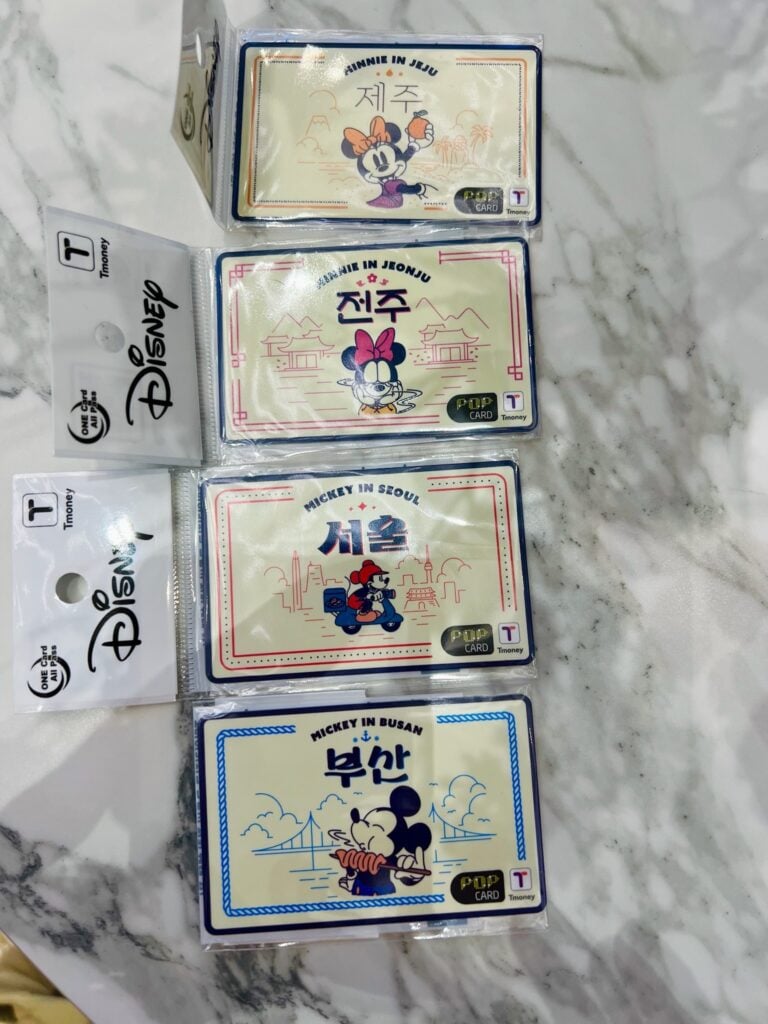
Our super cute Disney-themed T-Money cards!
One of the biggest perks is that T-Money automatically applies transfer discounts when you switch between buses and subways within a certain time window. You don’t need to do anything special — just keep tapping as you go, and the system does the math for you.
It’s also incredibly flexible. You can:
Top it up in seconds at subway station machines
Reload it at convenience stores like CU, GS25, or 7-Eleven
Add only as much money as you need (great if you’re bouncing between cities)
Who T-Money is best for:
First-time visitors
Travelers moving between multiple cities all over the country
Where to Buy a T-Money Card
You’ve got two easy options:
Before your trip: You can order a T-Money card on Klook and pick it up at the airport after you land. This is the most stress-free option (zero setup stress after a long flight).
Once you’re in Korea: T-Money cards are sold nearly everywhere, especially at convenience stores inside and outside subway stations. You’ll find them usually hanging near the register.
How Does The Climate Card Work?
The Climate Card is Seoul’s answer to unlimited transit — and it’s a game changer if you plan to stay mostly within the city.
Unlike T-Money, which deducts fare per ride, the Climate Card lets you ride unlimited buses and subways for a set number of days. No tracking balances, no wondering how much each ride costs. You just tap and go as much as you want!
During our 6-day trip to Seoul, we relied heavily on our Climate Card. We bought the 5-day unlimited pass, paid just about $10 USD per card, and it saved us SO much money!
IMPORTANT THINGS TO KNOW
The Climate Card is Seoul-only. It does not work for travel outside the city (except for the ride from Seoul -> ICN Airport). Here’s exactly where within Seoul you can use the Climate Card.
Unless you have a Korean card, the easiest option is to pay for the card in cash when you arrive in Seoul.
Look for them at the convenience stores. They look different from T-Money cards. It says “Climate Card” on them.
Climate Card Pricing (Unlimited Rides)
You choose your package based on how long you’ll be in Seoul (they’re all insanely cheap!):
1-day pass: KRW 5,000
2-day pass: KRW 8,000
3-day pass: KRW 10,000
5-day pass: KRW 15,000
7-day pass: KRW 20,000
For longer stays:
30-day pass: KRW 62,000
30-day pass + public bikes: KRW 65,000
A note on bikes: Access to Seoul’s public bike system (Ttareungi) requires a Korean phone number. If you don’t have one, skip the bike-included option — you won’t be able to activate it. The short-term passes also don’t come with bike access.
Once you choose your package, you can’t change it until it expires. The valid term begins on the date of charging the card with the multi-day package, NOT on the date of purchasing the card at the convenience store.
Where To Buy The Climate Card
Buying the Climate Card is a two-step process that does require a little bit of hunting, but it’s still pretty easy.
First, purchase the physical card:
Available at convenience stores (GS25, 7-Eleven, CU, etc.)
Also sold at customer safety areas inside Seoul Metro Lines 1–8
Card itself costs KRW 3,000 (cash only)
Then, load your pass:
Use the subway station machines to select your package
Payment is accepted via cash or a Korean credit/debit card
Once activated, you’re good to ride unlimited until your pass expires.
T-Money vs Climate Card: Which One Should You Use?
This really comes down to what your travel itinerary looks like.
If you’re hopping cities or want one card that works all over Korea → T-Money
If you’re staying in Seoul and plan to move around a lot each day → Climate Card
Plenty of travelers (myself included) end up using both depending on the trip.
Which Card Is Better for Seoul?
If you’re spending most (or all) of your time in Seoul, the answer is easy: get the Climate Card.
For our first trip to South Korea, we spent about a week entirely in Seoul, and the Climate Card paid for itself almost immediately. Every subway ride, bus hop, and random cross-city errand was essentially “free” once we activated it. We weren’t thinking about fares, balances, or tapping into a remaining amount—we just hopped on and went.
Because all of our transportation stayed within Seoul, there was no real need for a T-money card from a transit standpoint. The only reason we still carried one was for convenience—being able to pay for drinks, snacks, or quick convenience store stops without dealing with cash. But for getting around the city? Climate Card all the way.
If you plan to bounce around neighborhoods, take the subway multiple times a day, or just explore without overthinking logistics, the Climate Card is hands-down the most cost-effective and stress-free option.
What If You’re Visiting Seoul and Other Parts of Korea?
If your trip includes Seoul plus other cities—think Busan, Jeju, Gyeongju, or anywhere outside the capital—then having both cards actually makes the most sense.
Here’s why:
The Climate Card only works in Seoul. Once you leave the city, it’s basically useless. Meanwhile, the T-money card works nationwide, making it essential for intercity travel and local transit outside of Seoul.
In this case, the ideal setup looks like this:
Use the Climate Card during your longer stay in Seoul to save money on unlimited rides.
Use your T-money card for everywhere else—subways, buses, taxis, and even small purchases across South Korea.
That said, if you’re only spending 2–3 days in Seoul before moving on, the Climate Card probably isn’t worth it. In that situation, just grab a T-money card and pay as you go. It’s widely accepted, easy to use, and keeps things simple for shorter stays.
Our Experience With The Climate Card
We visited about three convenience stores before we finally found the Climate Card hanging on the wall of a 7-Eleven. I was so stoked when I finally found it, because I did read that they were a little bit hard to find (especially in touristy areas like Myeongdong–where our hotel was located).
Luckily, in the Myeongdong area, convenience stores are practically on every corner, so we were able to pop in and out of three convenience stores within a time span of only 10 minutes.
We purchased 4 cards totaling 12,000 won (about $8 USD). We plan to reuse them on future trips, so our $8 wasn’t wasted whatsoever.
We hung onto these cards until the following day, at which point we were going to start using them for our remaining five days in Seoul. We headed to the local subway station and went to the top-up kiosk and loaded the pass with the 5-day unlimited travel package.
We paid for the package fare with cash, and it was a pretty straightforward process. Just follow the prompts on the kiosk screen.
From there, it was tap-and-go, and we never had to worry about how many rides we were taking or how much we were spending, which was ideal for us. We were traveling as a party of 4, two of whom were Papu’s elderly parents with limited mobility, who needed to take the bus and train more frequently than we would have if traveling on our own.
On an average day, we were easily hopping on trains or buses 5–6 times. Between sightseeing, meals, coffee stops, and swinging by Papu’s parents’ hotel to pick them up, we were constantly moving around the city.
The Climate Card saved us so much money over the six days we were in Seoul.
To put real numbers on it, if we’d paid as we went, one ride costs about ₩1,550.
6 rides per day × ₩1,550 = ₩9,300 per day (~$6.33 USD)
Over 5 days: ₩9,300 × 5 = ₩46,500 (~$32 USD)
If we had been using a T-money card, all of that would’ve been pay-as-you-go, meaning we would’ve spent ₩46,500 on transportation alone.
Instead, we used the 5-day Climate Card, which costs ₩15,000 total (~$10 USD) for unlimited rides.
That’s a difference of ₩31,500 saved ($22 USD) per person — and that’s without ever thinking twice about taking an extra train, making a quick detour, or splitting up and meeting back up later. AND that’s being conservative. Some days we rode more than 5-6 times.
Those extra hotel pickup runs? Normally, you’d think twice about them because each detour adds cost. But with the Climate Card, we never hesitated. We just hopped on, hopped off, and kept moving without mentally tallying every ride.
Clear winner? The Climate Card, no contest!
When we go back to Seoul next year, we are 100% opting for Climate Card again.
What About Day Trips Outside Of Seoul? Will The Climate Card Work?
Short answer: no. The Climate Card is Seoul-only.
If you take a day trip to places like Paju, Jeju, Suwon, Nami Island, or anywhere outside Seoul city limits, the Climate Card will not work on local buses, subways, or regional trains once you’re there. That’s where a T-money card becomes useful, since it works nationwide and is accepted almost everywhere in South Korea.
That said, this is why the Climate Card is such a good deal if most of your time is actually in Seoul. You’re not paying for rides you don’t need, and every subway or bus ride inside the city is already covered.
For us, day trips are usually non-negotiable, and we did do one while in Seoul. But we booked a guided day tour, which meant:
Transportation was included
No figuring out trains or buses
No need to use a T-money or Climate Card that day
That made the Climate Card still 100% worth it for the rest of the trip.
Pro Tip: If you’re leaning toward the Climate Card but want to add on a day trip from Seoul, book a guided tour. You avoid the logistics headache, and still get maximum value from unlimited Seoul transport the rest of the time.
If your itinerary is mostly DIY day trips outside Seoul, then T-money is the better option.
But if Seoul is your home base and day trips are occasional (or guided), the Climate Card is still the clear winner.
Other Posts You’ll Love:
Seoul For First Timers: 15 Must Do’s On Your Very First Trip!
Seoul is a sensory overload of a city. I mean that in a VERY good…
Read More
15 Cool Things To Do In Gangnam – Seoul Neighborhood Guide
Gangnam was my home base for most of my Seoul trip, which means I woke…
Read More
What To Bring Back From Seoul: 25 Ideas For Souvenir Shopping
Seoul has a way of making you fall in love downright obsessed with all the…
Read More
8 Cool Day Trips From Seoul To Escape The Big City Bustle
Once you decide to step outside Seoul, it quickly becomes clear that day trips here…
Read More
Myeongdong Neighborhood Guide: 16 Cool Things To Do In Seoul’s Livelist District
Myeongdong is the Seoul neighborhood that absolutely smacks the jetlag out of you the second…
Read More
15 Must-Try Foods At Gwangjang Market
Walking into Gwangjang Market is a feast for the senses. ALLLL the senses. The moment…
Read More
Source: travelswithelle.com



Sorry, the comment form is closed at this time.