


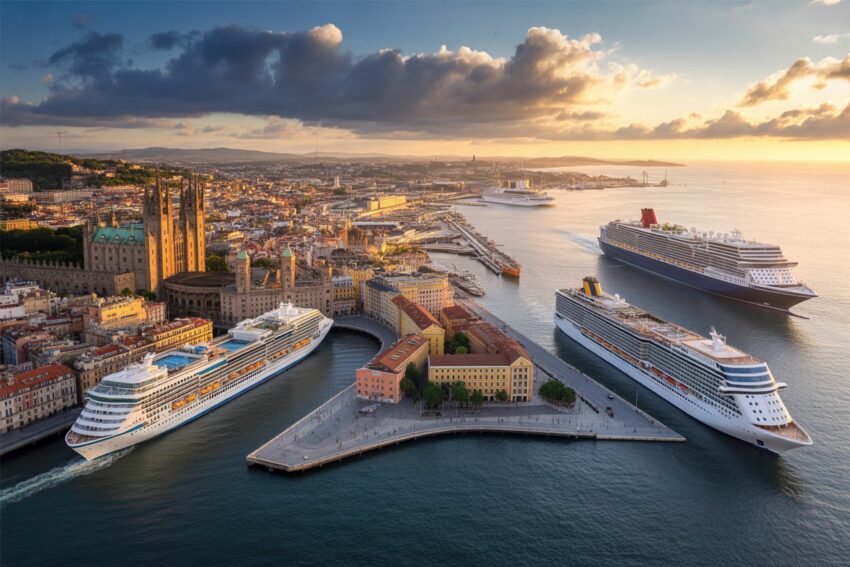
Southampton Joins Portland, Civitavecchia, Taranto, Piraeus and More European Cruise Ports Welcoming Millions of Passengers Last Year, Boosting Nautical Tourism: And the Consequences Could Be Far Bigger Than Anyone Expected
Southampton Joins Portland, Civitavecchia, Taranto, Piraeus and More European Cruise Ports Welcoming Millions of Passengers Last Year, Boosting Nautical Tourism: And the Consequences Could Be Far Bigger Than Anyone Expected
Southampton joins Portland, Civitavecchia, Taranto, Piraeus and more European crusie ports welcoming millions of crusie passengers last year, boosting nautical tourism—and suddenly the story is far bigger than anyone expected. Southampton joins Portland, Civitavecchia, Taranto, Piraeus and more European crusie ports welcoming millions of crusie passengers last year again, and the ripple effect across nautical tourism is impossible to ignore. From Southampton to Portland, from Civitavecchia to Taranto, and from Piraeus to more European crusie ports, the surge of crusie passengers last year is reshaping how nautical tourism works, grows and competes across Europe.
However, the consequences could be far bigger than anyone expected. Because when Southampton joins Portland, Civitavecchia, Taranto, Piraeus and more European crusie ports welcoming millions of crusie passengers last year, the scale of nautical tourism expansion becomes impossible to overlook. Ports are busier. Cities are transforming. Tourism flows are accelerating. And millions of crusie passengers arriving at European crusie ports are pushing nautical tourism into an entirely new phase.
Meanwhile, as Southampton joins Portland, Civitavecchia, Taranto, Piraeus and more European crusie ports welcoming millions of crusie passengers last year, experts warn that infrastructure, sustainability and economic impacts will define the next decade of nautical tourism. Therefore, the implications are unfolding fast. What happens next could change the future of European crusie ports, crusie passengers and nautical tourism altogether.
Travel And Tour World urges readers to read the entire story to uncover why this surge across Southampton, Portland, Civitavecchia, Taranto, Piraeus and more European crusie ports welcoming millions of crusie passengers last year could reshape global nautical tourism in ways few anticipated.
Europe’s cruise industry surged dramatically in 2025, marking one of the most powerful comebacks in modern tourism. From the sun-drenched Mediterranean hubs of Barcelona and Civitavecchia to the cool Baltic gateways of Stockholm and Tallinn, cruise ports across the continent welcomed millions of passengers and hundreds of ships. Official figures released by port authorities reveal that passenger numbers in many European destinations not only recovered from the pandemic years but in several cases surpassed pre-2019 records, highlighting a renewed appetite for ocean travel.
The data also shows a broader transformation taking place across Europe’s maritime tourism sector. Cruise ports are not only handling more ships and passengers but are also investing heavily in green infrastructure, modern terminals and year-round operations. As a result, Europe is consolidating its position as one of the most dynamic cruise regions in the world.
Mediterranean Ports Lead Europe’s Cruise Recovery
The Mediterranean remains the undisputed powerhouse of European cruising. Major ports in Italy, Spain and Greece handled the largest passenger volumes in 2025.
The Port of Civitavecchia, the main maritime gateway to Rome, remained one of Europe’s busiest cruise hubs. The port recorded more than 3.5 million cruise passengers in 2025, supported by over 860 ship calls. Large cruise lines continued to expand itineraries across the Western Mediterranean, bringing a steady flow of visitors eager to explore Rome and nearby Italian cultural destinations.
Further east, the Port of Piraeus in Greece experienced another landmark year. Nearly 1.85 million cruise passengers passed through the port in 2025. The port authority highlighted record ship arrivals and major investments in new terminals designed to accommodate next-generation cruise vessels.
Spain’s Port of Barcelona also demonstrated strong growth. By mid-2025 alone, the port had already welcomed 1.69 million cruise passengers, and final results indicated around 2.3 million cruise travellers for the full year. Barcelona’s continued success is linked to its role as a leading homeport, where passengers begin or end their voyages.
Meanwhile, Valencia also reported impressive numbers, handling roughly 799,000 cruise passengers across 267 ship calls. More than half of those visitors were transit passengers arriving for short shore excursions.
The Port of Vigo in northern Spain also saw cruise tourism surge, welcoming more than 306,000 cruise passengers, representing a dramatic increase compared with previous years.
Portugal Strengthens Its Atlantic Cruise Gateway
Portugal’s Atlantic ports recorded some of the most significant growth in Europe’s cruise sector.
The Port of Lisbon achieved its best year ever for turnaround cruises. More than 206,000 passengers started or ended their voyages in Lisbon, while overall cruise passenger numbers reached roughly 705,000 travellers. Port officials estimated that cruise tourism generated over €80 million in direct economic impact for the city.
Lisbon has increasingly become a strategic Atlantic hub for cruise lines operating transatlantic routes between Europe and North America.
Further south, the island port of Funchal in Madeira celebrated its busiest year ever. The port welcomed 331 cruise ship calls, bringing 746,000 passengers and more than 278,000 crew members to the island. Cruise tourism generated approximately €62.9 million for the local economy, according to regional authorities.
The Port of Leixões, serving Porto in northern Portugal, also continued its upward trajectory. By mid-2025 the port had already handled more than 142,000 passengers, and forecasts suggested a full-year total of around 240,000 cruise travellers.
Northern Europe’s Baltic Ports Experience Strong Growth
While the Mediterranean dominates in passenger numbers, Northern Europe and the Baltic Sea have become some of the fastest-growing cruise regions.
The Ports of Stockholm reported a particularly strong season. A total of 136 cruise ships visited the Swedish capital, bringing about 256,000 passengers. Officials noted that the number of calls and passenger volumes both increased significantly compared with previous years.
A major development in Stockholm was the inauguration of new shore-power connections, allowing cruise ships to switch off engines while docked. This move is part of a wider effort across Europe to reduce emissions in port cities.
In neighbouring Estonia, the Port of Tallinn experienced similar momentum. The port recorded 118 cruise ship calls, bringing nearly 190,000 passengers to the city. American, German and British travellers represented the largest share of cruise visitors.
Tallinn also reported an increase in winter cruises, with ships visiting during the colder months — a trend that reflects the growing popularity of year-round Baltic itineraries.
Scandinavian and Nordic Ports Expand Infrastructure
Northern European cruise ports are rapidly modernising infrastructure to accommodate larger ships and greener operations.
The Port of Helsinki reported around 175,000 cruise visitors in 2025, alongside more than 9.6 million total passengers across all maritime transport services. Cruise ship calls increased by more than 26 percent, showing renewed demand for Baltic itineraries.
In Denmark, Copenhagen Malmö Port (CMP) also recorded strong results. Copenhagen alone welcomed 316 cruise calls and nearly 866,500 cruise passengers. The nearby port of Visby in Sweden handled 160,500 passengers, while Malmö recorded smaller but growing cruise traffic.
A notable achievement in Copenhagen was the connection of 88 cruise ship visits to shore-power systems, reducing emissions and improving environmental sustainability.
Germany’s Cruise Ports See Continued Expansion
Germany’s Baltic ports also played a key role in Europe’s cruise rebound.
The Port of Kiel began its 2025 cruise season expecting 175 ship calls and roughly one million cruise passengers, continuing a trend of high demand in the Baltic cruise market.
Kiel has invested heavily in shore-power infrastructure, allowing ships to plug directly into renewable electricity while docked — a move widely seen as essential for sustainable port operations.
Meanwhile, the cruise port of Warnemünde near Rostock was expected to welcome more than 165 cruise calls and over half a million passengers, although final official figures were still being verified.
UK Cruise Ports Maintain Strong Market Position
The United Kingdom remains one of Europe’s most important cruise markets.
The Port of Southampton, operated by Associated British Ports, recorded a record-breaking 2025 cruise season. More than three million cruise passengers travelled through the port, with 449 ship visits during the year.
Southampton is one of Europe’s largest cruise departure hubs and continues to generate significant economic benefits for the surrounding region. Estimates suggest each cruise call contributes between £1.9 million and £2.5 million to the local economy.
Elsewhere in England, Portland Port in Dorset expected around 60 cruise calls and more than 100,000 passengers during 2025.
Ports such as Portsmouth and Dover also continued expanding cruise operations, although full passenger statistics had not yet been released.
Sustainability Becomes a Central Focus
Across Europe, port authorities increasingly emphasised sustainability and environmental protection.
Many ports — including Stockholm, Copenhagen, Kiel and Lisbon — expanded shore-power facilities that allow cruise ships to connect directly to electrical grids while docked. This technology significantly reduces emissions and noise pollution in port cities.
Several ports are also exploring zero-emission cruise terminals, electric shuttle transport for passengers, and improved waste-management systems.
A New Era for European Cruise Tourism
The statistics released by port authorities show that 2025 marked a turning point for European cruise tourism. Passenger numbers have rebounded strongly, infrastructure investments are accelerating, and cruise itineraries are expanding into new seasons and regions.
While Mediterranean ports still dominate in overall passenger numbers, the rapid growth of Baltic and Northern European destinations demonstrates that the continent’s cruise landscape is evolving.
As new ships enter service and ports continue investing in sustainability and capacity, Europe’s cruise sector appears poised for another decade of expansion and innovation.
The post Southampton Joins Portland, Civitavecchia, Taranto, Piraeus and More European Cruise Ports Welcoming Millions of Passengers Last Year, Boosting Nautical Tourism: And the Consequences Could Be Far Bigger Than Anyone Expected appeared first on Travel And Tour World.
Source: travelandtourworld.com



Sorry, the comment form is closed at this time.