


Thailand Emerges as the World’s Most Internationally Driven Hotel Market in 2025 with Overseas Guests Dominating Reservations and Supporting Strategic Rate Growth
Thailand Emerges as the World’s Most Internationally Driven Hotel Market in 2025 with Overseas Guests Dominating Reservations and Supporting Strategic Rate Growth
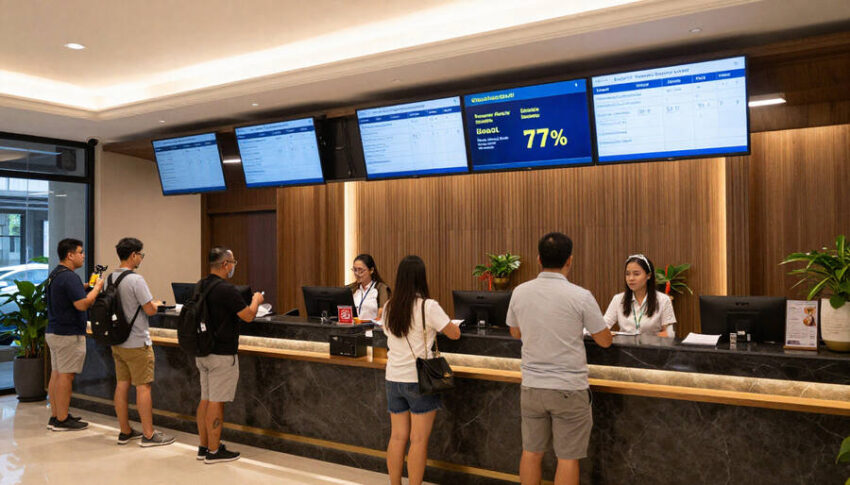
Thailand has positioned itself at the forefront of the global hospitality market in 2025, recording the highest share of international hotel bookings worldwide even as overall foreign arrival numbers fluctuated throughout the year. With overseas guests accounting for seventy seven percent of total hotel reservations, the country demonstrated that while visitor volumes may shift, global demand for Thailand’s accommodation sector remains remarkably strong and resilient.
New hospitality data reveals that 77 percent of all hotel reservations across Thailand were made by international travellers in 2025, a 1.14 percentage-point rise from the previous year. That figure stands as the highest international booking share recorded among leading global tourism markets, placing Thailand in a category of its own.
While some destinations leaned more heavily on domestic demand to cushion volatility, Thailand remained firmly anchored to cross-border travel. In comparison, international guests represented 49 percent of hotel bookings in Malaysia, 51 percent in Indonesia, 59 percent in Spain, 67 percent in Italy, and 53 percent in France. The gap highlights Thailand’s distinct positioning as a destination whose accommodation economy is overwhelmingly shaped by global mobility.
Shifting from Volume to Value
Although total foreign arrivals experienced fluctuations during the year, the profile of visitors evolved. Those who chose Thailand tended to stay longer and contribute more to hotel revenues.
Bookings of two nights or more climbed to 35 percent, up from 29 percent in 2024, making Thailand home to the longest-staying hotel guests in the Asia-Pacific region. This extension in stay duration helped hotels manage occupancy more efficiently and strengthened yield performance across key markets.
The change in travel behaviour supported pricing power. Thailand’s average daily rate (ADR) rose by 3 percent to THB 4,984, despite global economic uncertainty and mixed outbound sentiment in certain regions. Rather than competing purely on discounting, many hotels maintained rate integrity while targeting high-intent international travellers.
The year, however, unfolded unevenly.
Seasonal Highs and Market Sensitivity
January opened 2025 with strong momentum. Room rates surged 21 percent year-on-year to THB 6,101, reflecting a spike in international arrivals during the early part of the year. Winter travel demand, combined with improved regional air connectivity, created an early boost for urban and resort markets alike.
December delivered the strongest overall revenue performance. Average rates climbed 4 percent to THB 6,169, supported by year-end leisure travel and high-profile regional events, including the 2025 SEA Games and the 10th anniversary of the Wonderfruit festival. These gatherings reinforced Thailand’s appeal as both a cultural and sporting events destination, drawing visitors from across Asia and beyond.
By contrast, September underscored the sector’s vulnerability to shifts in global travel conditions. As outbound demand slowed in certain source markets, hotel rates dipped 4.26 percent to THB 3,911, marking the sharpest monthly decline of the year. The downturn highlighted the delicate balance between international reliance and market diversification.
Booking Ecosystem Mirrors Demand Trends
Thailand’s distribution landscape in 2025 reflected its international orientation.
The leading hotel booking revenue channels were Booking.com, Agoda, direct hotel websites, Expedia Group, Trip.com, Hotelbeds, Goibibo & MakeMyTrip, Tiket.com, Traveloka, WebBeds, TBOHolidays and DidaTravel.
Online travel agencies maintained significant influence, particularly among long-haul travellers. At the same time, direct bookings through hotel websites continued to perform strongly, signalling sustained investment in digital marketing, loyalty programmes and direct acquisition strategies.
India emerged as one of the most dynamic growth engines. Goibibo and MakeMyTrip climbed to seventh place among booking revenue sources, mirroring a 16 percent year-on-year increase in arrivals from India, which remained Thailand’s third-largest inbound market. Rising middle-class outbound travel and improved connectivity strengthened the India–Thailand corridor.
China showed gradual recovery toward the end of the year. Renewed activity from Chinese travellers supported DidaTravel’s return to the top twelve revenue channels. Although volumes remain below earlier peaks, incremental gains from China continue to carry significant weight in Thailand’s tourism mix.
Regional travellers across Southeast Asia also sustained demand, reinforcing Thailand’s reputation as a convenient, competitively priced and visa-friendly destination for short-haul leisure trips.
An Industry Defined by Global Reach
The defining takeaway from 2025 is clear: Thailand’s hotel sector remains structurally international. Even in a year marked by geopolitical tension and economic caution, overseas guests formed the overwhelming majority of bookings.
The growth in longer stays and modest yet steady ADR increases suggest that Thailand succeeded in attracting travellers willing to commit both time and spending. Rather than chasing volume at any cost, the industry appears to have focused on value retention and revenue optimisation.
As global travel patterns continue to evolve, agility will be critical. Monitoring shifts in outbound markets, leveraging data to capture event-driven demand and balancing pricing strategies across seasons will determine how effectively Thailand sustains its momentum.
In 2025, the numbers reveal a market that did not merely endure external headwinds but recalibrated around high-value international demand. Thailand’s hotels demonstrated that resilience lies not only in attracting visitors, but in deepening engagement with those who choose to arrive.
The post Thailand Emerges as the World’s Most Internationally Driven Hotel Market in 2025 with Overseas Guests Dominating Reservations and Supporting Strategic Rate Growth appeared first on Travel And Tour World.
Source: travelandtourworld.com



Sorry, the comment form is closed at this time.