

The $11.7 Trillion Ripple Effect: How the Iran Conflict is Paralyzing Global Travel and the World Economy
The $11.7 Trillion Ripple Effect: How the Iran Conflict is Paralyzing Global Travel and the World Economy
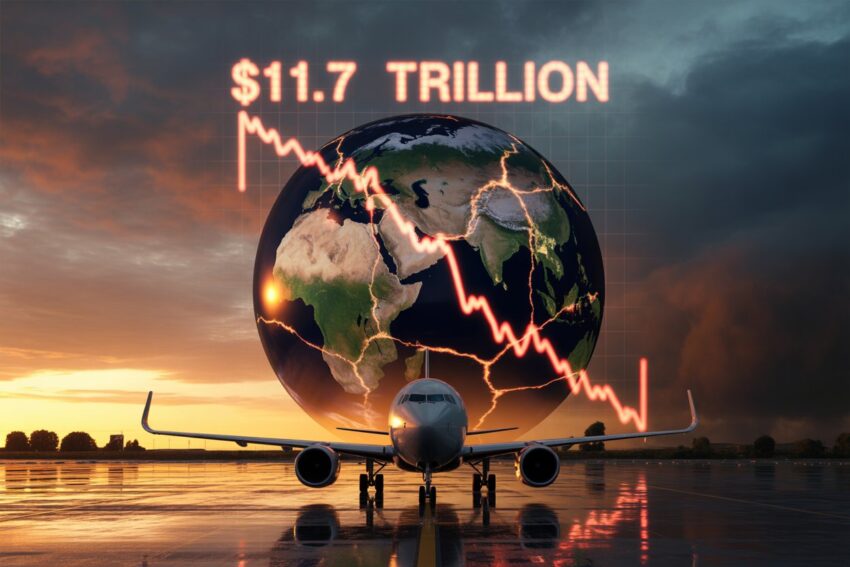
As the military conflict involving Iran, Israel, and the United States intensifies in March 2026, the world is beginning to realize that the “front lines” aren’t just in the Middle East—they are in our airports, our supply chains, and our bank accounts. Recent economic projections suggest a staggering $11.7 trillion could be wiped from the global economy if current travel and transit shutdowns persist.
This isn’t just about canceled vacations. It is about a fundamental breakdown of the “transit bridge” that connects the East and West, threatening to send global inflation into a tailspin and derail the post-2025 economic recovery.
The Choke Point: Beyond the Strait of Hormuz
While the world’s eyes are on the Strait of Hormuz—the narrow waterway through which 20% of the world’s oil and liquefied natural gas (LNG) passes—the economic damage is spreading through an even more fragile network: the sky.
The Middle East, specifically hubs like Dubai, Doha, and Abu Dhabi, serves as the central nervous system for global aviation. When countries like the UAE, Qatar, and Kuwait are forced to restrict or close their airspace due to missile activity and drone strikes, the “hub-and-spoke” model of international travel collapses.+1
A Crisis of Connectivity
For over a decade, the Gulf has positioned itself as the reliable bridge between Europe, Asia, and Africa. That reliability has evaporated in a matter of days.
Mass Cancellations: Over 10,000 flights have already been canceled since the escalation began on February 28, 2026.
Stranded Millions: Hundreds of thousands of passengers are currently stranded in transit hubs, with major carriers like Emirates, Etihad, and Qatar Airways forced to ground large portions of their fleets.
Rising Costs: Airlines that continue to fly must navigate a “patchwork” of restricted airspaces, leading to longer flight paths, higher fuel consumption, and, inevitably, soaring ticket prices.
The $11.7 Trillion Question: How Did We Get Here?
Economists reaching the $11.7 trillion figure aren’t just looking at lost ticket sales. They are calculating a “dual supply shock.”
The Energy Spike: With the effective closure of the Strait of Hormuz, Brent crude has already surged toward $85 per barrel, with some analysts warning of a spike to $140 if a full blockade is sustained. This adds an immediate “tax” on every industry, from manufacturing to home heating.
The Tourism Freeze: In countries like Thailand, which was aiming for 36 million visitors in 2026, the war has caused a 20% drop in bookings almost overnight. Tourism accounts for nearly 10% of global GDP; when people stop moving, the money stops flowing.
Supply Chain Paralysis: Major shipping lines like Maersk have halted passage through the Suez Canal and the Strait of Hormuz. This doesn’t just delay the latest smartphone; it blocks the transit of chemicals, fertilizers, and food staples, threatening global food security.
Humanizing the Economic Data
Behind the trillion-dollar headlines are the people. It’s the small business owner in London facing a 10% hike in energy bills. It’s the family in Mumbai unable to receive remittances from a relative working in the Gulf. It’s the stranded traveler in a Dubai airport hotel, wondering if they will make it home for a wedding or a funeral.
“The optimism that defined the start of 2026 has evaporated like water on a stove top,” says one financial analyst. The reality is that we live in a hyper-connected world where a missile in the Gulf can trigger a mortgage rate hike in the UK and a grocery price surge in Vietnam.
The Path Forward
Is there a way out? Analysts suggest that the “duration” of the conflict is the most critical variable.
Short-term (1 month): The global economy likely absorbs the shock with some volatility but avoids a full recession.
Prolonged (6+ months): The $11.7 trillion loss becomes a reality, likely triggering a global recession and a permanent shift in how international trade and travel are structured.
For now, the aviation and tourism sectors are in “stress-test” mode. Central banks are reconsidering interest rate cuts, and governments are discussing interventions to protect citizens from soaring energy costs.
As we move deeper into March 2026, the cost of the Iran war is being measured not just in military hardware but in the stalled engines of global commerce. The world is waiting to see if the “bridge” can be rebuilt, or if we are entering a new, fragmented era of isolation.
The post The $11.7 Trillion Ripple Effect: How the Iran Conflict is Paralyzing Global Travel and the World Economy appeared first on Travel And Tour World.
Source: travelandtourworld.com



Sorry, the comment form is closed at this time.