


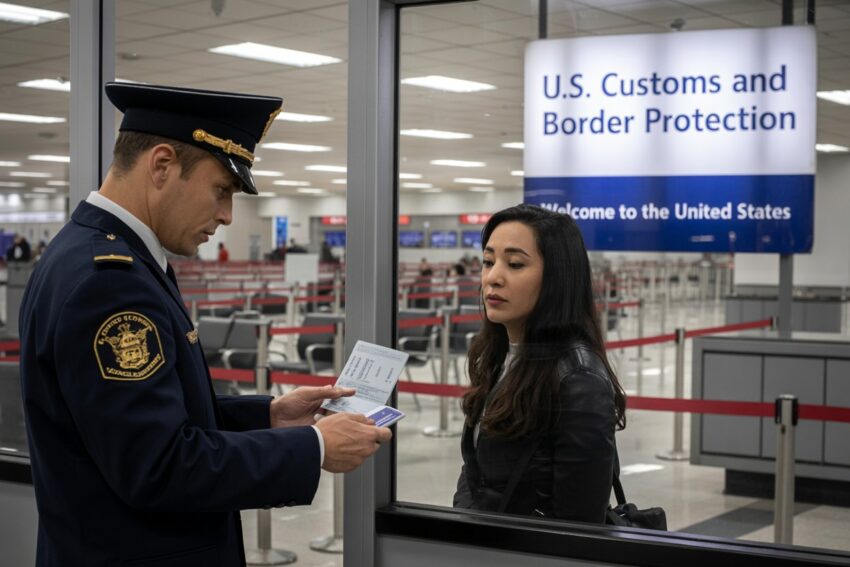
The Great American Lockout: Why Foreign CEOs are Being Banned from the US Now!
The Great American Lockout: Why Foreign CEOs are Being Banned from the US Now!
There is a chilling, unfamiliar silence falling over the sleek boardrooms of London and Paris—a silence born not from a lack of ambition, but from a sudden, impenetrable barrier. For decades, the journey between the financial heart of the UK and the tech-hubs of America was a routine bridge, crossed by innovators and executives with little more than a handshake and a valid passport. But today, that bridge is being systematically dismantled. As senior executives find their visa applications summarily rejected over minor, decades-old infractions, the human toll is becoming undeniable. It is a story of missed family milestones, derailed career paths, and a growing sense of alienation among America’s oldest allies. The “Special Relationship” is being tested by a bureaucracy that seems to have forgotten that the world’s greatest economy was built on the very movement it is now working so hard to restrict.
The London Lockdown: A Surge in Unprecedented Denials
A major travel disruption has taken hold at the U.S. Embassy in London, where non-immigrant visa refusals have reached record-breaking levels. According to a critical editorial published by The Washington Post Editorial Board on February 11, 2026, the administration is now blocking foreign CEOs and top-tier professionals from entering the United States at rates never before seen in the consular process.
The crackdown centers on the aggressive application of Section 214(b) of the Immigration and Nationality Act. While this rule traditionally required applicants to prove they didn’t intend to stay in the U.S. permanently, it is now being used as a broad “catch-all” to deny entry for even the most minor legal blemishes. Consular officers are reportedly torpedoing applications over university-era cannabis possession, decades-old police cautions, and single-instance traffic violations that were previously ignored.
The “Catch-and-Revoke” Directive: Rubio’s Global Mandate
The engine behind this shift is the “Catch-and-Revoke” directive issued by Secretary of State Marco Rubio last summer. This policy instructs U.S. posts worldwide to re-examine any criminal history—no matter how dated or insignificant—when assessing a traveler’s admissibility.
Data from the Financial Times and reports highlighted by the Washington Post suggest the fallout is immediate. Major British and European firms have reported that senior staff have missed critical board meetings, investor roadshows in New York, and trade-show keynotes in San Francisco. One aerospace firm even had to reroute a product-launch team through Dublin, only to have their visas cancelled upon arrival during secondary screening. The administration’s “security-first” framework prioritized these denials even for law-abiding individuals who have visited America for years without incident.
Economic Fallout: A Chilling Effect on Tourism and Trade
The humanized cost of this policy is mirrored by a stark economic reality. The U.S. Travel Association and other industry groups have warned of a “chilling effect” similar to the post-9/11 slowdown. According to the National Travel and Tourism Office (NTTO), the number of foreign visitors to the United States fell by 6 percent last year, a decline many attribute to the growing unpredictability of the visa process.
The Washington Post editorial noted that while violent criminals should certainly be barred, treating a business leader with a thirty-year-old misdemeanor as a national security threat is an “unforced error.” This overreach is particularly damaging as the Department of Commerce seeks to revitalize the U.S. tourism economy. Instead, the current “integrity fees” and the threat of arbitrary denial are pushing many global firms to seek “remote-first” alternatives or move their investments to more accessible markets in Asia and the EU.
Vetting 55 Million: The Continuous Screening Reality
This is not an isolated incident in London. The administration has expanded “continuous vetting” to cover all 55 million valid U.S. visa holders. According to State Department cables, any indication of ineligibility—including social media posts or historical records from home countries—can result in an immediate revocation.
Governmental updates from the DHS 2026 Budget indicate a massive increase in funding for data-mining and “social media identifiers,” requiring ESTA applicants to provide ten years of email addresses and phone numbers. Immigration lawyers have shared that attempts to apply at “easier” posts like Paris or Madrid have been thwarted by new inter-consular data sharing that flags every previous refusal, effectively creating a “digital blacklist” for thousands of global professionals.
An Uncertain Horizon for Global Partnerships
As the sun sets over the Potomac, the debate over America’s borders has moved from the southern desert to the international arrivals gate. The “State of OR” in travel has become a “State of No,” as the administration balances its security goals against the economic necessity of global engagement.
For the traveler caught in this tightening net, the message is one of extreme caution. The era of the “routine business trip” has ended, replaced by a landscape of background checks, waiver mazes, and costly legal facilitation. As we look toward the remainder of 2026, the question remains: Can a nation truly be “great” if it is closed to the very people who wish to do business, create jobs, and share in the American dream? The world is watching, the queues in London are growing, and the bridge between two continents has never felt more fragile.
The post The Great American Lockout: Why Foreign CEOs are Being Banned from the US Now! appeared first on Travel And Tour World.
Source: travelandtourworld.com



Sorry, the comment form is closed at this time.