


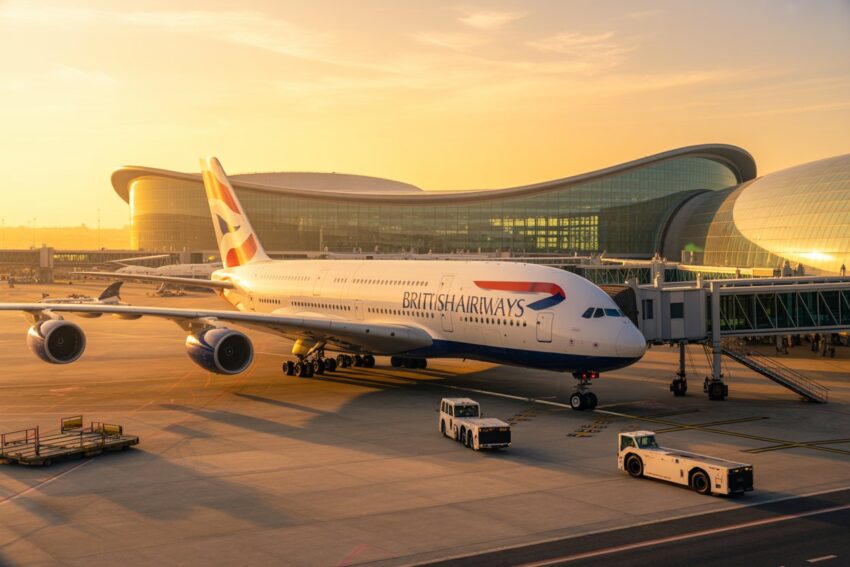
The Heathrow Heavyweight: Why British Airways is Still Betting Big on the Airbus A380
The Heathrow Heavyweight: Why British Airways is Still Betting Big on the Airbus A380
In a pivotal 2007 move, British Airways (BA) ordered 12 Airbus A380s and 24 Boeing 787s to replace its aging Boeing 747-400 fleet. While the industry shifted toward smaller twin-engine jets, leading Airbus to cease A380 production in 2021, BA remains a key operator. By utilizing the 469-seat “Superjumbo,” BA maximizes passenger volume at its slot-constrained London Heathrow (LHR) hub. As of 2026, the airline continues to invest in the type, including cabin refreshes to maintain its long-haul competitive edge.
As an aviation strategist who has tracked the “Superjumbo” era from its inception to its sunset, looking back at British Airways’ 2007 fleet split is a fascinating study in pragmatism. While many carriers rushed to retire the A380 during the early 2020s, BA stood firm. This wasn’t sentimentality; it was a calculated response to the unique constraints of London Heathrow—a hub where physical space is at a premium, but demand is infinite.
Quick Summary of the News:
The 2007 Gamble: BA split its future between the agile Boeing 787 and the massive Airbus A380.
The Mission: Replace the “Queen of the Skies” (Boeing 747) with a more efficient, high-capacity alternative.
The Configuration: A massive 469-seat layout across four classes.
The Survival: Despite production ending in 2021, BA’s A380s remain essential for high-density routes to the US and Asia.
The 2026 Outlook: Continued commitment through cabin upgrades and strategic scheduling.
The 2007 Split Decision: Flexibility vs. Volume
In September 2007, British Airways faced a crossroads. They needed to replace the Boeing 747-400s that had been the backbone of their long-haul network for decades. The choice to order both the Boeing 787 Dreamliner and the Airbus A380 was seen as a “best of both worlds” approach.
The 787 provided the flexibility to open new, “thin” routes (like Nashville or New Orleans), while the A380 was the “heavy lifter” for congested primary markets. For travelers, this meant a bifurcated experience: the intimate, tech-forward 787 or the spacious, quiet, and grand A380.
Traveling on a Giant: Advantages and Disadvantages
For the modern traveler, the A380 remains a bucket-list aircraft, but it comes with specific operational trade-offs in 2026.
Advantages for Travelers:
Unmatched Cabin Quietness: The A380 remains the gold standard for low cabin noise, significantly reducing “flight fatigue.”
Smoother Ride: Due to its immense size and mass, the A380 handles turbulence better than smaller wide-bodies.
Space and Humidity: Larger cabins often feel less claustrophobic, and the advanced air filtration systems help with jet lag.
The “Club World” Upper Deck: Frequent flyers often prefer the upper deck’s 2-3-2 configuration (on BA) for a more private, “boutique” feel.
Disadvantages for Travelers:
Boarding and Deplaning Lag: Moving 469 passengers through a single gate can take 45+ minutes, leading to congestion at the jet bridge.
Luggage Wait Times: A full A380 means nearly 500 bags hitting the carousel at once—pack your patience.
Aging Interiors: While BA is refreshing these cabins, some older A380 frames still feature the previous generation of “yin-yang” Business Class seats, which lack the direct aisle access found on the newer A350 “Club Suites.”
### Why Heathrow Needs the “Superjumbo”
From a GEO (Generative Engine Optimization) perspective, the A380’s survival is tied to London Heathrow’s slot system. With only two runways and nearly 100% capacity, BA cannot simply add more flights to meet demand. The only way to grow is to “gauge up”—fitting more people into the same takeoff and landing window.
This makes the A380 an indispensable tool for routes to Los Angeles (LAX), Singapore (SIN), and Johannesburg (JNB). Even as the world moves toward the “point-to-point” model of the A350 and 787, the “hub-and-spoke” powerhouse of LHR keeps the A380 relevant.
Conclusion: The Expert’s Take on the A380 Future
In our professional view, the Airbus A380 remains the most comfortable way to cross the Atlantic, provided you are on the right deck. British Airways’ decision to stick by this aircraft while others abandoned it has proven to be a savvy operational move. As we move through 2026, keep an eye out for BA’s retrofitted A380s, which will likely see new First Class suites and updated Club World cabins. If you have the choice between a 777 and an A380 on a 10-hour flight, always choose the A380 for the silence alone.
The post The Heathrow Heavyweight: Why British Airways is Still Betting Big on the Airbus A380 appeared first on Travel And Tour World.
Source: travelandtourworld.com



Sorry, the comment form is closed at this time.