


The Untamed Elegance of Ulva: A Journey into Scotland’s Community-Owned Sanctuary
The Untamed Elegance of Ulva: A Journey into Scotland’s Community-Owned Sanctuary
Scotland’s western coastline is defined by a jagged, poetic geography, with hundreds of islands rising from the Atlantic like granite sentinels. While Lewis and Harris’ cultural monoliths frequently receive attention, a constellation of smaller, “hidden gems” is largely overlooked by casual travellers. Among these treasures, the Isle of Ulva represents both ancient history and modern community resilience. Because of its proximity, this eight-square-mile sanctuary is frequently misidentified as a mere extension of the Isle of Mull. It is separated from its larger neighbour by only a narrow stretch of water. It’s a place where the frenetic pace of modern life is replaced by the rhythmic toll of the ferry bell and the hum of quad bikes, the primary mode of transportation on an island with no paved roads.
A Legacy Etched in Stone and Soil
The human narrative of Ulva is one of profound depth, stretching back far beyond the written word. Evidence of habitation dating to the Mesolithic era, approximately 7,000 years ago, has been unearthed by archaeologists, suggesting that these woodlands were once the roaming grounds of hunter-gatherers. While the population once peaked at around 800 residents, the twentieth century saw a steady decline, leaving only a small, dedicated group of inhabitants. However, a pivotal shift occurred in 2018 when the island was transitioned into public ownership. Under the stewardship of the North West Mull Community Woodland Company, a mission was launched to revitalize the population and preserve the island’s unique heritage. This movement toward community empowerment has transformed Ulva from a quiet relic into a living laboratory for sustainable island living.
The Wild Majesty of the Inner Hebrides
The landscape of Ulva is a study in contrasts, offering a microcosm of the Scottish Highlands within its compact borders. To the east, visitors are greeted by lush, dense woodlands that provide a soft, verdant canopy. In stark contrast, the southern and western reaches of the island are defined by rugged terrain and dramatic sea cliffs that drop precipitously into the grey-blue depths of the Hebridean Sea. This varied topography serves as a vital sanctuary for a diverse array of fauna. The heights of the island are utilized as breeding grounds by majestic golden eagles, while the coastal cliffs provide nesting sites for puffins. Even the insect world holds rarities here; the Scotch Burnet Moth, a species found in only a handful of locations, is known to thrive on Ulva’s slopes.
The surrounding waters are equally vibrant. The silhouettes of minke whales and the slow, hulking forms of basking sharks are frequently spotted by those navigating the coastline. For nature enthusiasts, the island represents a rare opportunity to witness an ecosystem that remains largely unburdened by industrial intervention.
Architectural Revival and the Spirit of Gometra
While the natural world dominates the senses, the island’s built environment is currently undergoing a significant metamorphosis. Ulva House, a 1950s mansion that had succumbed to years of disrepair, has become the focal point of a major restoration project. This endeavour, led by interior designer Banjo Beale and his husband, Ro, is being documented for a global audience. The logistical complexities of renovating a remote estate—where every piece of equipment must be transported by boat—are being showcased as a tribute to Hebridean ingenuity.
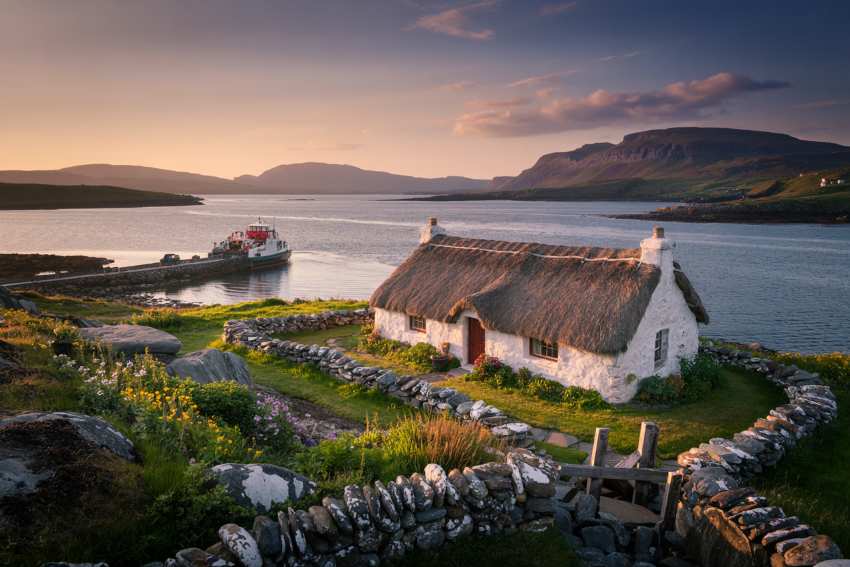
Beyond the mansion, the island’s cultural landmarks offer a glimpse into its social fabric. The Ulva Church and the Ulva Walled Garden remain essential stops for any itinerary. Although Shiela’s Cottage—a traditional thatched dwelling—is currently undergoing refurbishment, it stands as a silent witness to the island’s crofting past. For those with an adventurous spirit, the tidal island of Gometra can be reached at low tide by wading across the sands, though a more permanent bridge is maintained for a reliable crossing between the two landmasses.
Navigating the Gateway: Access and Amenities
A one-of-a-kind, on-demand ferry service from Mull’s coast makes Ulva accessible. The ferry is summoned by signalling the boatman, Rhuri Munro, who provides seasonal service from late March to October. The crossing costs a nominal fee, and well-behaved dogs are welcome to travel for free, emphasising the island’s approachable, community-centric atmosphere.
Upon arrival, the Boathouse Cafe serves as the island’s social hub, where local flavours are celebrated. The lack of cars means that the silence is broken only by the wind and the occasional quad bike, providing an immersive experience for those seeking true seclusion. As the island continues on its path to repopulation and renewal, it remains a prime example of how Scotland’s remote communities are reclaiming their future while honouring their 7,000-year-old history.
The post The Untamed Elegance of Ulva: A Journey into Scotland’s Community-Owned Sanctuary appeared first on Travel And Tour World.
Source: travelandtourworld.com



Sorry, the comment form is closed at this time.