


This Hidden Danish Island Duo Is Being Called the Ultimate Milky Way Playground and It Is Putting Every Other Nordic Night Escape to Shame
This Hidden Danish Island Duo Is Being Called the Ultimate Milky Way Playground and It Is Putting Every Other Nordic Night Escape to Shame
As a night‑time travel destination, Møn and the nearby island of Nyord are being celebrated as Denmark’s most dreamy, nocturnal and highly Instagrammable corner of the country. Together, they are being designated as Dark Sky Park Møn and Nyord, and are being promoted to travellers who are seeking slow‑paced nature, unforgettable night photography and immersive stargazing rather than classic city lights. The experience is being framed as a blend of calm coastal scenery, open rural landscapes and some of the darkest skies in Scandinavia.
Visitors are being drawn to this area because it is being presented not only as somewhere beautiful by day but also as a destination that truly comes into its own after sunset. Long evenings are being spent under deep, inky skies, while sounds from the sea and countryside replace city noise. For many travellers, the appeal is being found in this contrast: days can be used for hiking cliffs and exploring villages, while nights are being reserved for watching stars, photographing the Milky Way and joining guided Dark Sky experiences.
Official Dark Sky recognition and what it means
Møn and Nyord are being officially recognised by the International Dark‑Sky Association as an International Dark Sky Park and a Dark Sky Community, and this is being highlighted as the first such designation in the Nordic region. This recognition is being granted because of exceptionally low levels of light pollution and carefully protected nocturnal environments. For visitors, this means that artificial light is being actively kept under control, so the natural darkness and clarity of the night sky are being preserved.
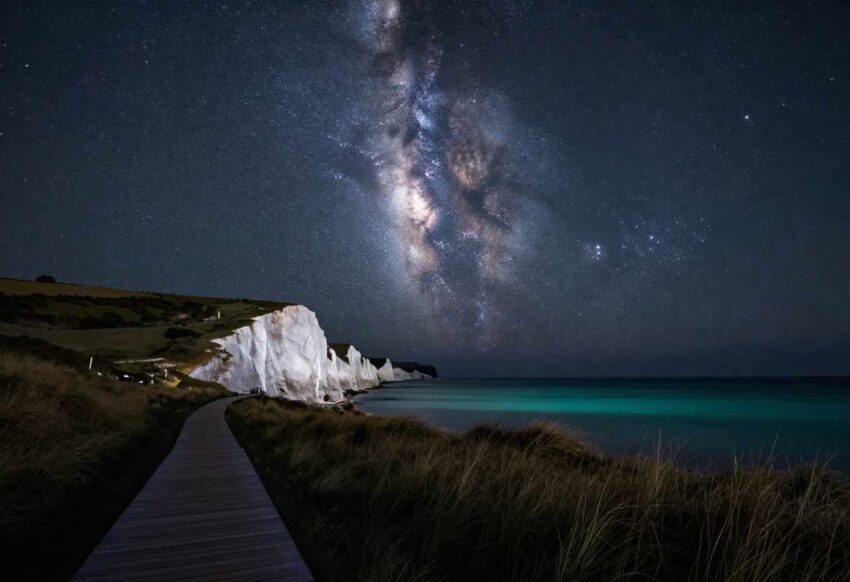
On clear nights, up to about 5,000 stars and the Milky Way are being described as visible to the naked eye, which is far more than can be seen from typical towns or cities. Under these conditions, the sky is being turned into a vast, luminous canopy ideal for long‑exposure photography and detailed stargazing. The islands’ white chalk cliffs, open coastlines and rural scenery are being used as striking foregrounds, so images of the night sky are being framed by dramatic silhouettes and reflections rather than by buildings or streetlights.
Local tourism bodies are being positioned as strong promoters of this night‑time character. The area is being marketed as a unique, slow‑paced, night‑time nature escape where visitors can step away from everyday glare and rediscover darkness as something peaceful and beautiful. Guided night tours and stargazing experiences with telescopes and binoculars are being offered, and these are being described as immersive, atmospheric activities. Travellers are being invited to combine sky‑watching with landscape photography and informal education about constellations, planets and the broader universe.
Signature star‑watching locations around Møn
Within Møn Dark Sky Park, several specific locations are being repeatedly highlighted by local and Dark Sky‑focused organisations as particularly favourable for stargazing and night photography. These spots are being recommended because they offer open horizons, minimal light pollution and distinctive scenery.
The observation tower at Ulvshalevej 401, 4780 Stege is being noted for its elevated position and open view, with very little surrounding light. This combination is being seen as ideal for wide‑angle Milky Way shots and sweeping panoramas that capture both sky and landscape. Liselund park, also known as Liselund Palace Park, at Langebjergvej 6, 4791 Borre is being described as a romantic, sheltered garden setting within the forest. It is being protected from wind and stray light, making it suitable for long, unhurried stargazing sessions where visitors can lie back or sit quietly while watching constellations move overhead.
Sømarke Stendysse, located on Stendyssevej, 4791 Borre, is being valued for its ancient stone structures in open countryside. Here, unobstructed horizons and very dark skies are being matched with a sense of historical depth, so travellers can experience both prehistoric monuments and modern astrophotography in a single visit. For many guests, this creates a powerful feeling of standing in the same place as people from thousands of years ago while looking up at the same night sky.
Coastlines, cliffs and observatories by night
The boardwalk at GeoCenter Møns Klint, at Stengårdsvej 8, 4791 Borre, is being presented as one of the most visually dramatic settings in the park. From this cliff‑top vantage point above the Baltic Sea, visitors are being offered far‑reaching views over the water and up into the sky. The combination of white chalk cliffs, dark sea and star‑filled sky is being seen as particularly suited to striking nightscape compositions, especially when the Milky Way or bright constellations stretch above the horizon.
Damsholte Observatory, situated at Grønsundvej 251, 4780 Stege, is being operated as a dedicated astronomical site where telescopes and guided observations are made available on selected dates. This location is being used to give visitors a more structured introduction to astronomy, with hosts explaining planets, deep‑sky objects and the basics of observation technique. For travellers who prefer a guided, informative experience rather than self‑directed stargazing, this observatory is being positioned as an excellent starting point.
Beaches along the southern coast of Møn are being described as wide, open seafront locations with 360‑degree views and almost no artificial light. These areas are being recommended for meteor showers, Milky Way arcs and long‑exposure images that capture the movement of stars across the sky. On some very clear nights, occasional Northern Lights are being reported, which adds an extra layer of excitement and visual interest for those who are lucky enough to witness them.
Aborrebjerget, Nyord bird tower and Lake Huno
Among all the viewing points in the Dark Sky Park, Aborrebjerget, Nyord bird tower and the southern Møn beaches are being singled out as standout star spots. Aborrebjerget, at about 143 metres, is being recognised as Møn’s highest point and is repeatedly described as one of the absolute best locations on the island for star‑watching. It offers a completely open 360‑degree panorama, so visitors can turn in any direction and still enjoy an unobstructed view of the night sky.
On Nyord, the Nyord bird tower stands in open meadows and provides a full 360‑degree view of the Milky Way, moonrise and constellations above a very dark landscape. This elevated platform is being used as a natural observatory where the sky appears to rest directly on the surrounding fields and sea. For photographers, the symmetry of the tower, the horizon and the Milky Way arch is being seen as particularly appealing.
Hunosøen, also known as Lake Huno, is being valued as a tranquil lakeside spot where constellations and the Milky Way can be reflected in still water. This creates highly photogenic compositions that appear to bring the sky down to Earth, with stars mirrored on the lake’s surface. Together, these locations are being promoted by regional tourism sites and Dark Sky organisations as some of the finest places in Denmark to experience the night sky, and Møn and Nyord are being repeatedly described as among the country’s darkest and most star‑rich areas.
Reaching Møn and Nyord from Copenhagen
From a travel logistics perspective, Møn and Nyord are being portrayed as easily reachable from Copenhagen, which strengthens their appeal as a short break destination. Travellers are being told that the journey can be made either by public transport or by car, with clear routes for each option.
By public transport, visitors are being advised to take a train from København H, or Copenhagen Central Station, to Vordingborg Station. This journey is being estimated at about 57 minutes on DSB services, which generally run on an hourly basis. From Vordingborg Station, a bus operated by Movia, typically route 660R, runs to Stege on Møn in around 45 minutes, usually every 30 minutes. For Nyord, the same train route to Vordingborg Station is being used, followed by a bus towards Stege and then a local bus or taxi to the Nyord causeway, from which the island is being accessed.
For those travelling by car, the drive from Copenhagen to Møn or the Nyord area is usually being described as taking around 1–1.5 hours via motorway E47/E55 and the bridge near Vordingborg. Informal local estimates suggest that combining the train from Copenhagen to Vordingborg with a local taxi from the station can reduce total travel time to approximately 1.5–2 hours, while often being considerably cheaper than a taxi for the entire distance. This combination of options is being presented as giving visitors the flexibility to balance cost, speed and convenience according to their preferences.
Dark Sky tours and experiences on Møn and Nyord
Once visitors arrive, Dark Sky tourism initiatives are being used to help them get the most from the darkness. Under the Dark Sky Møn banner, guided nighttime tours led by certified DarkSky guides are being arranged. These tours typically involve the use of telescopes and binoculars and include explanations of constellations, planets and the principles behind Dark Sky certification. A regularly updated events calendar is being maintained, listing stargazing walks, lectures and special seasonal tours devoted to meteor showers, the Milky Way and other notable night‑sky phenomena.
Naturguide Møn is being presented as another key organiser of Dark Sky experiences. This group offers guided Dark Sky walks that place emphasis on the night environment, including nocturnal animals, plants and the way human senses adapt to darkness. These walks are being framed as safe, informative ways to encounter deep darkness, which can be unfamiliar to urban visitors. Regional promotion from South Zealand and Møn’s tourism board includes the marketing of “7 fascinating Dark Sky spots,” featuring locations such as Aborrebjerget and the Nyord bird tower. Some of these locations are being used as regular sites for guided tours and themed experiences.
These activities are being described as suitable for both beginners and experienced stargazers. Visitors with little prior knowledge are being offered introductions to basic astronomy and night‑sky orientation, while those with more experience are being given access to high‑quality dark sites and local insight. Collectively, these tours and events are being positioned as a core element of Dark Sky tourism in Denmark, with Møn and Nyord being presented as flagship destinations.
Northern Lights possibilities at Grenen
Beyond Møn and Nyord, Denmark’s night‑sky offering is being complemented by limited opportunities to observe the Northern Lights. Skagen and the Grenen headland are being mentioned as some of the better locations in the country for occasional aurora sightings. These displays are being described as relatively rare and highly dependent on solar activity, weather and darkness, but the geography of the area offers advantages. The Grenen region, at Denmark’s northern tip, provides broad sea horizons and relatively low local light pollution, which can improve the chances of seeing faint aurora when conditions are favourable.
Guidance for Northern Lights viewing at Grenen emphasises several practical points. The best chances in Denmark are generally being associated with the period from October to March, on cold, clear and dark nights. Viewing is usually being recommended in the late evening to night hours, when skies are at their darkest. Viewpoints that are removed from town lights, such as remote beaches or dunes, are being favoured because they reduce direct light interference and offer better views towards the northern sky.
Weather and sky clarity are being highlighted as critical, with clear or mostly clear conditions being essential for any realistic chance of seeing aurora activity. Travellers are being encouraged to check cloud cover and aurora forecasts before heading out. Comfort is also being considered important, as observers may need to stand outside for extended periods in cold and windy weather. Layered clothing, blankets and hot drinks are commonly being recommended, together with tripods and long exposure settings for cameras, which help capture faint or rapidly changing auroral forms. It is being underscored that Denmark lies south of the main auroral oval, so sightings at Grenen are being regarded as special, opportunistic experiences rather than guaranteed events, even during peak season.
A complete night‑sky destination in Denmark
Overall, Dark Sky Park Møn and Nyord is being presented as Denmark’s leading nocturnal travel destination. The area offers some of the country’s darkest skies, a network of carefully chosen star‑watching locations, straightforward transport links from Copenhagen and an expanding programme of guided tours and events. Visitors are being given the chance to combine peaceful days by cliffs, lakes and beaches with evenings spent under skies rich with stars and the Milky Way.
When occasional Northern Lights opportunities at Grenen are added into the picture, Denmark’s night‑sky offering is being seen as both varied and atmospheric. Structured Dark Sky tourism on Møn and Nyord is being combined with the possibility of rare auroral displays in the far north, providing travellers with a wide range of nocturnal experiences. For those interested in the quieter, more reflective side of Scandinavian travel, this region is being positioned as a destination where darkness itself becomes the main attraction.
The post This Hidden Danish Island Duo Is Being Called the Ultimate Milky Way Playground and It Is Putting Every Other Nordic Night Escape to Shame appeared first on Travel And Tour World.
Source: travelandtourworld.com



Sorry, the comment form is closed at this time.