


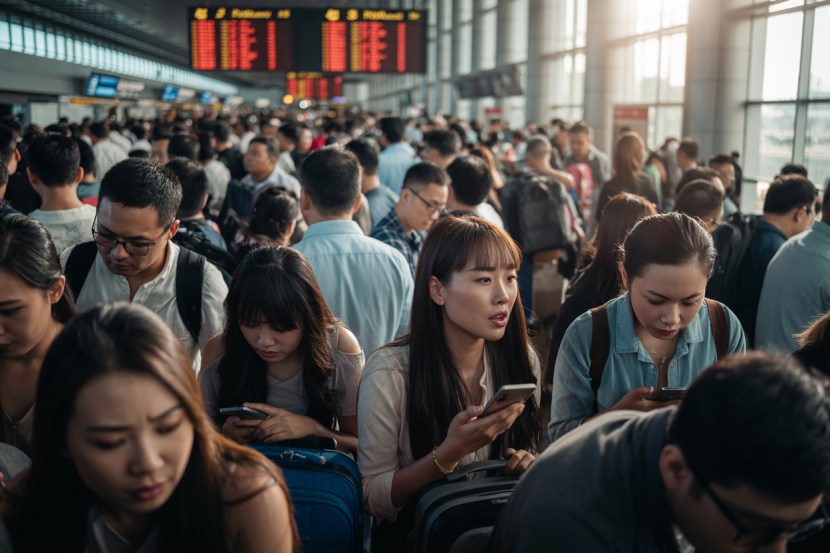
Thousands Of Passengers Stranded In Asia As Japan, Korean, Singapore, ANA, AirAsia, Lion Air, and Other Airlines Cancel 143 and Delay 3,909 Flights Across Thailand, Singapore, Japan, South Korea, Indonesia, Hong Kong and More Including Tokyo, Bangkok, Seoul, Jakarta, and Changi
Thousands Of Passengers Stranded In Asia As Japan, Korean, Singapore, ANA, AirAsia, Lion Air, and Other Airlines Cancel 143 and Delay 3,909 Flights Across Thailand, Singapore, Japan, South Korea, Indonesia, Hong Kong and More Including Tokyo, Bangkok, Seoul, Jakarta, and Changi
Thousands of travelers were stranded across Asia today as extensive flight issues resulted in 143 flight cancellations and 3,909 delays, including Tokyo Haneda Airport (611 delays, 23 cancellations), which led disruptions, followed by Kuala Lumpur International Airport (470 delays), Singapore Changi Airport (453 delays, 3 cancellations), Bangkok Suvarnabhumi Airport (381 delays, 2 cancellations), Narita International Airport (363 delays, 8 cancellations), Incheon International Airport (336 delays, 0 cancellations), Jakarta Soekarno-Hatta International Airport (325 delays, 9 cancellations), Hong Kong International Airport (282 delays, 1 cancellation), Fukuoka Airport (217 delays, 13 cancellations), and Osaka Itami Airport (153 delays, 11 cancellations). Smaller but heavily cancellation-weighted disruptions were seen at Izumo (23 cancellations) and Kikai (16 cancellations).
The most affected airlines by volume included Japan Airlines (JAL: 491 delays, 32 cancellations), All Nippon Airways (ANA: 275 delays, 9 cancellations), AirAsia (200+ delays), Singapore Airlines (160+ delays), and Lion Air (157 delays).
Popular carriers not among the most disrupted but still impacted included Cathay Pacific, Korean Air, Scoot, Garuda Indonesia, and Malaysia Airlines, all reporting notable delay volumes.
According to the latest updates, Tokyo, Osaka, Fukuoka, Singapore, Bangkok, Kuala Lumpur, Jakarta, Hong Kong, Incheon, and Jeju were among the most affected cities, reflecting widespread disruption across Japan, South Korea, Indonesia, Singapore, Thailand, Malaysia, and Hong Kong.
Update today: Asia recorded 3,909 delays and 143 cancellations, affecting Japan, Southeast Asia, and East Asia simultaneously.
Japan remained the epicenter, with Haneda, Narita, Fukuoka, and Osaka Itami accounting for a large share of cancellations.
Low-cost carriers and flag carriers alike, including Japan Airlines, ANA, AirAsia, and Lion Air, reported sustained delays.
Major hubs stayed operational, but high delay ratios at Singapore Changi, Kuala Lumpur, and Bangkok caused extended passenger congestion.
Most Affected Asian Airports
Tokyo Haneda Airport
Haneda was Asia’s most disrupted hub today with 611 delays and 23 cancellations, heavily impacting Japan Airlines, ANA, and ANA Wings operations on domestic and regional routes.
Kuala Lumpur International Airport
Kuala Lumpur logged 470 delays and zero cancellations, driven largely by AirAsia, Malaysia Airlines, and Malindo Air, indicating congestion rather than service suspension.
Singapore Changi Airport
Changi recorded 453 delays and 3 cancellations, with Scoot and Singapore Airlines accounting for more than half of delayed movements.
Suvarnabhumi Airport
Bangkok saw 381 delays and 2 cancellations, with Thai Airways and Thai VietJet Air facing prolonged delay ratios throughout the day.
Narita International Airport
Narita posted 363 delays and 8 cancellations, including a notable concentration of delayed international services operated by Jetstar Japan and United Airlines.
Airlines Most Affected by Asia Flight Cancellations and Delays
Japan Airlines
JAL faced 491 delays and 32 cancellations across multiple Japanese airports, making it the single most affected airline by volume.
All Nippon Airways
ANA and its subsidiaries reported over 275 delays and 9 cancellations, particularly at Haneda, Fukuoka, and Osaka Itami.
AirAsia
AirAsia operations across Kuala Lumpur and Singapore contributed 200+ delays, though no cancellations were reported.
Lion Air
Lion Air logged 157 delays across Jakarta and Makassar, accounting for the bulk of Indonesia’s disruption count.
Singapore Airlines
Singapore Airlines recorded more than 160 delays across Changi, Hong Kong, and Kuala Lumpur, with no cancellations reported.
What Can Impacted Passengers Do?
Monitor airline apps and airport departure boards frequently
Allow extra time for airport check-in and security
Confirm rebooking and compensation eligibility with airlines
Avoid tight connections where possible
Retain boarding passes and delay notifications for claims
Learn More
Overview of Asia Flight Cancellations
Tokyo Haneda, Narita, Singapore Changi, Kuala Lumpur, Bangkok Suvarnabhumi, and Jakarta Soekarno-Hatta appeared repeatedly as pressure points.
Building on this pattern, Japan Airlines and All Nippon Airways together accounted for a disproportionate share of cancellations across Japan, particularly at Tokyo Haneda Airport, Narita International Airport, Fukuoka Airport, and Osaka Itami Airport. This indicates localized operational strain within Japan’s domestic and short-haul network rather than a single-hub failure.
In contrast, disruption dynamics across Singapore, Malaysia, Thailand, and Indonesia were overwhelmingly delay-driven. High-volume hubs such as Singapore Changi Airport, Kuala Lumpur International Airport, Suvarnabhumi Airport, and Jakarta Soekarno-Hatta International Airport remained operational with minimal cancellations, suggesting congestion, air traffic flow restrictions, or aircraft rotation delays rather than airport closures.
Low-cost carriers played a central role in compounding delay volumes. AirAsia and Lion Air together generated hundreds of delayed flights across Malaysia and Indonesia, amplifying ripple effects on connecting regional routes. Meanwhile, network carriers such as Singapore Airlines and Korean Air experienced persistent delays at major hubs despite avoiding cancellations, highlighting schedule compression across long-haul and regional operations.
Additional pressure points emerged in South Korea and Hong Kong, where Incheon International Airport and Hong Kong International Airport showed sustained delay ratios across multiple international carriers. These patterns reinforce that today’s disruptions were systemic and multi-country, driven by cumulative delays across Asia’s busiest hubs rather than isolated airline-specific failures.
Image Source: AI
Source: Different airports and FlightAware
The post Thousands Of Passengers Stranded In Asia As Japan, Korean, Singapore, ANA, AirAsia, Lion Air, and Other Airlines Cancel 143 and Delay 3,909 Flights Across Thailand, Singapore, Japan, South Korea, Indonesia, Hong Kong and More Including Tokyo, Bangkok, Seoul, Jakarta, and Changi appeared first on Travel And Tour World.
Source: travelandtourworld.com



Sorry, the comment form is closed at this time.