


Travel Disruption Strikes Middle East: Flights Grounded as US‑Israel, Iran Tensions Escalate
Travel Disruption Strikes Middle East: Flights Grounded as US‑Israel, Iran Tensions Escalate
The ongoing missile exchanges between the US, Israel, and Iran have plunged the Middle East into a state of travel turmoil. As missile strikes and escalating airspace closures disrupt flight patterns, airlines, airports, and passengers across the globe are facing an unprecedented situation. The travel sector, heavily reliant on air corridors over the Middle East, is grappling with hundreds of flight cancellations, detours, and stranded passengers. This chaos is not just affecting Middle Eastern hubs but has ripple effects that extend to Europe, Asia, and beyond, affecting millions of travelers.
Mass Cancellations and Stranded Passengers
With escalating geopolitical tensions, airspace restrictions in the Middle East have resulted in flight cancellations on a massive scale. Countries such as Israel, Iran, Iraq, and Saudi Arabia have been forced to close their airspaces temporarily or operate under extreme restrictions. As a result, airlines have cancelled hundreds of flights, especially those bound for, or passing through, major Middle Eastern hubs like Dubai, Doha, Abu Dhabi, and Istanbul.
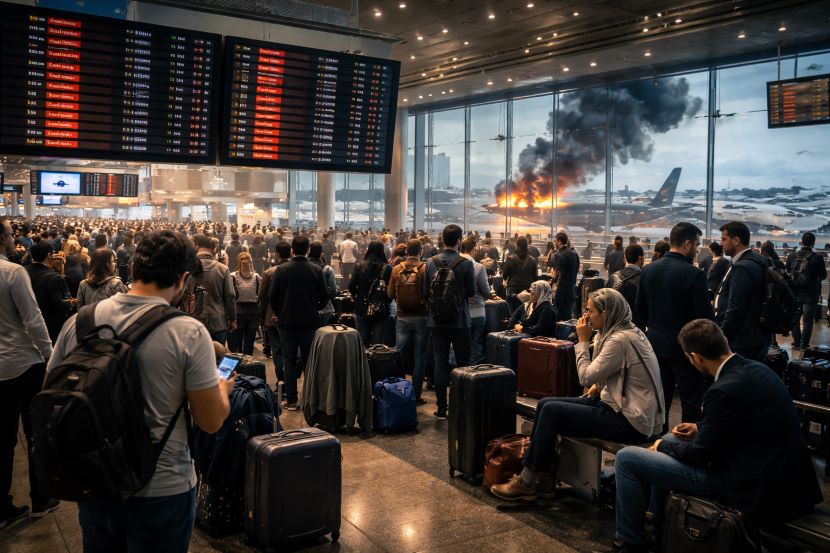
The impact on travelers has been severe. Passengers with layovers in these airports have been left stranded, unable to get timely information about rescheduled flights. Those with urgent business or family connections face frustration as flights are delayed or cancelled indefinitely. In Dubai, one of the world’s busiest airports, hundreds of passengers are seen lining up at help desks, trying to make sense of delayed schedules, while others are anxiously checking if their flights will resume anytime soon.
Airlines Race to Assist Stranded Travelers
In contrast, Air India has announced multiple repatriation flights, focusing on major destinations like Doha, Dubai, and Abu Dhabi. This initiative is especially critical for Indian nationals, many of whom had to extend their stays in Middle Eastern cities far beyond their original itineraries.
However, as airlines like Qatar Airways, Etihad, and Emirates continue to operate on limited schedules, passengers are facing skyrocketing ticket prices due to reduced seat availability. Flights that were previously affordable are now booked out, leaving only high-cost tickets available for those looking to escape the turmoil.
Airports Struggling to Handle the Crisis
Middle Eastern airports, such as Dubai International and Hamad International, are seeing a flood of passengers stuck without options. These airports, which previously served as key transit hubs for international flights, are now overwhelmed with delays and rebookings. The closures and restrictions mean that thousands of travelers have been left with little choice but to wait, sometimes without clear information on when their flights might depart.
With ground staff stretched thin due to the ongoing disruption, airports are struggling to maintain basic services like baggage handling, security checks, and customer support. At Dubai International, passengers have been seen spending hours waiting in long queues, attempting to rebook flights or claim refunds, all while facing ongoing uncertainty about the situation.
Moreover, many travelers are unaware of the complex compensation rules enforced by airlines under these extraordinary circumstances. While some airlines are offering refunds and free rebookings, others have been slow to react, leaving travelers to fend for themselves in the crowded terminals.
Rerouting and Extended Journey Times: An Added Burden
For travelers caught in the Middle East airspace crisis, rerouting becomes a painful and costly necessity. Airlines have been forced to take longer routes to avoid the conflict zones. Flights from Europe and Asia, which would normally pass through the Gulf region, are now being rerouted either over Africa or via northern Europe, adding several hours to flight durations. The extra fuel costs, longer flights, and operational complexities translate into higher prices for passengers. Unfortunately, most travelers are left with little choice but to pay for the extended journey times or accept rerouted itineraries at a significant inconvenience.
Long-Term Impact on Middle Eastern Tourism
With airspace uncertainty and widespread cancellations, tourists are now likely to avoid the region until the situation stabilizes. The Gulf tourism sector, which relies heavily on international arrivals, now faces an uncertain future as geopolitical tensions continue to impact travel stability. For the travel industry in general, this disruption highlights the fragility of aviation networks in politically sensitive regions. Tourists and business travelers alike are reconsidering their travel plans, with many opting for alternative destinations in Europe, Southeast Asia, or the Americas.
What Lies Ahead for Travelers?
As the situation continues to evolve, travelers are urged to stay vigilant and check with airlines regularly for updates on their flights. Many airlines are offering free rescheduling for affected travelers, while some countries are offering travel advisories and support for citizens stuck abroad. Looking ahead, travelers must prepare for more turbulence. Travel agencies and airlines are expected to implement flexible booking policies to allow passengers to change plans with minimal penalties. However, passengers may still find themselves facing the financial burden of rerouting, rebooking, and rescheduling, with no clear end in sight for the current airspace disruptions.
Travelers in Limbo Amid Conflict
As US-Israel and Iran’s missile exchanges continue to rage, the travel industry faces one of its most significant disruptions in years. Thousands of stranded passengers, delayed flights, and rebooked itineraries underline the growing chaos, while airports and airlines scramble to provide support. The immediate impact on travelers is undeniable, with extended delays, longer journeys, and skyrocketing prices causing anxiety for millions. The future of Middle Eastern air travel remains uncertain as the conflict continues to unfold. Tourism in the region faces long-term consequences, and global travelers will need to remain adaptable and vigilant.
The post Travel Disruption Strikes Middle East: Flights Grounded as US‑Israel, Iran Tensions Escalate appeared first on Travel And Tour World.
Source: travelandtourworld.com



Sorry, the comment form is closed at this time.