


Turbulence Ahead: How the 2026 Government Shutdown is Impacting Florida Travelers and Airlines
Turbulence Ahead: How the 2026 Government Shutdown is Impacting Florida Travelers and Airlines
For millions of travelers, Florida is a place of escape—a land of sun, sand, and seamless vacations. However, in February 2026, the mood at major hubs like Miami International (MIA), Orlando International (MCO), and Fort Lauderdale-Hollywood (FLL) has shifted from tropical relaxation to palpable tension. A partial federal government shutdown, which began on January 31, 2026, has entered its third week, casting a long shadow over the state’s vital tourism industry.
While the palm trees remain, the “human machinery” that keeps the skies safe—the TSA agents, air traffic controllers, and customs officers—is under immense strain. As lawmakers in Washington remain deadlocked, Florida’s travelers and airlines are left to navigate the turbulent fallout.
The “Essential” Struggle: Working Without a Paycheck
The 2026 shutdown is particularly complex. While parts of the government remain funded through September, the Department of Transportation (DOT) and the Department of Homeland Security (DHS) are currently without appropriations. This means that approximately 95% of TSA workers and thousands of FAA air traffic controllers are classified as “essential.”
In human terms, this means they are required by law to show up for work, but they are doing so without receiving their paychecks. As the shutdown nears the end of its second pay cycle, the financial pressure is hitting home. In Florida, where the cost of living in metro areas has surged, federal employees are facing impossible choices between filling their gas tanks to get to the airport or paying their rent.
The Ripple Effect at Florida Hubs
Early in the shutdown, the impact was largely invisible. But as February progresses, the cracks are beginning to show. At Miami International Airport, sick calls among TSA staff have reportedly doubled. When officers are forced to take up second jobs or simply cannot afford the childcare required to make their shifts, staffing levels plummet.
The result for travelers is a “congestion cascade”:
Longer Security Lines: Security wait times at MCO and MIA have occasionally spiked to over 90 minutes during peak morning rushes.
Terminal Closures: Recalling the record-breaking 43-day shutdown of late 2024, some airports have begun “pre-emptive” terminal closures to consolidate staffing and maintain safety standards.
Staffing Shortages in the Sky: Perhaps more concerning is the strain on Air Traffic Control (ATC). The FAA was already facing a shortage of 3,000 controllers entering 2026. With the shutdown halting new hires and training programs, the existing workforce is being stretched thin, leading to mandated “ground holds” that delay flights across the Southeast.
Airlines on High Alert
For major carriers like American Airlines, which operates its primary Latin American hub in Miami, and Southwest, a dominant force in Orlando, the shutdown is an economic nightmare. Trade groups like Airlines for America have warned that a prolonged lapse in funding could cost the travel industry billions.
Airlines are currently stuck in a defensive posture. They are preemptively canceling some domestic flights to avoid the chaos of last-minute ground stops. Furthermore, the modernization of air travel infrastructure—the NextGen satellite-based tracking systems that were supposed to be fully integrated by 2026—has ground to a halt as non-essential technicians are furloughed.
The Human Cost of the Deadlock
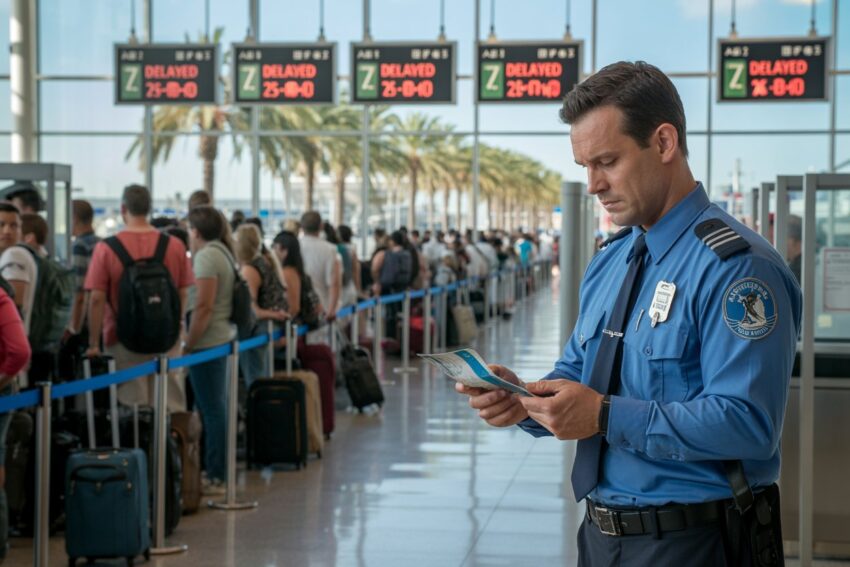
Beyond the statistics and flight boards, there is a human story in the airport terminals. It’s the TSA officer in Orlando politely asking a frustrated family to step forward, knowing they won’t be able to pay their own electric bill this week. It’s the business traveler missing a career-defining meeting because of a staffing-related delay at FLL.
Industry experts, including Jeffrey Price, a professor of aviation, emphasize that this is more than an “inconvenience.” It is a systemic stress test on the safety and confidence of the U.S. air travel system. When the people responsible for your safety are worried about their own survival, the entire system loses its edge.
Survival Guide for Florida Travelers
If you have travel plans to or from Florida in late February 2026, preparation is your only defense:
Arrive Extra Early: The “two-hour rule” is no longer enough. Aim for three to four hours before your departure, especially at MCO and MIA.
Check Flight Status Frequently: Don’t wait until you’re at the airport. Use airline apps and sites like FlightAware to see if ground stops are being issued for your destination.
Pack Your Patience: Remember that the TSA agents and controllers are the victims of this political stalemate, not the cause. A kind word or a “thank you” goes a long way for someone working for free.
Verify Passports and Visas: Passport processing and Global Entry applications are currently experiencing significant delays. Check your expiration dates now.
Final Thoughts
Florida’s economy is built on movement. It relies on the 100 million-plus visitors who fly into the state annually to fuel its hotels, theme parks, and restaurants. As the 2026 government shutdown drags on, it isn’t just a political battle in D.C.—it’s an economic and human crisis playing out in the departure lounges of the Sunshine State. For the sake of the travelers, the federal workers, and the airlines, one can only hope that the “Year of the Horse” brings the speed and energy needed to resolve this deadlock before the system truly breaks.
The post Turbulence Ahead: How the 2026 Government Shutdown is Impacting Florida Travelers and Airlines appeared first on Travel And Tour World.
Source: travelandtourworld.com



Sorry, the comment form is closed at this time.