


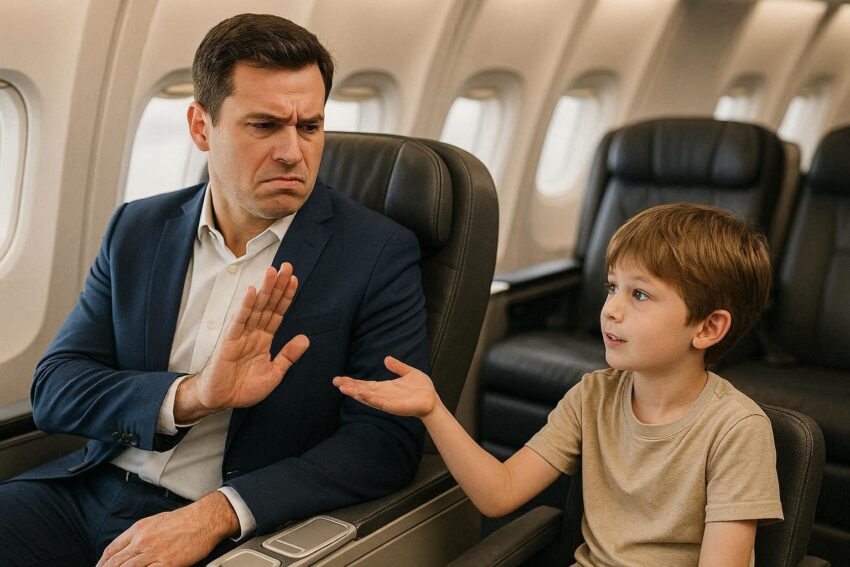
United States–Qatar–UAE Flight Drama: 7,000 Dollars Business Class Seat Dispute on Qatar Airways Sparks Global Etiquette Debate
United States–Qatar–UAE Flight Drama: 7,000 Dollars Business Class Seat Dispute on Qatar Airways Sparks Global Etiquette Debate
A long-haul journey connecting the United States, Qatar, and the United Arab Emirates unexpectedly became the center of an international debate after a premium cabin dispute unfolded onboard a Qatar Airways flight. What was meant to be a celebratory graduation trip turned into a viral flashpoint over entitlement, fairness, and airline etiquette. A young passenger who had independently funded her education and rewarded herself with a business class ticket reportedly declined a request to surrender her seat to a child seated in economy. The refusal, though polite, triggered escalating tension that later spread across social media platforms.
The incident, which occurred on a route linking Cincinnati and Dubai, has fueled conversations about the expectations placed on premium cabin travelers, parental responsibility in booking arrangements, and the limits of inflight courtesy. As premium travel demand grows between the United States and the Middle East, questions surrounding seat ownership and cabin rights are increasingly being examined in public discourse.
Incident Overview on a United States to United Arab Emirates Route
The situation reportedly unfolded on a Qatar Airways flight operating between Cincinnati CVG and Dubai DXB. The journey, linking the United States with the United Arab Emirates via Qatar Airways’ long-haul network, was expected to proceed routinely.
A 21-year-old student had purchased a business class ticket valued at approximately 7,000 dollars. The ticket had been acquired as a personal graduation gift after her education had been funded independently. Shortly after boarding, a request was made by the woman seated beside her. It was asked whether the premium seat could be exchanged so that the woman’s daughter, who had been assigned an economy class seat, could experience business class.
The request was declined politely after it was clarified that the proposed swap would involve a downgrade from business class to economy. It was later shared that the mother had reportedly received an upgrade and wished for her daughter to enjoy the business class experience as well. Assumptions were allegedly made that the young traveler had not personally financed her ticket.
As the discussion intensified, tension was said to have escalated. The matter reportedly required cabin crew intervention to restore order.
Cabin Crew Intervention and Airline Policy
Airline staff were eventually called upon to address the disagreement. It was clarified by the crew that passengers could not be involuntarily downgraded from business class to economy in order to accommodate personal requests. The operational policies of Qatar Airways were reinforced, emphasizing that seat changes across cabin classes cannot be mandated unless required for operational reasons.
An alternative was suggested to the mother. It was indicated that she could exchange seats with another passenger seated near her daughter in economy, should a willing traveler be found. However, no other passenger could be compelled to relinquish a higher-class seat.
The aircraft’s suite-style business cabin configuration was later described as having provided privacy, allowing the student to avoid further interaction during the remainder of the flight to Dubai.
The Rising Sensitivity Around Premium Cabin Travel
As international travel between the United States, Qatar, and the United Arab Emirates has continued to rebound, premium cabin bookings have increased. Business class tickets on long-haul routes such as Cincinnati to Dubai frequently command significant prices, particularly on globally recognized carriers like Qatar Airways.
With higher financial commitments attached to premium cabins, passengers have become increasingly protective of their purchased benefits. Business class offerings often include lie-flat seats, enhanced privacy, premium dining, and priority services. The monetary value of such tickets reinforces the perception that these benefits represent a contractual entitlement rather than a flexible courtesy.
In this case, a ticket worth 7,000 dollars represented not only a financial investment but also a personal milestone. That context has been cited by many observers as a factor influencing public sympathy.
Why Seat Swap Requests Often Lead to Conflict
Seat swap requests are common across global airlines. However, conflict tends to arise when such requests involve unequal exchanges. According to a 2023 North American traveler survey commissioned by Kayak, passengers are generally receptive to polite seat change requests when the exchange is equivalent or more favorable. Willingness reportedly decreases significantly when downgrades or paid upgrades are involved.
The psychological dynamics of air travel play a notable role. Flights between countries such as the United States and the United Arab Emirates can span more than 12 hours. Comfort levels, rest opportunities, and space allocations directly impact the travel experience. When a premium seat is relinquished, not only financial value but also physical comfort is affected.
In the reported incident, the request required a shift from business class to economy, a change that would have reduced comfort and amenities considerably. As a result, refusal was widely viewed online as a reasonable exercise of passenger rights.
Proper Etiquette for Requesting Seat Changes
Travel experts frequently emphasize proactive planning to prevent inflight disputes. Several best practices are commonly recommended:
Seat Selection During Booking
Seats are encouraged to be selected during ticket purchase. Monitoring reservations is advised in case aircraft changes alter seat assignments.
Avoid Downgrade Requests
Passengers are generally advised against requesting swaps that would require another traveler to accept a less comfortable or lower-class seat.
Offer Fair Compensation
If a less favorable swap is requested, compensation such as monetary reimbursement or other benefits may improve acceptance rates.
Respect Refusals
Passengers are under no obligation to switch seats. Polite requests should be made with the understanding that refusal is a valid response.
When these principles are overlooked, misunderstandings can escalate quickly, particularly in premium cabins.
Social Media Reaction Across the United States and Beyond
After details of the incident were shared online and reported by Newsweek, widespread commentary followed. A significant portion of social media users expressed support for the business class passenger. Many argued that parents bear responsibility for securing appropriate seating arrangements at the time of booking, especially on international routes between countries like the United States and the United Arab Emirates.
Some commentators suggested that premium seat swaps would only be considered acceptable if substantial compensation were offered. Others highlighted that inflight pressure tactics should not be normalized, particularly when high-value tickets are involved.
The discourse also reflected broader frustrations experienced by travelers navigating increasingly crowded aircraft cabins.
The Broader Debate Over Premium Cabin Entitlement
Premium cabin entitlement has emerged as a recurring topic in global travel discussions. As airlines differentiate cabin experiences more distinctly, disparities between economy and business class have grown more pronounced. On carriers such as Qatar Airways, business class suites are marketed as luxury experiences, reinforcing perceptions of exclusivity.
Airlines generally maintain strict policies against involuntary downgrades except in operational disruptions. Such policies are designed to protect revenue integrity and passenger satisfaction. When passengers independently negotiate seat changes, airline authority is typically limited to ensuring compliance with ticketed cabin assignments.
This incident has underscored the delicate balance between personal courtesy and contractual rights. While inflight kindness remains encouraged, the expectation of sacrifice without compensation has increasingly been questioned.
A Reflection of Modern Travel Pressures
As international aviation continues expanding across corridors connecting the United States, Qatar, and the United Arab Emirates, inflight etiquette challenges are likely to persist. Greater cabin segmentation, rising ticket prices, and heightened social media visibility contribute to the amplification of such disputes.
In this case, no formal airline violation was reported, and operational procedures were upheld. However, the viral nature of the event has highlighted evolving passenger attitudes toward fairness and personal boundaries in shared travel spaces.
The episode ultimately serves as a reminder that planning, courtesy, and respect for ticketed entitlements remain essential elements of a smooth journey, particularly when premium cabins are involved.
The post United States–Qatar–UAE Flight Drama: 7,000 Dollars Business Class Seat Dispute on Qatar Airways Sparks Global Etiquette Debate appeared first on Travel And Tour World.
Source: travelandtourworld.com



Sorry, the comment form is closed at this time.