


United States: Southwest Airlines Advances Starlink WiFi Rollout Across Fleet as Cabin Upgrades Accelerate Toward 2026
United States: Southwest Airlines Advances Starlink WiFi Rollout Across Fleet as Cabin Upgrades Accelerate Toward 2026
In the highly competitive aviation landscape of the United States, a new chapter in inflight connectivity is being shaped as Southwest Airlines moves forward with the deployment of Starlink WiFi across its aircraft fleet. The Dallas-based carrier is positioning itself alongside other major US airlines in embracing next-generation satellite internet technology, signaling a decisive shift in how onboard digital experiences are delivered. As air travel demand continues to grow across the United States and international routes spanning 11 countries, expectations surrounding speed, reliability, and uninterrupted access to online services have steadily intensified.
Against this backdrop, the introduction of Starlink’s low-Earth orbit satellite system is being presented as a transformational step in Southwest’s broader modernization strategy. Faster browsing, high-definition streaming, and enhanced real-time connectivity are being integrated into a larger overhaul of cabin interiors and seating models. While connectivity remains central to the announcement, the initiative reflects a comprehensive effort to elevate the passenger experience across domestic and cross-border routes connecting the United States with neighboring countries.
Starlink WiFi Rollout Across the Fleet
A large-scale installation program has been initiated by Southwest Airlines to equip more than 300 aircraft with Starlink satellite internet technology by the end of 2026. The first aircraft fitted with the system is scheduled to enter passenger service during the summer season, with the rollout gradually expanding across the carrier’s network.
Operations centered around Dallas Love Field in the United States are expected to be among the earliest beneficiaries of the upgraded connectivity. From there, aircraft operating to destinations across 11 countries will progressively receive the system as installations continue.
Starlink, developed and operated by SpaceX, currently relies on more than 9,000 low-Earth orbit satellites. These satellites operate significantly closer to Earth than traditional geostationary systems, allowing reduced latency and substantially higher data speeds. As a result, passengers are expected to experience connectivity that more closely resembles home broadband service rather than the limited bandwidth typically associated with inflight internet.
Continuous connectivity from takeoff to landing is being emphasized as a key benefit. Streaming live sports, accessing cloud-based work platforms, engaging in online gaming, and maintaining real-time messaging are among the core functionalities supported by the system.
Southwest Becomes the Fourth Major US Airline to Adopt Starlink
With this deployment, Southwest Airlines becomes the fourth major carrier in the United States to adopt Starlink for inflight connectivity. A broader industry trend toward low-Earth orbit satellite solutions is increasingly evident across the US aviation market.
At United Airlines, Starlink installation efforts are currently underway across the fleet. By early 2026, nearly all of its dual-cabin regional jets had already been equipped with the technology, reflecting a rapid integration strategy.
Similarly, Hawaiian Airlines has already introduced Starlink internet across its Airbus fleet. Its sister carrier, Alaska Airlines, operating under Alaska Air Group since their 2024 merger, has also begun system installations across its aircraft. This coordinated adoption signals a clear shift among US carriers away from legacy satellite providers and toward faster, more stable satellite networks.
The collective movement among airlines based in the United States highlights a growing recognition that inflight connectivity is no longer considered a luxury but a baseline expectation for travelers flying both domestically and internationally.
Passenger Experience and Connectivity Benefits
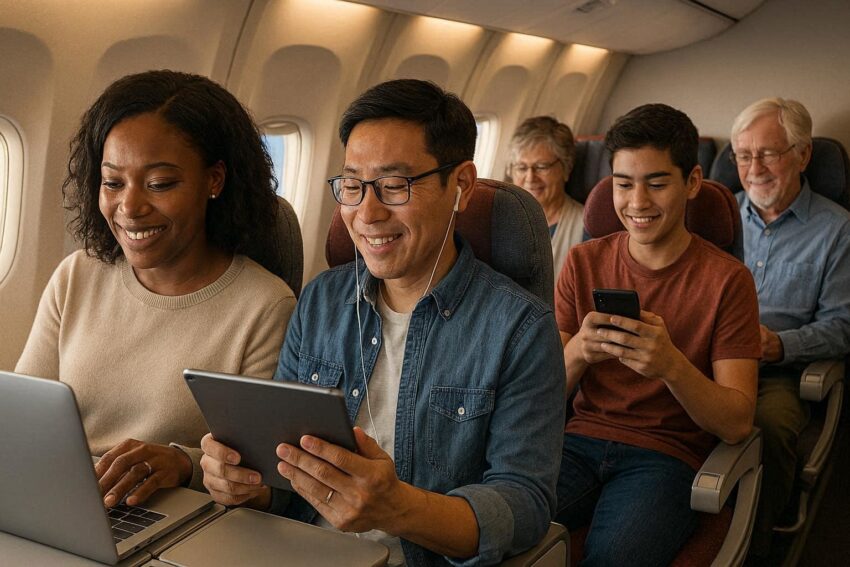
The upgraded Starlink system is designed to accommodate a wide spectrum of passenger needs. High-definition streaming and live entertainment access are expected to be supported without the buffering limitations often associated with older systems. Real-time social media engagement, video conferencing, and instant messaging platforms can be utilized more reliably throughout the flight.
Remote work capabilities are also anticipated to improve significantly. Cloud-based collaboration tools, secure VPN connections, and large file downloads are expected to function more efficiently, benefiting business travelers operating between the United States and international destinations.
Online gaming and bandwidth-intensive applications are additionally supported, marking a notable expansion in the scope of inflight digital usage.
Southwest Airlines has already offered complimentary WiFi to Rapid Rewards members on equipped aircraft through its partnership with T-Mobile. With the integration of Starlink, both speed and network stability are expected to improve substantially, enhancing the value of existing loyalty benefits.
Broader Cabin Modernization Strategy
The Starlink rollout forms part of a larger transformation effort underway at Southwest Airlines. Significant operational and product changes are being introduced simultaneously, marking one of the most substantial shifts in the airline’s history.
A transition toward assigned seating is currently being implemented, signaling a departure from the airline’s long-standing open seating model. In addition, premium seating and extra legroom options are being introduced across select routes.
Several physical cabin upgrades are also being integrated into the fleet modernization plan. These include:
Installation of new RECARO aircraft seats
Addition of in-seat power outlets throughout cabins
Expansion of overhead bin capacity to accommodate more carry-on luggage
Integration of personal device holders within seatbacks
Introduction of extra legroom seating paired with upgraded snack and beverage offerings on select flights
Enhanced boarding priority for premium seat customers and loyalty members
Collectively, these upgrades represent a deliberate repositioning of Southwest Airlines within the US aviation market. While the carrier continues to operate under a low-cost model, its product offering is being reshaped to better compete with full-service rivals in the United States and on international routes.
Industry observers have further indicated that potential future enhancements, such as airport lounges and expanded premium cabin options, are being evaluated, although no formal announcements have been issued.
Network Strength and Loyalty Program
Southwest Airlines currently serves 118 airports across 11 countries, maintaining one of the most extensive domestic networks in the United States. In 2025, more than 134 million passengers were transported across its network, supported by a workforce exceeding 72,000 employees.
Rapid Rewards members continue to benefit from loyalty points accrual, redemption flexibility, and complimentary inflight WiFi on equipped aircraft. As Starlink connectivity is rolled out, these benefits are expected to be reinforced through improved service reliability.
The modernization of fleet interiors and connectivity infrastructure reflects an ongoing strategy aimed at enhancing customer satisfaction while sustaining operational efficiency. By integrating advanced satellite technology and cabin upgrades simultaneously, a comprehensive passenger experience enhancement is being pursued.
Starlink and Corporate Background
Starlink is operated by SpaceX and provides global broadband coverage through a constellation of low-Earth orbit satellites. The network has been designed to support data-intensive services including streaming, video communication, and gaming, even in remote or high-altitude environments such as commercial aircraft cabins.
Southwest Airlines, founded in 1971, remains one of the largest domestic airline operators in the world. Headquartered in Dallas in the United States, the airline has built its reputation on point-to-point routes, operational efficiency, and a simplified fleet strategy. Continued investment in technology and product improvements is being positioned as essential to maintaining competitiveness in the evolving US and global aviation markets.
As airlines across the United States increasingly adopt advanced satellite connectivity solutions, the deployment of Starlink WiFi across Southwest’s fleet underscores a broader transformation within commercial aviation. Enhanced digital capability, expanded premium offerings, and evolving passenger expectations are collectively shaping the next phase of air travel in the United States and beyond.
The post United States: Southwest Airlines Advances Starlink WiFi Rollout Across Fleet as Cabin Upgrades Accelerate Toward 2026 appeared first on Travel And Tour World.
Source: travelandtourworld.com



Sorry, the comment form is closed at this time.