


You’ll Never Guess How Many Flights Were Grounded — New York City’s Storm Turns Travel Into a Nightmare
You’ll Never Guess How Many Flights Were Grounded — New York City’s Storm Turns Travel Into a Nightmare
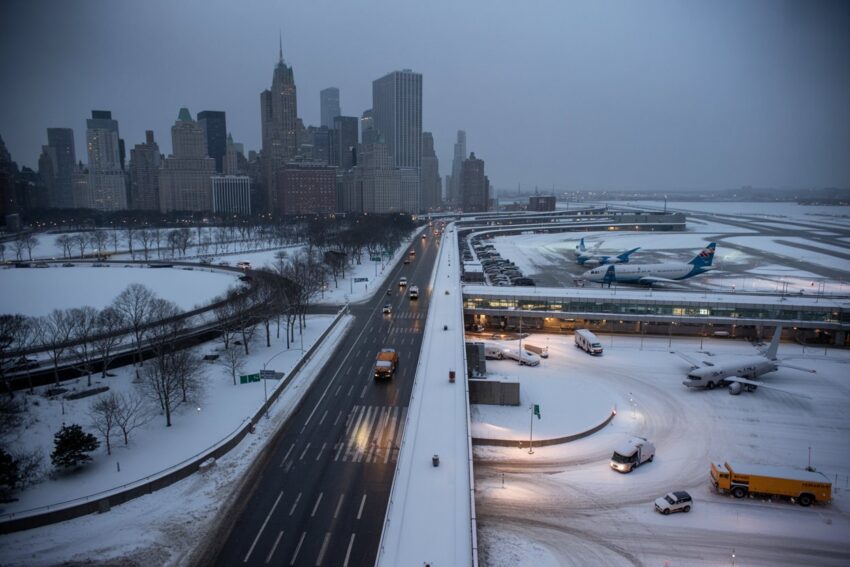
New York City’s transportation grid and major aviation hubs were pushed to the breaking point as a powerful winter storm moved up the Eastern Seaboard, forcing pre-emptive flight cancellations and wide-ranging travel bans. Airports that normally handle tens of thousands of passengers daily reduced operations to emergency levels, leaving airlines, crews and passengers scrambling for alternatives.
What happened — the operational picture
Meteorologists warned that the storm would intensify rapidly and deliver heavy, wind-driven snowfall across the Northeast. In the 48 hours surrounding the storm’s peak, airline operations responded by cancelling massive blocks of flights to avoid leaving crews and planes stranded in unsafe conditions. Flight-tracking services reported the cumulative impact: more than 10,000 flights canceled across U.S. schedules through Tuesday, with many thousands more delayed as recovery plans struggled to take hold.
The Federal Aviation Administration (FAA) publicly advised airlines and travelers that winter-weather tools such as ground stops, ground delay programs and reroutes would be in effect and urged people to confirm flight status before traveling. The FAA reiterated that it coordinates airspace and ground programs but does not itself cancel airline schedules — airlines make those calls in coordination with local airports and weather guidance.
Airport-level disruptions and hotspots
Major New York-area hubs experienced the largest share of cancellations: John F. Kennedy, LaGuardia and Newark Liberty saw the bulk of grounded flights and ground stops as runways and ramps became unsafe and snow-removal teams worked under extreme conditions.
Neighboring cities including Boston and Philadelphia also reported heavy cancellations, stretching the ripple effects beyond the immediate NYC region.
Flight-tracking aggregates recorded thousands of cancellations on the storm’s first full day, followed by additional waves of cancellations as airlines pared back schedules for caution and crew-rest logistics.
Stranded travellers and cascading delays
Thousands of passengers faced extended waits at terminals and overcrowded rebooking lines. Hotels near major airports reported surges in requests for emergency lodging, while carriage services and roads were constrained by local travel bans. Transit authorities and city officials imposed non-essential travel restrictions to keep emergency routes clear, which compounded the challenge for anyone attempting to reach an airport.
Infrastructure and public-safety fallout
Power outages affected hundreds of thousands of customers across multiple states as high winds and wet-heavy snow brought down power lines and toppled trees. Municipal responders prioritized clearing critical arteries and opening emergency shelters. City agencies deployed plows and salt trucks in a race to restore basic mobility once accumulation rates slowed.
Official voices and data sources
Public agencies and flight-data providers formed the backbone of the operational narrative. The FAA’s National Airspace System status briefings signalled ground stops and delay programs in impacted airports, while flight-tracking services provided near-real-time tallies of cancellations and disruptions. State and city emergency declarations activated guard units and municipal resources for rescue, clearing and public welfare operations.
Why totals differ across reports
Published totals for canceled and disrupted flights varied because different sources use different metrics and time stamps: some tallies count only cancellations in a given snapshot, while others aggregate cancellations and long delays across a multi-day window. Aggregators often report cumulative “disrupted” flights (cancellations + delays + ground stops), which leads to higher figures than a single-day cancellation count. For transparency in reporting, time-stamped citation of the dataset used is essential.
Travel advice and immediate next steps
Authorities and airlines offered consistent practical advice for travelers:
Confirm flight status directly with the airline before heading to the airport.
Expect multi-day recovery for many routings; re-accommodation may take time due to crew-rest rules and aircraft rotations.
Save receipts for unexpected lodging or transport costs if seeking reimbursement.
Monitor official city and state advisories for road closures and shelter openings.
Economic ripple effects
Beyond immediate inconvenience, the storm will have short-term economic impacts: cargo delays for time-sensitive freight, lost business from canceled travel, and additional municipal costs for cleanup and emergency services. The aviation industry also absorbs recovery costs for repositioning aircraft and crews and compensation obligations tied to airline policies
Across neighborhoods and terminals, the storm left everyday routines frozen: commuters stayed home, delivery services paused, and airport concourses became temporary shelters for the displaced. Municipal workers, airline crews and emergency responders—often working through the night in brutal conditions—became the thin line protecting movement and safety. As skies clear and teams begin clearing runways and roads, the human task shifts from survival to recovery: coaxing a gridlocked transportation network back to life while tending to communities hit hardest by the storm.
The post You’ll Never Guess How Many Flights Were Grounded — New York City’s Storm Turns Travel Into a Nightmare appeared first on Travel And Tour World.
Source: travelandtourworld.com



Sorry, the comment form is closed at this time.